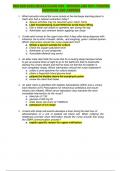
COMPLETE SOLUTIONS BREAST SURGERY
COMPLETE SOLUTIONS BREAST SURGERY BREAST 1. After intraductal papilloma, unilateral bloody nipple discharge from one duct orifice is most commonly caused by which of the following pathologic conditions? A. Paget's disease of the nipple. B. Intraductal carcinoma. C. Inflammatory carcinoma. D. Subareolar mastitis. Answer: B 2. Which of the following conditions is associated with increased risk of breast cancer? A. Fibrocystic mastopathy. B. Severe hyperplasia. C. Atypical hyperplasia. D. Papillomatosis. Answer: C 3. Which of the following breast lesions are noninvasive malignancies? A. Intraductal carcinoma of the comedo type. B. Tubular carcinoma and mucinous carcinoma. C. Infiltrating ductal carcinoma and lobular carcinoma. D. Medullary carcinoma, including atypical medullary lesions. Answer: A 4. Which of the following are the most important and clinically useful risk factors for breast cancer? A. Fibrocystic disease, age, and gender. B. Cysts, family history in immediate relatives, and gender. C. Age, gender, and family history in immediate relatives. D. Obesity, nulliparity, and alcohol use. Answer: C 5. Which of the following pathologic findings is the strongest contraindication to breast preservation (lumpectomy with breast radiation) as primary treatment for a newly diagnosed breast cancer? A. Grade 3, poorly differentiated, infiltrating ductal carcinoma. B. Extensive intraductal cancer around the invasive lesion. C. Tumor size greater than 3 cm. D. Positive surgical margin for invasive cancer. Answer: D 6. Axillary lymph node dissection is routinely used for all of the following conditions except; A. 2-cm. pure comedo-type intraductal carcinoma. B. 1-cm. infiltrating lobular carcinoma. C. 8-mm. infiltrating ductal carcinoma. D. A pure medullary cancer in the upper inner quadrant. Answer: A 7. Failure to perform radiation after wide excision of an invasive cancer risks which of the following outcomes? A. Recurrence of cancer in the ipsilateral breast. B. Shorter survival time. C. Regional nodal recurrence. D. Greater chance of breast cancer mortality. Answer: A 8. Which of the following treatments should never be recommended to a patient with purely intraductal carcinoma? A. Modified radical mastectomy. B. Lumpectomy to clear surgical margins, followed by observation. C. Incisional biopsy with an involved margin, followed by radiation. D. Excisional biopsy to clear margins, followed by radiation. Answer: C 9. The proper treatment for lobular carcinoma in situ (LCISJ includes which of the following components? A. Close follow-up. B. Radiation after excision. C. Mirror-image biopsy of the opposite breast. D. Mastectomy and regional node dissection. Answer: A 1 0. Which of the following statements most accurately reflects the findings of large overview analyses of clinical trials in which adjuvant chemotherapy for early-stage breast cancer was compared to a control group treated only with surgery? A. The benefit of adjuvant therapy is confined to young patients. B. Adjuvant therapy benefits all patients and is independent of age or node status. C. Adjuvant therapy does not work in estrogen-positive patients. D. The magnitude of benefit is very large. Answer: B 1 1 . Which of the following statements are true about reconstruction of the breast following mastectomy? A. A permanent prosthesis or tissue expander may be inserted at the time of the ablative surgery. B. If the patient requires adjuvant chemotherapy or radiation therapy, reconstruction of the breast is delayed until completion of the treatment. C. Extensive postmastectomy defects require the use of a flap. Answer: ABC 1 2. Which of the following statements are true about the management of mammary hyperplasia? A. Reduction mammaplasty can be performed only on women younger than 40 years. B. Removal of breast tissue to reduce size of the breast is usually predicated on the use of a nipple, areola, and dermal pedicle flap. C. If removal of 2000 gm. of breast tissue is needed, breast amputation with immediate free nipple-areola grafting is performed. Answer: BC 1 3. Which of the following statement(s) is/are true concerning the anatomy of the breast? a. About 25% of the lymphatic drainage of the breast courses to the internal mammary nodes b. Nerves within the axillary fat pad include the intercostal brachial nerve, the long thoracic nerve, and thoracodorsal nerve c. Fascial bands projecting through the breast to the skin form a supporting framework known as Cooper's ligaments d. The ductal system of the breast from the alveoli to the skin are lined with columnar epithelium Answer: b, c 1 4. Which of the following statement (s) is/are true concerning the recurrence of breast cancer? a. The majority of patients recur within five years of diagnosis b. More than 70% of breast cancer recurrence involve distant metastases c. Pulmonary metastases are the most common initial site of distant recurrence d. The local recurrence rate following breast-conserving procedures varies from 1 0% to 40% whether or not radiation was used e. Recurrent disease will be seen in at least 35% of node-negative patients undergoing appropriate primary breast therapy Answer: a, b, d 1 5. Which of the following statement(s) is/are true concerning mammography? a. Up to 50% of cancers detected mammographically are not palpable b. One third of palpable breast cancers are not detected by mammography c. The sensitivity of mammography increases with age d. The American Cancer Society currently recommends routine screening mammography beginning at age 40 e. Only about 10% of nonpalpable lesions detection mammographically are found to be malignant at biopsy Answer: a, c, d 16. A 35-year-old woman, who is currently breast-feeding her firstborn child, develops an erythematous and inflamed fluctuant area on breast examination. Which of the following statement(s) is/are true concerning her diagnosis and management? a. The most common organism which would expect to be cultured is Staphylococcus aureus b. Open surgical drainage is likely indicated c. Breast-feeding absolutely should be discontinued d. If the inflammatory process does not completely respond, a biopsy may be indicated Answer: a, b, d 1 7. Which of the following statement(s) is/are true concerning the surgical staging of breast cancer? a. All biopsy specimens should be transported to pathology in formalin within 24 hours of the procedure b. Removal of only level I axillary lymph nodes may understage breast cancer in up to one-fourth of patients c. Level III axillary lymph nodes should be removed in all axillary lymph node dissections d. A clinically negative axilla will be found to have histologically positive metastasis in approximately one- third of patients Answer: b, d 1 8. Which of the following statement(s) is/are true concerning the effect of various hormones on breast physiology? a. Estrogen receptors are present only in breast cancer cells b. Mammary ductal dilatation and differentiation of alveolar epithelial cells and secretory cells are the result of rising progesterone levels c. The early first trimester breast changes are primarily due to the increased progesterone effects of pregnancy d. Milk production and secretion after childbirth are maintained by ongoing secretion of prolactin by the anterior pituitary gland Answer: b, d 19. A pre-menopausal woman three years after mastectomy for breast cancer presents with pulmonary metastases. Which of the following statement(s) is/are true concerning her management? a. If the patient has received adjuvant therapy, her response is likely to be better b. If the patient is ER-positive, hormonal therapy should be the first line of treatment c. The response to chemotherapy will likely be dose-dependent d. Combination chemotherapy will likely work better in this patient than a woman who is post- menopausal Answer: b, c, d 20. Which of the following statementfs) is/are true concerning intraductal papilloma? a. This lesion is the most common cause of bloody nipple discharge b. Serous non-bloody discharge is unlikely to be due to an intraductal papilloma c. A nonpalpable lesion can often be diagnosed with ductography d. An isolated lesion is considered premalignant Answer: a, c 21. A 21 -year-old woman presents with an asymptomatic breast mass. Which of the following statements) is/are true concerning her diagnosis and treatment? a. Mammography will play an important role in diagnosing the lesion b. Ultrasonography is often useful in the differential diagnosis of this lesion c. The mass should always be excised d. The lesion should be considered pre-malignant Answer: b 22. Which of the following are factors associated with an increased risk for developing breast cancer? a. Nulliparity b. Oophorectomy before age 35 c. Use of oral contraceptives d. High-fat, high-caloric diet e. Post-menopausal use of conjugated estrogens Answer: a, d Which of the following chromosomal and/or genetic abnormalities is/are associated with the development of breast cancer? f. Mutations in the p53 tumor suppressor gene g. A mutation in the short arm of chromosome 2 h. The presence of a BRCA 1 gene on chromosome 1 7 i.The presence of the BRCA 2 gene on chromosome 1 3 Answer: a, b, c, d 23. A 45-year-old woman presents with a weeping eczematoid lesion of her nipple. Which of the following statement(s) is/are true concerning her diagnosis and management? a. Treatment is with warm compresses and oral antibiotics b. Biopsy of the nipple revealing malignant cells within the milk ducts is invariably associated with an underlying invasive carcinoma c. The appropriate treatment is mastectomy d. The lesion always represents a high-risk disease with a significant risk of subsequent metastatic disease Answer: c 24. Which of the following treatment(s) is/are of proven benefit in the treatment of mastodynia associated with fibrocystic breast disease? a. Avoidance of methylxanthine compounds, particularly caffeine b. Cessation of smoking c. Vitamin E d. Danazol Answer: a, b, d 25. Which of the following statement(s) is/are true concerning breast reconstruction? a. The timing of breast reconstruction is of no oncologic significance b. Breast reconstruction may interfere with detection of local recurrence of breast cancer c. Maintenance of an effective subpectoral pocket for a breast implant requires preservation of the pectoralis fascia d. Because of its complexity, the TRAM flap is seldom used for primary breast reconstruction Answer: a, c 26. Which of the following statement(s) is/are true concerning the histologic variants of invasive breast carcinoma? a. The presence of an in situ component with invasive ductal carcinoma adversely affects prognosis b. Medullary carcinomas, although often of large size, are associated with a better overall prognosis than common invasive ductal cancers c. Mucinous or colloid carcinoma is one of the more common variants of invasive ductal cancer d. Invasive lobular carcinoma is associated with a higher incidence of bilateral breast cancer Answer: b, d 27. Which of the following statement(s) is/are correct concerning cystosarcoma phyllodes? a. The tumor is most commonly seen in post-menopausal women b. Total mastectomy is necessary for all patients with this diagnosis c. Axillary lymph node dissection is not necessary for malignant cystosarcoma phyllodes d. Most patients with the malignant variant of cystosarcoma phyllodes die of metastatic disease Answer: c 28. Which of the following statement(s) is/are true concerning local recurrence of breast cancer? a. The percentage of patients with chest wall recurrence as their initial site of failure following mastectomy is similar for node-negative and node-positive patients b. Most patients with local-regional recurrence of their disease will eventually die of metastatic disease c. The treatment of local recurrence following mastectomy includes local radiation therapy and systemic chemotherapy d. In-breast recurrence following breast conserving surgery is not a negative prognostic factor e. Regional lymph node recurrence following axillary node dissection is rare Answer: a, b, c, e 29. Which of the following statements) is/are correct concerning prognostic factors for breast carcinoma? a. Prognosis is improved with estrogen or progesterone receptor positivity b. Increased thymidine labeling index, a measure of the proportion of cells in the DNA synthetic phase (S- phase), is associated with improved survival c. High tumor levels of cathepsin D are associated with an improved prognosis d. fmmunohistochemical demonstration of active angiogenesis correlates with increased metastatic potential and poor prognosis Answer: a, d 30. Which of the following statement(s) is/are true concerning adjuvant systemic therapy? a. Adjuvant tamoxifen in postmenopausal, node-positive, ER-positive women is equivalent to cytotoxic chemotherapy b. Tamoxifen clearly improves survival in all hormonal receptor-positive patients c. CMF is associated with improved overall survival in both pre-menopausal and post-menopausal node- positive patients d. There is no evidence to suggest a role for chemotherapy in node-negative patients Answer: a 3 1 . Which of the following statement(s) is/are true concerning tissue sampling techniques for breast masses? a. The sensitivity of fine needle aspiration biopsy is such that mastectomy can be performed in the case of malignant diagnosis b. The accuracy of mammographic-directed fine needle aspiration biopsy is comparable to that achieved for that of palpable lesions c. Core-needle biopsy showing normal breast tissue is an acceptable diagnosis d. The technique of core-needle biopsy is not applicable to radiographically detected lesions Answer: b 32. A 42-year-old woman undergoes her first mammogram. Clustered microcalcifications are seen but there is no mass palpable. Which of the following statement(s) is/are true concerning this patient's diagnosis and management? a. A needle localization and excision of the mass is necessary to establish the diagnosis b. Frozen-section examination is particularly useful in the diagnosis of this lesion c. Intense interlobular fibrosis and proliferation of small ductules with loss of orientation of lobules and epithelial cells may suggest carcinoma d. This finding is associated with an increased risk of cancer Answer: a, c 33. Which of the following conclusion(s) can be drawn from the results of the NSABP prospective randomized trials completed in the 1970's and T980's7 a. Delay of axillary node dissection until there is clinical evidence of disease does not influence overall survival b. Removal of clinically negative nodes has no therapeutic benefit c. Breast irradiation reduces both local recurrence and overall survival d. Modified radical mastectomy offers no advantage of lumpectomy with axillary node dissection Answer: a, b, d 34. Which of the following statement(s) is/are true concerning non-invasive breast carcinoma? a. Ductal carcinoma in situ (DCIS) is associated with a significant risk of development of invasive ductal carcinoma in the same quadrant of the same breast as the initial lesion b. DCIS should not be treated with breast conservation therapy c. Lobular carcinoma in situ (LCIS) is the most common form of non-invasive breast cancer d. When LCIS is found, there is an up to 50% chance of lobular carcinoma in situ of the contralateral breast e. About one-third of patients with biopsy-proven LCIS develop invasive cancer, always of the same breast Answer: a, d
Written for
- Institution
- BREAST SURGERY
- Module
- BREAST SURGERY
Document information
- Uploaded on
- March 3, 2024
- Number of pages
- 261
- Written in
- 2023/2024
- Type
- Exam (elaborations)
- Contains
- Questions & answers
Subjects
-
complete solutions breast surgery breast 1