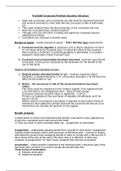
Leasehold Covenants Problem Question Structure
There are two different sets of rules for OLD and NEW leases:
Old rules for leases granted before 1 January 1996
New rules for leases granted on or after 1st January 1996- see Landlord
and Tenant (Covenants) Act 1995.
Enforceability of Leasehold Covenants under OLD Law
Here the distinction between legal and equitable leases is important as covenants
only run in legal leases.
a) Original parties liable for the duration of the lease
b) s.136 LPA: The benefit of a contract could be assigned, sold or transferred to
another
a. Burden cannot pass in contract.
c) Tenant: Burden AND benefit of a covenant can pass to a successor if the
covenant (Spencers Case):
a. The covenant touches and concerns the land (so it’s a benefit to the
land itself, not the personal right)
b. Privity of estate between both parties (both parties having an
interest in the land)
c. There has been a legal assignment of a legal lease (so a deed).
d) Landlord: Benefit of tenant's covenant passes under s141 LPA 1925 and
burden of landlord's covenant passes under s142 LPA if the covenants have
"reference to the subject matter”
Landlord Passes… Benefit - s141 LPA 1925 & Burden- s142 LPA 1925
Problem with old leases is that privity of contract means that the original covenantor
stays liable. So if the current tenant can’t pay, the original parties would be
vulnerable.
Enforceability of Leasehold Covenants under NEW Law
Rules apply to both legal and equitable leases.
Enforceability of covenants under new leases governed by the Landlord and
Tenant (Covenants) Act 1995 (LT(C)A).
a) Tenant: Burden of tenant’s covenant passes to the incoming tenant under
s3(2)(a) UNLESS expressed to be personal: s.3(6)
b) Release on assignment – S.5(2)(A) - circumstances and conditions that must
apply on assignment - allows parties to make provisions previous S.19 (1A-
1E)
There are two different sets of rules for OLD and NEW leases:
Old rules for leases granted before 1 January 1996
New rules for leases granted on or after 1st January 1996- see Landlord
and Tenant (Covenants) Act 1995.
Enforceability of Leasehold Covenants under OLD Law
Here the distinction between legal and equitable leases is important as covenants
only run in legal leases.
a) Original parties liable for the duration of the lease
b) s.136 LPA: The benefit of a contract could be assigned, sold or transferred to
another
a. Burden cannot pass in contract.
c) Tenant: Burden AND benefit of a covenant can pass to a successor if the
covenant (Spencers Case):
a. The covenant touches and concerns the land (so it’s a benefit to the
land itself, not the personal right)
b. Privity of estate between both parties (both parties having an
interest in the land)
c. There has been a legal assignment of a legal lease (so a deed).
d) Landlord: Benefit of tenant's covenant passes under s141 LPA 1925 and
burden of landlord's covenant passes under s142 LPA if the covenants have
"reference to the subject matter”
Landlord Passes… Benefit - s141 LPA 1925 & Burden- s142 LPA 1925
Problem with old leases is that privity of contract means that the original covenantor
stays liable. So if the current tenant can’t pay, the original parties would be
vulnerable.
Enforceability of Leasehold Covenants under NEW Law
Rules apply to both legal and equitable leases.
Enforceability of covenants under new leases governed by the Landlord and
Tenant (Covenants) Act 1995 (LT(C)A).
a) Tenant: Burden of tenant’s covenant passes to the incoming tenant under
s3(2)(a) UNLESS expressed to be personal: s.3(6)
b) Release on assignment – S.5(2)(A) - circumstances and conditions that must
apply on assignment - allows parties to make provisions previous S.19 (1A-
1E)