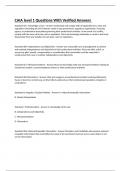
CAIA level 1 Questions With Verified Answers
Standard I(A) - Knowledge of Law - Answer Understand and comply with all applicable laws, rules and regulations (including the CFA institutes code) of any government, regulatory organization, licensing agency, or professional association governing their professional activities. In the event of a conflict, comply with the more strict law, rule or regulation. Must not knowingly participate or assist in and must disassociate from any violation of such laws, rules or regulations Standard I(B)- Independence and Objectivity - Answer Use reasonable care and judgement to achieve and maintain independence and objectivity in their professional activities. Must not offer, solicit, or accept any gifts, benefit, compensation or consideration that reasonably could be expected to compromise their own or another independence and objectivity Standard I(C)- Misrepresentations - Answer Must not knowingly make any misrepresentations relating to investment analysis, recommendations actions or other professional activities Standard I(D) Misconduct - Answer Must not engage in any professional conduct involving dishonesty, fraud, or deceit or commit any act that reflects adversely on their professional reputation, integrity or competence Standard II: Integrity of Capital Markets - Answer A. Material Nonpublic Information B. Market Manipulation Standard I: Professionalism - Answer A. Knowledge of the Law B. Independence and Objectivity C. Misrepresentation D. Misconduct Standard II(A) Material Nonpublic Information - Answer Members and Candidates who possess material nonpublic information that could affect the value of an investment must not act or cause others to act on the information. Standard II B - Market Manipulation - Answer Members must not engage in practices that distort prices or artificially inflate volume with the intent to mislead market participants Standard III: Duties to Clients - Answer A. Loyalty, Prudence, and Care B. Fair Dealing C. Suitability D. Performance Presentation E. Preservation of Confidentiality Standard III(A) - Loyalty, Prudence, and Care - Answer Members and Candidates have a duty of loyalty to their clients and must act with reasonable care and exercise prudent judgment. Members and Candidates must act for the benefit of their clients and place their clients' interests before their employer's or their own interests. Standard III(B) Fair Dealing - Answer Members and Candidates must deal fairly and objectively with all clients when providing investment analysis, making investment recommendations, taking investment action, or engaging in other professional activities. Standard III(C) Suitability - Answer When Members and Candidates are in an advisory relationship with a client, they must: Make a reasonable inquiry into a client's or prospective client's investment experience, risk and return objectives, and financial constraints prior to making any investment recommendation or taking investment action and must reassess and update this information regularly. Determine that an investment is suitable to the client's financial situation and consistent with the client's written objectives, mandates, and constraints before making an investment recommendation or taking investment action. Judge the suitability of investments in the context of the client's total portfolio. When Members and Candidates are responsible for managing a portfolio to a specific mandate, strategy, or style, they must make only investment recommendations or take only investment actions that are consistent with the stated objectives and constraints of the portfolio. Standard III(D) Performance Presentation - Answer When communicating investment performance information, Members and Candidates must make reasonable efforts to ensure that it is fair, accurate, and complete. Standard III(E) Preservation of Confidentiality - Answer Members and Candidates must keep information about current, former, and prospective clients confidential unless: The information concerns illegal activities on the part of the client; Disclosure is required by law; or The client or prospective client permits disclosure of the information. Standard IV: Duties to Employers - Answer A. Loyalty B. Additional Compensation Arrangements C. Responsibilities of Supervisors Standard IV(A) Loyalty - Answer In matters related to their employment, Members and Candidates must act for the benefit of their employer and not deprive their employer of the advantage of their skills and abilities, divulge confidential information, or otherwise cause harm to their employer. Standard IV(B) Additional Compensation Arrangements - Answer Members and Candidates must not accept gifts, benefits, compensation or consideration that competes with, or might reasonably be expected to create a conflict of interest with their employers unless they obtain written consent from all parties involved. Standard IV(C) Responsibilities of Supervisors - Answer Members and Candidates must make reasonable efforts to ensure that anyone subject to their supervision or authority complies with applicable laws, rules, regulations, and the Code and Standards. Standard V: Investment Analysis, Recommendations, and Actions - Answer A. Diligence and Reasonable Basis B. Communication with Clients and prospective clients C. Record Retention Standard V(A) - Diligence and Reasonable Basis - Answer Members and Candidates must: 1. Exercise diligence, independence, and thoroughness in analyzing investments, making investment recommendations, and taking investment actions. 2. Have a reasonable and adequate basis, supported by appropriate research and investigation, for any investment analysis, recommendation, or action. Standard V(B) - Communication with Clients and Prospective Clients - Answer Members and candidates must: 1. Disclose to clients and prospective clients the basic format and general principles of the investment process used to analyze investments, select securities, and construct portfolios and must promptly disclose any changes that might materially affect those processes 2. Disclose to clients and prospective clients significant limitations and risks accounted with the investment process 3. Use reasonable judgement to identify with factors are important to their investment analyses, recommendations, or actions and include those factors in communications with clients and prospective clients 4. Distinguish between fact and opinion in the presentation of investment analyses and recommendations Standard V(C) Record Retention - Answer Members and Candidates must develop and maintain appropriate records to support their investment analyses, recommendations, actions, and other investment-related communications with clients and prospective clients. Standard VI: Conflicts of Interest - Answer A. Disclosure of Conflicts B. Priority of Transactions C. Referral Fees Standard VI(A) - Disclosure of Conflicts - Answer Members and Candidates must make full and fair disclosure of all matters that could reasonably be expected to impair their independence and objectivity or interfere with respective duties to their clients, prospective clients, and employer. Members and Candidates must ensure that such disclosures are prominent, are delivered in plain language, and communicate the relevant information effectively. Standard VI(B) - Priority of Transactions - Answer Investment transactions for clients and employers must have priority over investment transactions in which a Member or Candidate is the beneficial owner. Standard VI(C) Referral Fees - Answer Members and Candidates must disclose to their employer, clients, and prospective clients, as appropriate, any compensation, consideration, or benefit received from or paid to others for the recommendation of products or services. Traditional Investments - Answer include publicly traded equities, fixed-income securities, and cash Real Assets - Answer associated with investments that directly control non-financial assets and represent actual rights to consumption rather than financial claims to cash flows generated by the tangible and intangible assets of a firm. Examples: 1. Real Estate (land and permanent improvements to the land; land- raw land, timberland and farmland) 2. Infrastructure investments (investments represent claims on the cash flows generated by the assets) 3. intellectual property 4. Natural Resources 5. Commodities Hedge Funds - Answer Private investment vehicles that typically use leverage, derivatives, and long and short investment strategies. Minimal regulatory restrictions. Private Equity - Answer Includes both debt and equity securities that are not publicly traded. Examples: 1. Venture Capital 2. LBOs 3. Mezz debt 4. Distressed Debt Structured Products - Answer segment the cash flows of traditional investments or link the product's returns to one or more market values in order to achieve certain risk Prime Broker - Answer Executes trades on behalf of an alternative investment manager, lends securities to sell short, provides research data, produces account statements and other documentation, and provides financing for leverage Bank Structures - Answer 1. US- Investment Banks and Commercial Banks are separate in the US 2. Germany- "Universal Banking"- institutions that allow both commercial and investment banking 3. UK- similar to US, separates IB and CB 4. Japan- Multiple corporations are linked together via cross ownership structures "Keiretsu"; reduces the number of public shareholders and allows banks to have considerable authority Securities Act of 1933 - Answer Governs new securities issues and requires the company to disclose relevant information, to register new issues, and to disseminate a prospectus Investment Company Act of 1940 - Answer instituted to regulate investment pools (mutual funds). Hedge funds use exemptions to avoid registering Investment Advisors act of 1940 - Answer requires that investment advisors register with the SEC. hedge funds use exemptions Regulation T margin rule - Answer Fed rule conceding leverage- stipulates that only 50% of the value of a security can be purchased on margin. HFs must avoid falling under this rule bc leverage Forward Contract - Answer A bilateral contract that obligates one party to buy and the other to sell a specific quantity of an asset, at a set price, on a specific date in the future; No premium is paid to get into the contract ; Used to hedge risk and speculate on prices; Buyer has long position; Seller has short position; Can terminate a forward contract by entering into the opposite position in another trade notional principal - Answer Face amount on the underlying asset upon which cash flows on a derivative instrument are based (i.e. forward or swap) return on notional principal - Answer Gain or loss on the derivative instrument divided by the notional principle Ex Post Pricing Model - Answer Describes "after the fact" historical returns. Focuses on realized returns. Ex Ante Pricing Model - Answer Describes "before the fact" expected future returns. Skewness - Answer The extent to which the distribution data is not symmetric about its mean - Tails of a skewed distribution will be: - Elongated to the right for a positively skewed distribution (also mean > median) - Elongated to the left for a negatively skewed distribution (median > mean) Mesokurtic - Answer Distribution with zero excess kurtosis Leptokurtic - Answer Distribution with a peak that extends above that of a normal distribution and tails that are fatter than those of a normal distribution - i.e. have a greater percentage of small deviations from the mean and a greater percentage of extremely large deviations from the mean compared to a normal distribution. - Leptokurtic distributions have a higher probability of large loss versus otherwise identical investments with normally distributed returns Platykurtic - Answer Distribution with a peak that lies beneath that of a normal distribution, implying a smaller % of small deviations from the mean compared to a normal distribution CAPM Model - Answer Describes the relationship between risk and expected return for individual assets. Model assumes normal returns distributions and assets are liquid. CAPM consists of three components: 1. Risk Free Rate 2. The stocks Beta coefficient 3. The expected market risk premium Beta - Answer Measures the sensitivity of an asset's returns to changes in the broad market return Autocorrelation - Answer Correlation over time for an asset Homoskedastic - Answer Variances of returns are constant over time Jacque- Bera Test - Answer Used to test data for departures from the normal distribution using a null hypothesis and an alternative hypothesis: H(0)- data are normally distributed H(A)- Data are not normally distributed If data follows normal distribution Skewness =0 and Excess Kurtosis=0 and the JB stat =0 Heteroskedastic - Answer Variances of financial data are not constant over time Value at Risk (VaR) - Answer Measure of potential loss- interpreted as the worse case possible loss under normal conditions over a specific period of time for a given confidence level The VaR for a portfolio will be zero for a portfolio with individual assets that have non-zero VaRs if the assets are perfectly negatively correlated. The portfolio VaR will equal the sum of the individual VaRs if the assets are perfectly positively correlated. If the assets are uncorrelated (i.e., correlation is zero), the portfolio VaR will lie between the perfect positive and perfect negative correlation cases. VaR assumes normally distributed returns and does not consider skewness in its calculation. Calculating VaR requires four inputs: -The portfolio's expected return. -The historical volatility of portfolio returns. -The significance level (probability of a loss greater than VaR). -The desired time dimension. Example- a one-day VaR of $20 million at a 95% confidence level implies that the one-day loss will be greater than $20 million 5% of the time. Monte Carlo Analysis - Answer Model that simulates values for risk factors (e.g. interest rates) and estimates how changes in risk factors affect the fund's returns. Simulation randomly generates thousands of possibly outcomes for the fund and those simulated outcomes indicate what types of losses are possible. Sharpe Ratio - Answer The expected excess return (defined as the difference between the mean return for the portfolio and the RF rate) earned per unit of total risk (i.e. standard deviation) SR=[E(Rp)-Rf]/σp E(Rp) = expected return for portfolio p Rf = risk-free rate σp = standard deviation of returns for portfolio p Average Tracking Error - Answer Difference in mean returns between the portfolio and the portfolio's benchmark. Also know as active risk Multifactor Asset Pricing Model - Answer Describes the relationship between expected returns of assets and the assets' exposures to multiple risk factors- better explains systematic risk than single factor models Theoretical Models - Answer Use assumptions and logic that presumably capture underlying investment behavior. Empirical Models - Answer Based on historically observed behavior Fama-French Models - Answer Empirical multi factor asset pricing model based on the following three factors: 1. Market Beta (systematic risk) 2. Market capitalization/size (SMB- small minus big) 3. book to market ratio (HML- high minus low) Fama-French Carhart Model: (all of the above inputs) 4. Momentum (performance factor) Carrying Costs - Answer Costs involved with holding an asset until expiration of the forward contract. Includes both the cost of sorting the asset and the opportunity cost associated with using capital to purchase the asset Call Option - Answer Gives the option holder the right to buy a security or a particular asset in the future at a specified price Put Option - Answer Give the option holder the right to sell a particular security or asset in the future for a specified price Moneyness of an Option - Answer 1. In the money- immediate exercise would result in a positive payoff 2. At the money- zero payoff 3. Out of the money- immediate exercise would result in a negative payoff Long Call Option - Answer Unlimited upside profit potential but limited downside Short Call Option - Answer unlimited downside potential but limited upside Long Put Option - Answer limited upside profit potential since the security price cannot fall below zero and has limited downside Short Put Option - Answer limited downside loss potential and limited upside
Written for
- Institution
- CAIA - Chartered Alternative Investment Analyst
- Module
- CAIA - Chartered Alternative Investment Analyst
Document information
- Uploaded on
- February 18, 2024
- Number of pages
- 49
- Written in
- 2023/2024
- Type
- Exam (elaborations)
- Contains
- Questions & answers
Subjects
-
caia level 1 stuvia
-
caia level 1 questions with verified answers
-
standard ia knowledge of law understand and co
-
standard ib independence and objectivity use re

Also available in package deal