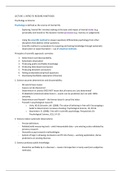
LECTURE 1: INTRO TO RESEARCH METHODS
Psychology as Science:
Psychology is defined as the science of mental life.
- Exploring ‘mental life’ involves looking at the basis and impact of mental states (e.g.
personality and mood) or the dynamic mental processes (e.g. memory or judgement).
- Using the scientific method to answer questions differentiate psychology from other
disciplines that address similar questions.
- Scientific method is a procedure for acquiring and testing knowledge through systematic
observation or experimentation – use of empirical methods.
Principles of scientific approach: overview:
1. Determinism and discoverability
2. Systematic observation
3. Producing public (verifiable) knowledge
4. Producing data-based conclusions
5. Producing tentative conclusions
6. Asking answerable (empirical) questions
7. Developing falsifiable explanation (theories)
1. Science assumes determinism and discoverability:
- All events have causes
- Causes can be discovered
- Determinism in science DOES NOT mean that all events are ‘pre-determined’
- Probabilistic (statistical) determinism – events can be predicted, but not with 100%
certainty.
- Determinism and freewill – the former doesn’t cancel the latter.
- Freewill in psychological research:
o Vohs, KD & Schooler, JW. (2008). The value of believing in free will: Encouraging a
belief in determinism increases cheating. Psychological Science, 19, 49-54.
o Baumeister, R. (2008). Free will in scientific psychology. Perspectives On
Psychological Science, 3(1), 14-19.
2. Science makes systematic observations:
- Precise definitions
- Reliable/valid measuring tools – yield interpretable data – pre-existing scales validated by
previous research.
- Generally accept research methodologies
- System of logic in drawing conclusions and fit into theory – working explanation, derive
predictions on existing theories.
3. Science produces public knowledge:
- Should be verifiable by 2+ observers – reason introspection is rarely used (non-subjective
methods).
Psychology as Science:
Psychology is defined as the science of mental life.
- Exploring ‘mental life’ involves looking at the basis and impact of mental states (e.g.
personality and mood) or the dynamic mental processes (e.g. memory or judgement).
- Using the scientific method to answer questions differentiate psychology from other
disciplines that address similar questions.
- Scientific method is a procedure for acquiring and testing knowledge through systematic
observation or experimentation – use of empirical methods.
Principles of scientific approach: overview:
1. Determinism and discoverability
2. Systematic observation
3. Producing public (verifiable) knowledge
4. Producing data-based conclusions
5. Producing tentative conclusions
6. Asking answerable (empirical) questions
7. Developing falsifiable explanation (theories)
1. Science assumes determinism and discoverability:
- All events have causes
- Causes can be discovered
- Determinism in science DOES NOT mean that all events are ‘pre-determined’
- Probabilistic (statistical) determinism – events can be predicted, but not with 100%
certainty.
- Determinism and freewill – the former doesn’t cancel the latter.
- Freewill in psychological research:
o Vohs, KD & Schooler, JW. (2008). The value of believing in free will: Encouraging a
belief in determinism increases cheating. Psychological Science, 19, 49-54.
o Baumeister, R. (2008). Free will in scientific psychology. Perspectives On
Psychological Science, 3(1), 14-19.
2. Science makes systematic observations:
- Precise definitions
- Reliable/valid measuring tools – yield interpretable data – pre-existing scales validated by
previous research.
- Generally accept research methodologies
- System of logic in drawing conclusions and fit into theory – working explanation, derive
predictions on existing theories.
3. Science produces public knowledge:
- Should be verifiable by 2+ observers – reason introspection is rarely used (non-subjective
methods).