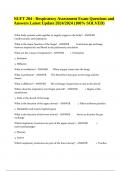
NUFT 204 - Respiratory Assessment Final Exam Questions and Answers Latest Update 2024/2025 (100% SOLVED)
NUFT 204 - Respiratory Assessment Final Exam Questions and Answers Latest Update 2024/2025 (100% SOLVED) What body systems work together to supply oxygen to the body? - ANSWER Cardiovascular and respiratory What is the major function of the lungs? - ANSWER Continuous gas exchange between inspired air and blood in the pulmonary circulation What are the 3 steps of respiration? - ANSWER 1. Ventilation 2. Perfusion 3. Diffusion What is ventilation? - ANSWER When oxygen comes into the lungs What is perfusion? - ANSWER The blood flow that goes to the lungs and the tissues What is diffusion? - ANSWER The exchange of gases that occurs in the alveoli Where does the respiratory tract begin and end? - ANSWER 1. Begins at the mouth/nose 2. Ends at the alveoli of the lungs What is the function of the upper airway? - ANSWER .1. Filters airborne particles 2. Humidifies and warms inspired gases What is the function of the lower airway? - ANSWER Serves as location for gas exchange Which respiratory structures are part of the upper airway? - ANSWER 1. nose/nasal passages 2. Pharynx 3. Larynx Which respiratory structures are part of the lower airway? - ANSWER 1. Trachea NUFT 204 - Respiratory Assessment Exam Questions and Answers Latest Update 2024/2024 (100% SOLVED) 2. Bronchi 3. Bronchioles 4. Alveoli Where is respiration controlled? - ANSWER In the brainstem How many lobes does the right lung have? How many does the left lung have? - ANSWER 1. Right has 3 2. Left has 2 What type of process is expiration? - ANSWER Passive What muscles mediate respiration? - ANSWER 1. Diaphragm 2. SCM 3. Scalenes 4. Intercostal 5. Obliques What is the primary muscle of inspiration? - ANSWER diaphragm What occurs to the diaphragm and thorax during inspiration? - ANSWER 1. Diaphragm contracts 2. Thorax expands (increases in size) What occurs to the diaphragm and thorax during expiration? - ANSWER 1. Diaphragm relaxes 2. Thorax deflates (decreases in size) *note: decreased size in thorax space assists with pushing air out* Describe the technique for doing a respiratory exam. - ANSWER 1. Ensure a quiet environment 2. Properly position patient -when listening posteriorly should be seated -when listening anteriorly can be supine or seated 3. Ensure patient comfort -make sure hands and stethoscope are warm -use drape sheet to cover women's chest 4. Inspect then palpate then percuss then auscultate lungs -auscultation should be done on bare skin -palpation and percussion aren't done often by nurses -for auscultation should start posteriorly then laterally then anteriorly -for auscultation should compare B/L (i.e. use ladder pattern) What is the normal adult respiration rate? - ANSWER 12 to 20 What should be assessed during initial respiratory survey? - ANSWER 1. Observe patient's breathing pattern (includes RATE, DEPTH, and EFFORT) 2. Assess A-P diameter 3. Assess patient's color T/F - generally, respiration should be quiet and easy. - ANSWER True How is A-P diameter assessed? - ANSWER Look at anterior to posterior diameter (i.e. draw a line and measure from the front a of patient's chest to their spine) Compare that to the transverse diameter (i.e. draw a line and measure from the left side of the chest to the right side of the chest) Normally A-P diameter is 1/2 the transverse diameter (i.e. 1:2 ratio) What is cyanosis a sign of? - ANSWER Hypoxia What is the respiratory rate for an adolescent? - ANSWER 16 to 20 What is the respiratory rate for a child? - ANSWER 20 to 30 What is the respiratory rate for a toddler ( 2 years)? - ANSWER 25 to 32 What is the respiratory rate for an infant? - ANSWER 30 to 50 What is the respiratory rate for a newborn? - ANSWER 30 to 60 What should be asked when obtaining subjective respiratory assessment? - ANSWER 1. Any chronic conditions - examples: asthma, COPD, CHF, DM -for respiratory chronic conditions important to determine last time they used rescue meds and when they last took their routine respiratory meds 2. Any exposure to new medications -potential concern for allergies 3. Recent changes in diet 4. Any substance abuse/overdose -especially concerned about smoking of marijuana use since they increase risk of respiratory conditions like COPD and bronchitis - when asking this question be sure to not come off offensive/judging 5. Prior history of DVT/VTE, or PE -after have one of these one is at increased risk for another 6. Recent trauma to chest -remember chest pain isn't just a cardiac complaint 7. Any orthopena (difficulty laying flat), cough (nonproductive/productive), SOB ( at rest or with exertion), color of sputum, fatigue, voice hoarseness 8. Vaccination history -always encourage vaccination; especially in elderly 9. Environmental/occupational hazards 10. Recent travel history -homeless are at increased risk for TB and other communicable diseases What respiratory condition should cause alarm if it becomes recurrent (i.e. occurs multiple times within the same year)? What may it be a sign of? - ANSWER 1. Pneumonia 2. Cancer What is the specific type of pneumonia HIV positive patient's get? - ANSWER PCP pneumonia T/F - Once one has gotten penumonia, they are not at higher risk of having it again. - ANSWER False, they are at higher risk (not necessarily within the same year though) What is important to observe for on inspection for respiratory exam? - ANSWER 1. Shape of chest wall (is there any deformities like increased AP diameter) 2. Movement of chest wall (is there abnormal retraction (i.e. pulling/sinking) of soft tissues; especially in ICS or paradoxical movement) 3. Positioning of patient (are they struggling to breath (may see tripoding), or having painful breathing (may see splinting)) 4. Clubbing of fingers 5. Any nasal flaring 6. Any bruising In which population is it common to see retractions of soft tissues; especially in ICS? - ANSWER Children Which chronic respiratory condition is associated with increased AP diameter? - ANSWER COPD (specifically emphysema) What type of abnormal chest movement is considered life threatening? - ANSWER Paradoxical movement due to flail chest -chest wall will go in on inspiration and out on expiration -usually seen with rib fractures -usually caused by trauma What should be assessed for on palpation for a respiratory exam? - ANSWER 1. Tenderness EMAIL ME: EMAIL ME: 2. Appropriate chest wall expansion (aka chest wall excursion) 3. Symmetrical vocal or tactile fremitus *note: during palpation should be feeling muscles, bones, tendons, ect of thorax* What is vocal or tactile fremitus? - ANSWER When nurse or provider palpated for vibrations transmitted to chest wall -usually use ulnar surface of hand and have patient say "ninety-nine" in several spots on the thorax -normally should feel vibration symmetrically (otherwise concern for something (i.e. fluid, masses) blocking the sound wave) How is chest excursion assessed? - ANSWER 1. Place hands on patients chest wall with thumbs touching in middle 2. Have patient breath -thumbs should move apart on inspiration and together on expiration symmetrically What does percussion of the thorax during a respiratory exam assess for? - ANSWER Whether underlying tissues are air filled, fluid filled, or solid
Written for
- Institution
- NUFT 204
- Module
- NUFT 204
Document information
- Uploaded on
- February 12, 2024
- Number of pages
- 25
- Written in
- 2023/2024
- Type
- Exam (elaborations)
- Contains
- Questions & answers
Subjects
-
nuft 204
-
nuft
-
204
-
latest update 2024
-
2025
-
verified answers
-
nuft 204 respiratory assessment exam questions
-
nuft 204 final exam questions and answers

Also available in package deal