Customer & Marketing analytics
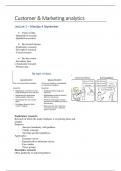
Lecture 1 – Monday 4 September
• Types of data:
- Quantitative research
- Qualitative research
• By research design
- Exploratory research
- Descriptive research
- Causal research
• By data source
- Secondary data
o Syndicated research
- Primary data
Exploratory research:
Research in which the major emphasis is on gaining ideas and
insights
Purposes:
- Increase familiarity with problem
- Clarify concepts
- Develop specific hypotheses
Approaches:
- Literature survey
- Experience/key informant survey
- Case studies
- Focus groups
Descriptive research
Often guided by an initial hypothesis
,Purposes:
- Describe the characteristics of certain groups
- Estimate the proportion of people in a specified population who behave in a certain way
- Examine associations between two or more variables
- Make specific predictions
Casual research
Research in which the major emphasis is on determining a cause‐
and‐effect relationship
- Descriptive research reveals associations between variables
- Causal research reveals associations between changes in variables
Makes use of experiments:
- Laboratory experiments
- Field experiments
- By research design
- Causal Research
Secondary data:
Data previously collected for purposes other than the research at hand
Internal sources:
- Accounting records (e.g., sales invoices, marketing expenditures)
- Customer transaction databases
- Clickstream data
- Operating records (e.g., warranty cards, customer complaint services)
- Previous market research studies
External sources:
- Market and industry research publishers (e.g., Datamonitor,
Euromonitor EIU, Forrester, Mintel)
- Trade associations
- Government agencies
Syndicated research:
Large‐scale marketing research that is undertaken by a research firm to be sold, often on a
subscription basis, to a number of clients (consumer panel data / scanner purchase data)
- Kantar NIPObase
- Nielsen TV Ratings
- Symphony IRI InfoScan
- ACNielsen Homescan
- Nielsen Bookscan
- GfK Consumer Pane
A Consumer Panel is a panel of households or individuals whose purchases are monitored on
a continuous or ongoing basis.
,By data source
Primary Data
Data collected specifically to answer the question(s) posed by the
current research objectives
Types of primary data:
- Demographic / Socioeconomic / Lifestyle characteristics
- Attitudes / Opinions
- Awareness / Knowledge
- Motivation
- Intentions and behaviour
Collecting primary data:
- Communication: Questioning respondents to secure the desired
information (via surveys, focus groups etc.)
- Observation: The situation of interest is watched and the relevant facts, actions, or
behaviours recorded
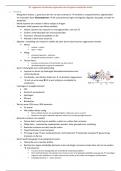
Lecture 2 – Monday 5 September
Learning objectives
- Refresh your basic knowledge and skills that you will need throughout the research
methods courses
- Learn how to prepare data for analysis
- Perform basic analyses techniques that you will need when conducting any type of
research
o Learn to use the “When to use which test”
Basic data analysis
1. Screen dataset: Investigate quality of data - Errors, missing values, inconsistencies
, 2. Explore and analyze the data*: add explanation
a. Describe and summarize data: A complete run-down analysis of all the
variables in your dataset one-at-a-time (univariate statistics)
b. Inferential analysis: Learning about “the world” (univariate statistics) -
Inferential statistics allow you to test a hypothesis or assess whether your data
is generalizable to the broader population.
c. Differential analysis: Compare parameters across groups. For instance: Do
women on average like beer as much as men? Are branded beers on average
liked as much as unbranded beers? (bivariate statistics)
d. Associative analysis: a process of searching for hidden association or pattern
in a large dataset. (bivariate statistics).
Univariate statistics summarizes only one variable at a time.
Bivariate statistics compares two variables
Multivariate statistics compares more than two variables.
Taste evaluations of beer brands
- A blind test, does the rating of the beer depend on whether you know which brand the
beer is?
Dataset: Taste evaluations (Beer.sav)
- Gender (female/male) - nominal
- Age (open ended question) - ratio
- Household Size (open ended question) - ratio
- Region (A’dam, R’dam, Utrecht/West/North/East/South) - nominal
- Social Class (A/BB/BO/C, D) – ordinal (should be revers coded to lowest – highest)
- Unbranded evaluation of beer A & B (10-point scale, 1 = poor; 10 = excellent) -
interval
- Branded evaluation of beer A & B (10-point scale, 1 = poor; 10 = excellent) - interval
Screening the dataset
Step 1: Check for missing data
- In long surveys, participants accidentally or deliberately miss out questions
- Sometimes, missing data is part of the research design: Responses other than original
scale (e.g., ‘don’t know’, ‘not applicable’ )
- With conditions; if you are in condition 1, the questions for condition 2 is missing.
Lecture 1 – Monday 4 September
• Types of data:
- Quantitative research
- Qualitative research
• By research design
- Exploratory research
- Descriptive research
- Causal research
• By data source
- Secondary data
o Syndicated research
- Primary data
Exploratory research:
Research in which the major emphasis is on gaining ideas and
insights
Purposes:
- Increase familiarity with problem
- Clarify concepts
- Develop specific hypotheses
Approaches:
- Literature survey
- Experience/key informant survey
- Case studies
- Focus groups
Descriptive research
Often guided by an initial hypothesis
,Purposes:
- Describe the characteristics of certain groups
- Estimate the proportion of people in a specified population who behave in a certain way
- Examine associations between two or more variables
- Make specific predictions
Casual research
Research in which the major emphasis is on determining a cause‐
and‐effect relationship
- Descriptive research reveals associations between variables
- Causal research reveals associations between changes in variables
Makes use of experiments:
- Laboratory experiments
- Field experiments
- By research design
- Causal Research
Secondary data:
Data previously collected for purposes other than the research at hand
Internal sources:
- Accounting records (e.g., sales invoices, marketing expenditures)
- Customer transaction databases
- Clickstream data
- Operating records (e.g., warranty cards, customer complaint services)
- Previous market research studies
External sources:
- Market and industry research publishers (e.g., Datamonitor,
Euromonitor EIU, Forrester, Mintel)
- Trade associations
- Government agencies
Syndicated research:
Large‐scale marketing research that is undertaken by a research firm to be sold, often on a
subscription basis, to a number of clients (consumer panel data / scanner purchase data)
- Kantar NIPObase
- Nielsen TV Ratings
- Symphony IRI InfoScan
- ACNielsen Homescan
- Nielsen Bookscan
- GfK Consumer Pane
A Consumer Panel is a panel of households or individuals whose purchases are monitored on
a continuous or ongoing basis.
,By data source
Primary Data
Data collected specifically to answer the question(s) posed by the
current research objectives
Types of primary data:
- Demographic / Socioeconomic / Lifestyle characteristics
- Attitudes / Opinions
- Awareness / Knowledge
- Motivation
- Intentions and behaviour
Collecting primary data:
- Communication: Questioning respondents to secure the desired
information (via surveys, focus groups etc.)
- Observation: The situation of interest is watched and the relevant facts, actions, or
behaviours recorded
Lecture 2 – Monday 5 September
Learning objectives
- Refresh your basic knowledge and skills that you will need throughout the research
methods courses
- Learn how to prepare data for analysis
- Perform basic analyses techniques that you will need when conducting any type of
research
o Learn to use the “When to use which test”
Basic data analysis
1. Screen dataset: Investigate quality of data - Errors, missing values, inconsistencies
, 2. Explore and analyze the data*: add explanation
a. Describe and summarize data: A complete run-down analysis of all the
variables in your dataset one-at-a-time (univariate statistics)
b. Inferential analysis: Learning about “the world” (univariate statistics) -
Inferential statistics allow you to test a hypothesis or assess whether your data
is generalizable to the broader population.
c. Differential analysis: Compare parameters across groups. For instance: Do
women on average like beer as much as men? Are branded beers on average
liked as much as unbranded beers? (bivariate statistics)
d. Associative analysis: a process of searching for hidden association or pattern
in a large dataset. (bivariate statistics).
Univariate statistics summarizes only one variable at a time.
Bivariate statistics compares two variables
Multivariate statistics compares more than two variables.
Taste evaluations of beer brands
- A blind test, does the rating of the beer depend on whether you know which brand the
beer is?
Dataset: Taste evaluations (Beer.sav)
- Gender (female/male) - nominal
- Age (open ended question) - ratio
- Household Size (open ended question) - ratio
- Region (A’dam, R’dam, Utrecht/West/North/East/South) - nominal
- Social Class (A/BB/BO/C, D) – ordinal (should be revers coded to lowest – highest)
- Unbranded evaluation of beer A & B (10-point scale, 1 = poor; 10 = excellent) -
interval
- Branded evaluation of beer A & B (10-point scale, 1 = poor; 10 = excellent) - interval
Screening the dataset
Step 1: Check for missing data
- In long surveys, participants accidentally or deliberately miss out questions
- Sometimes, missing data is part of the research design: Responses other than original
scale (e.g., ‘don’t know’, ‘not applicable’ )
- With conditions; if you are in condition 1, the questions for condition 2 is missing.