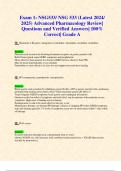
Exam 1: NSG533/ NSG 533 (Latest 2024/ 2025) Advanced Pharmacology Complete Review| Questions and Verified Answers| 100% Correct| Grade A
Exam 1: NSG533/ NSG 533 (Latest 2024/ 2025) Advanced Pharmacology Complete Review| Questions and Verified Answers| 100% Correct| Grade A Q: Histamine-2 Receptor Antagonists (cimetidine, famotidine, nizatidine, ranitidine) Answer: Decrease acid secretion by blocking histamine receptors in gastric parietal cells Relief from typical acute GERD symptoms and prophylactic More effective than antacids for chronic GERD but less effective than PPIs May be dosed intermittently or on schedule Famotidine is most effective in class for acid suppression and ulcer healing Q: PPI (omeprazole, pantoprazole, lansoprazole) Answer: Block gastric acid secretion by inhibiting gastric H+/K+-ATP in gastric parietal cells, producing profound long lasting antisecretory effect which maintains gastric pH above 4 Treats frequent GERD symptoms, heals gastric and esophageal ulcerations Greatest results for relief of symptoms and acid relief, esp for patients with moderate-severe symptoms. High rates of healing erosive disease Esomeprazole is said to be most effective but jury is out Maintenance therapy: on-demand PPI therapy consists of stopping PPI when GERD symptoms stop and starting again for 2-4 weeks if symptoms occur two or more times within 7 days while off therapy Q: PUD causes Answer: H. pylori infection through fecal-contaminated food or water chronic NSAID use, risk increases with combined corticosteroid use + NSAID (but not just steroids by themselves), stress-related mucosal damage in critically ill patients caused by gastric mucosal ischemia and intraluminal acid Zollinger-Ellison syndrome: caused by a gastrin-producing tumor (gastrinoma) which leads to hypersecretion causing diarrhea and malabsorption Q: Scopalamine Answer: Anticholinergic Blocks muscarinic receptors in vestibular system - halts signal to CNS For preventing and treating motion sickness & PONV Transdermal patch for up to 72 hours Typical anticholinergic SEs: dizzy, dry mouth, visual disturbances, sedation Q: antihistamines (nausea, vomiting) Answer: Prevent and treat N/V, vomiting due to motion sickness, vertigo, migraine High concentrations of Histamine1 in muscarinic cholinergic receptors in vestibular system First generation SE: drowsy, blurry vision, urinary retention 1st gen is effective, 2nd gen is not due to BBB *Combo of doxylamine and Vitamin B6 (pyridoxine) for NVP pregnancy Q: Phenothiazines (promethazine, -zine) Answer: Severe motion sickness, NVP, PONV, CINV dopamine antagonist to receptors in CTZ SE: EPS, sedation, orthostatic hypotension Q: Butyrophenone (droperidol, haloperidol) Answer: PONV, CINV Black Box warning for prolonged QT interval Q: Prokinetic agents (metoclopramide, domperidone) Answer: Increase LES tone, promote gastric motility for PONV, CINV, gastroparesis, GERD Crosses BBB Q: Corticosteroids Answer: Dexamethasone, methylprednisolone Alone or in combination with antiemetics for preventing and treating PONV, CINV, radiation induced N/V Q: Serotonin antagonists (ondansetron, -setron) Answer: CINV, PONV; well tolerated Q: Lorazepam Answer: Used as an adjunct to antiemetic agents for CINV Q: Cannabinoids Antiemetic, appetite stimulant activity
Written for
- Institution
- NSG533/NSG 533
- Module
- NSG533/NSG 533
Document information
- Uploaded on
- February 12, 2024
- Number of pages
- 23
- Written in
- 2023/2024
- Type
- Exam (elaborations)
- Contains
- Questions & answers
Subjects
-
nsg533nsg 533nsg533nsg 533 final exam
-
nsg533nsg 533nsg533nsg 533 exam
-
nsg533nsg 533nsg533nsg 533 exam 1
-
nsg533nsg 533nsg533nsg 533 exam 2
-
nsg533nsg 533nsg533nsg 533 exam 3
-
exam 1 nsg533 nsg 533 latest

Also available in package deal