
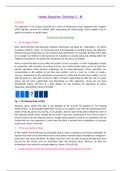
Hume: Enquiries: (Sectins 8
Summary:
The argument of the Enquiry proceeds by a series of incremental steps, separated into chapters
which logically succeed one another. Afer expounding his epistemology, Hume explains how to
apply his principles to specifc topics.
Empirical epistemiligy
1. Of the irigin if ideas
Next, Hume discusses the distncton between impressions and ideas. By "impressions", he means
sensatons, while by "ideas", he means memories and imaginings. According to Hume, the diference
between the two is that ideas are less vivacious than impressions. For example, the idea of the taste
of an orange is far inferior to the impression (or sensatonn of actually eatng one. Writng within the
traditon of empiricism, he argues that impressions are the source of all ideas.
Hume accepts that ideas may be either the product of mere sensaton, or of the imaginaton worring
in conjuncton with sensaton. According to Hume, the creatve faculty mares use of (at leastn four
mental operatons which produce imaginings out of sense-impressions. These operatons are
compounding (or the additon of one idea onto another, such as a horn on a horse to create a
unicornn; transposing (or the substtuton of one part of a thing with the part from another, such as
with the body of a man upon a horse to mare a centaurn; augmentng (as with the case of a giant,
whose size has been augmentedn; and diminishing (as with Lilliputans, whose size has been
diminishedn. (Hume 1974:317n In a later chapter, he also mentons the operatons of mixing,
separatng, and dividing. (Hume 1974:340n
Fig. 1. The Missing Shade if Blue
However, Hume admits that there is one objecton to his account: the problem of " The Missing
Shade of Blue". In this thought-experiment, he asrs us to imagine a man who has experienced every
shade of blue except for one (see Fig. 1n. He predicts that this man will be able to divide the color of
this partcular shade of blue, despite the fact that he has never experienced it. This seems to pose a
serious problem for the empirical account, though Hume brushes it aside as an exceptonal case by
statng that one may experience a novel idea that itself is derived from combinatons of previous
impressions. (Hume 1974:319n
. Of the assiciatin if ideas
In this chapter, Hume discusses how thoughts tend to come in sequences, as in trains of thought. He
explains that there are at least three rinds of associatons between ideas: resemblance, contguity in
space-tme, and cause-and-efect. He argues that there must be some universal principle that must
account for the various sorts of connectons that exist between ideas. However, he does not
immediately show what this principle might be. (Hume 1974:320-321n
3. Sceptcal diubtts cincerning the iperatins if the understanding (in toi parts8
Summary:
The argument of the Enquiry proceeds by a series of incremental steps, separated into chapters
which logically succeed one another. Afer expounding his epistemology, Hume explains how to
apply his principles to specifc topics.
Empirical epistemiligy
1. Of the irigin if ideas
Next, Hume discusses the distncton between impressions and ideas. By "impressions", he means
sensatons, while by "ideas", he means memories and imaginings. According to Hume, the diference
between the two is that ideas are less vivacious than impressions. For example, the idea of the taste
of an orange is far inferior to the impression (or sensatonn of actually eatng one. Writng within the
traditon of empiricism, he argues that impressions are the source of all ideas.
Hume accepts that ideas may be either the product of mere sensaton, or of the imaginaton worring
in conjuncton with sensaton. According to Hume, the creatve faculty mares use of (at leastn four
mental operatons which produce imaginings out of sense-impressions. These operatons are
compounding (or the additon of one idea onto another, such as a horn on a horse to create a
unicornn; transposing (or the substtuton of one part of a thing with the part from another, such as
with the body of a man upon a horse to mare a centaurn; augmentng (as with the case of a giant,
whose size has been augmentedn; and diminishing (as with Lilliputans, whose size has been
diminishedn. (Hume 1974:317n In a later chapter, he also mentons the operatons of mixing,
separatng, and dividing. (Hume 1974:340n
Fig. 1. The Missing Shade if Blue
However, Hume admits that there is one objecton to his account: the problem of " The Missing
Shade of Blue". In this thought-experiment, he asrs us to imagine a man who has experienced every
shade of blue except for one (see Fig. 1n. He predicts that this man will be able to divide the color of
this partcular shade of blue, despite the fact that he has never experienced it. This seems to pose a
serious problem for the empirical account, though Hume brushes it aside as an exceptonal case by
statng that one may experience a novel idea that itself is derived from combinatons of previous
impressions. (Hume 1974:319n
. Of the assiciatin if ideas
In this chapter, Hume discusses how thoughts tend to come in sequences, as in trains of thought. He
explains that there are at least three rinds of associatons between ideas: resemblance, contguity in
space-tme, and cause-and-efect. He argues that there must be some universal principle that must
account for the various sorts of connectons that exist between ideas. However, he does not
immediately show what this principle might be. (Hume 1974:320-321n
3. Sceptcal diubtts cincerning the iperatins if the understanding (in toi parts8


