Sociology Test Questions with Complete Solutions
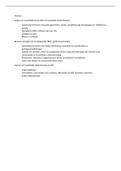
Sociology Test Questions with Complete Solutions Conflict Perspective: - ANSWER -Unlike the structural functional theory, which views society as a peaceful unit, conflict theory interprets society as a struggle for power between groups engaging in conflict for limited resources. Karl Marx is the founder of conflict theory. -Conflict perspective is one of the major theoretical approaches to sociological thought. It originated with Karl Marx and his critique of capitalism and has since developed along a number of lines. In general, the conflict perspective assumes that social life is shaped by groups and individuals who struggle or compete with one another over various resources and rewards, resulting in particular distributions of power, wealth, and prestige in societies and social systems. -These shape the patterns of everyday life as well as things such as racial, ethnic, and class inequality and relations among nations and regions of the world. Functionalist Perspective - ANSWER In the functionalist perspective, societies are thought to function like organisms, with various social institutions working together like organs to maintain and reproduce societies. According to functionalist theories, institutions come about and persist because they play a function in society, promoting stability and integration. The functionalist perspective, also called functionalism, is one of the major theoretical perspectives in sociology. It has its origins in the works of Emile Durkheim, who was especially interested in how social order is possible or how society remains relatively stable. -Functionalism interprets each part of society in terms of how it contributes to the stability of the whole society. Society is more than the sum of its parts; rather, each part of society is functional for the stability of the whole society. -The different parts are primarily the institutions of society, each of which is organized to fill different needs and each of which has particular consequences for the form and shape of society. The parts all depend on each other. -For example, the government, or state, provides education for the children of the family, which in turn pays taxes on which the state depends to keep itself running. The family is dependent upon the school to help children grow up to have good jobs so that they can raise and support their own families. In the process, the children become lawabiding, taxpaying citizens, who in turn support the state. Symbolic Interactionist Perspective: - ANSWER -The symbolic interaction perspective, also called symbolic interactionism, is a major framework of sociological theory. This perspective relies on the symbolic meaning that PEOPLE DEVELOP AND RELY UPON THE PROCESS OF SOCIAL INTERACTION. Although symbolic interactionism traces its origins to Max Weber's assertion that individuals act according to their interpretation of the meaning of their world, the American philosopher George Herbert Mead introduced this perspective to American sociology in the 1920s. -Symbolic interaction theory ANALYZES SOCIETY BY ADDRESSING THE SUBJECTIVE MEANINGS THAT PEOPLE IMPOSE ON OBJECTS, EVENTS, AND BEHAVIORS. Subjective meanings are given primacy because it is believed that people behave based on what they believe and not just on what is objectively true( smoking because it you think it makes you look cool rather than not smoking when you know it is bad for you). Thus, society is thought to be socially constructed through human interpretation. People interpret one another's behavior and it is these interpretations that form the social bond. These interpretations are called the "definition of the situation." For example, why would young people smoke cigarettes even when all objective medical evidence points to the dangers of doing so? -We also interpret people's actions and sayings based on race and gender because it is a socially constructed idea that they are different from Whites or males.
Written for
- Institution
- Sociology
- Module
- Sociology
Document information
- Uploaded on
- February 6, 2024
- Number of pages
- 13
- Written in
- 2023/2024
- Type
- Exam (elaborations)
- Contains
- Questions & answers
Subjects
-
sociology
-
sociology test
-
sociology test questions with complete solutions