WORK, ENERGY, POWER
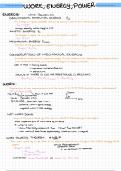
ENERGY: Uniz: Jolle(3)
GRAVITATIONAL POTENTIAL ENERGY: Ep
The possesses due to its position relative reference point
energy an
object to a
Ep= mgh
always specify what height
h =0
KINETIC ENERGY: Ek
The object has result of the
object's motion
energy
an a
as
Ex= EMVI
MECHANICAL ENERGY: Emech
The of the
sum
gravitational potential energy and the kinetic
energy at a point
Emech Ep+El
=
CONSERVATION OF MECHANICAL ENERGY:
Principle of conservation of mechanical In the absence of external forces
energy: air resistance or
any
(non-conservative forces), the mechanical
energy
of an
object is constant
USE IT FOR -
falling bodies
->
up/down inclined surface (hill
->
pendulums
ONLY IF THERE IS NO AIRRESISTANCE (IFRICTION (
(EprEkDe= (EptEcmidale =
(Ex+Eidf
WORK:
The product of the displacement and the component of the force parallel to the displacement
W =
F0xCos@
mag
of force I btwn F and 1x Fapplied
of displacement
mag. O
Unit: Joules (3) o >Oxa
SCALAR, but can be or
positive work
gains energy
-
work -> lose
negative energy
NET WORK DONE:
the net resultant force the
What is the work done
by or
acting on object
Also algebraic sum of work done
by all forces
2 ways to cal:
-
aram free
body, determine Fret (Unet"Fuet OxcosO]
work of each force
cal
separately (add all work wisigns)
-
WORK -
ENERGY THEOREN **
force object equal the kinetic of the
The work done by a net on an is to the
change in energy
object ONLY REQUIREMENT:
constant force
Unet =
DEi
friction, air resistance)
C. can be
Erginal-Ekinitial
-
=Emv1-Emuz
Cremember: Wet= FretOxcost on Wet= W_< W-+ W
ENERGY: Uniz: Jolle(3)
GRAVITATIONAL POTENTIAL ENERGY: Ep
The possesses due to its position relative reference point
energy an
object to a
Ep= mgh
always specify what height
h =0
KINETIC ENERGY: Ek
The object has result of the
object's motion
energy
an a
as
Ex= EMVI
MECHANICAL ENERGY: Emech
The of the
sum
gravitational potential energy and the kinetic
energy at a point
Emech Ep+El
=
CONSERVATION OF MECHANICAL ENERGY:
Principle of conservation of mechanical In the absence of external forces
energy: air resistance or
any
(non-conservative forces), the mechanical
energy
of an
object is constant
USE IT FOR -
falling bodies
->
up/down inclined surface (hill
->
pendulums
ONLY IF THERE IS NO AIRRESISTANCE (IFRICTION (
(EprEkDe= (EptEcmidale =
(Ex+Eidf
WORK:
The product of the displacement and the component of the force parallel to the displacement
W =
F0xCos@
mag
of force I btwn F and 1x Fapplied
of displacement
mag. O
Unit: Joules (3) o >Oxa
SCALAR, but can be or
positive work
gains energy
-
work -> lose
negative energy
NET WORK DONE:
the net resultant force the
What is the work done
by or
acting on object
Also algebraic sum of work done
by all forces
2 ways to cal:
-
aram free
body, determine Fret (Unet"Fuet OxcosO]
work of each force
cal
separately (add all work wisigns)
-
WORK -
ENERGY THEOREN **
force object equal the kinetic of the
The work done by a net on an is to the
change in energy
object ONLY REQUIREMENT:
constant force
Unet =
DEi
friction, air resistance)
C. can be
Erginal-Ekinitial
-
=Emv1-Emuz
Cremember: Wet= FretOxcost on Wet= W_< W-+ W