

Emmanuel Appiagyei Unit 29-Understanding Retail P2 Teacher:
Jaswinder
Role OF Retailing in the Distributon oo
Goods and Services P2
In this assignment I will be investigating the distribution methods of two
contrasting products that are perishable and not and will explain its process from
source to customer. The two products I am going to choose is Milk and Jeans
Step 1. Caring for the cows
Source:
http://milk.procon.org/view.resource.
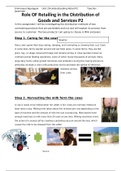
Dairy cows spend their days eating, sleeping, and ruminating or chewing their cud. Cows
in some dairy farms wander around and eat fresh grass. In some farms, they are fed
grain, hay, or silage conserved forage and remains all day in close quarters known as
confined animal feeding operations, some of which house thousands of animals. Many
large dairy farms utilize growth hormones and antibiotics during the rearing process to
artificially increase a cow's milk production and to decrease the spread of infectious
diseases among
their cows.
Step 2. Harvesting the milk form the cows
A cow is ready to be milked when her udder is full. Cows are normally milked at
least twice a day. Milking time takes about five minutes per cow depending on the
type of machine and the amount of milk the cow is producing. Most dairies have
enough machines to milk more than 20 cows at one time. Milking machines mimic
the action of a young calf by creating a pulsating vacuum around the teat, which
causes the milk to be released from the udder.
Source:
http://milk.procon.org/view.resource.
Jaswinder
Role OF Retailing in the Distributon oo
Goods and Services P2
In this assignment I will be investigating the distribution methods of two
contrasting products that are perishable and not and will explain its process from
source to customer. The two products I am going to choose is Milk and Jeans
Step 1. Caring for the cows
Source:
http://milk.procon.org/view.resource.
Dairy cows spend their days eating, sleeping, and ruminating or chewing their cud. Cows
in some dairy farms wander around and eat fresh grass. In some farms, they are fed
grain, hay, or silage conserved forage and remains all day in close quarters known as
confined animal feeding operations, some of which house thousands of animals. Many
large dairy farms utilize growth hormones and antibiotics during the rearing process to
artificially increase a cow's milk production and to decrease the spread of infectious
diseases among
their cows.
Step 2. Harvesting the milk form the cows
A cow is ready to be milked when her udder is full. Cows are normally milked at
least twice a day. Milking time takes about five minutes per cow depending on the
type of machine and the amount of milk the cow is producing. Most dairies have
enough machines to milk more than 20 cows at one time. Milking machines mimic
the action of a young calf by creating a pulsating vacuum around the teat, which
causes the milk to be released from the udder.
Source:
http://milk.procon.org/view.resource.


