

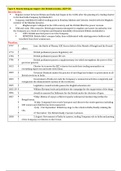
Topic 4: Nearly losing an empire: the British in India, 1829-58:
Introduction;
Regular contact between Britain and India had begun in the 1600s after the granting of a trading charter
to the East India Company by Elizabeth I.
Company established fortified trading posts in Bombay, Madras and Calcutta (traded with the Mughals -
member of the Muslim dynasty).
o Mughal empire collapsed in the 18th century and the British filled the power vacuum.
18th and early 19th centuries: British government attempted to regulate and assert its authority over
the Company as a result of corruption and financial instability (threatened British stockholders).
o 1829: British asserted power over the Company.
o HOWEVER: British didn't conquer India; they collaborated with existing power-holders and
benefited from their weaknesses.
Timeline;
1757 June: the Battle of Plassey (EIC forces defeat of the Nawab of Bengal and his French
allies).
1773 British parliament passes Regulatory Act.
1784 British parliament passes EIC Act.
1786 British parliament passes a supplementary Act which strengthens the power of the
governor general.
1813 Charter Act renews the EIC's charter but ends their trading monopolies on
everything expect tea and trade with China.
1829 Governor Bentinck makes the practice of sati illegal and subject to prosecution in all
British territory in India.
1833 Government of India Act ends the Company's commercial activities completely and
reorganises the administrative system of the territories.
1835 Legislative council in India passes the English education Act.
1835-39 William Sleeman leads and publicises the campaign for the suppression of the thagi.
1856 Awadh is annexed by Dalhousie for the British under the doctrine of lapse.
1857 9 May: Mutiny of sepoys at Meerut sparks widespread mutineering within the
Bengali army.
16 July: Company forces reach Cawnpore and discover the entire garrison including
200 women and children has been massacred.
1 July - 21st September: British lay siege to the rebels in Delhi, finally retaking the
city.
27 November: The British finally evacuate Lucknow.
1858 2 August: Government of India Act passes, ending Company rule in India and passing
of the Company's territories to the Crown.
Introduction;
Regular contact between Britain and India had begun in the 1600s after the granting of a trading charter
to the East India Company by Elizabeth I.
Company established fortified trading posts in Bombay, Madras and Calcutta (traded with the Mughals -
member of the Muslim dynasty).
o Mughal empire collapsed in the 18th century and the British filled the power vacuum.
18th and early 19th centuries: British government attempted to regulate and assert its authority over
the Company as a result of corruption and financial instability (threatened British stockholders).
o 1829: British asserted power over the Company.
o HOWEVER: British didn't conquer India; they collaborated with existing power-holders and
benefited from their weaknesses.
Timeline;
1757 June: the Battle of Plassey (EIC forces defeat of the Nawab of Bengal and his French
allies).
1773 British parliament passes Regulatory Act.
1784 British parliament passes EIC Act.
1786 British parliament passes a supplementary Act which strengthens the power of the
governor general.
1813 Charter Act renews the EIC's charter but ends their trading monopolies on
everything expect tea and trade with China.
1829 Governor Bentinck makes the practice of sati illegal and subject to prosecution in all
British territory in India.
1833 Government of India Act ends the Company's commercial activities completely and
reorganises the administrative system of the territories.
1835 Legislative council in India passes the English education Act.
1835-39 William Sleeman leads and publicises the campaign for the suppression of the thagi.
1856 Awadh is annexed by Dalhousie for the British under the doctrine of lapse.
1857 9 May: Mutiny of sepoys at Meerut sparks widespread mutineering within the
Bengali army.
16 July: Company forces reach Cawnpore and discover the entire garrison including
200 women and children has been massacred.
1 July - 21st September: British lay siege to the rebels in Delhi, finally retaking the
city.
27 November: The British finally evacuate Lucknow.
1858 2 August: Government of India Act passes, ending Company rule in India and passing
of the Company's territories to the Crown.


