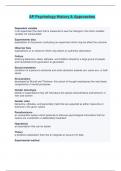
AP Psychology - History & Approaches Terminology
AP Psychology - History & Approaches Terminology Dependent variable in an experiment the item that is measured to see the changes in the other variable; variable not manipulated Experimenter bias expectation of the person conducting an experiment which may be affect the outcome Observer bias expectations of an observer which may distort an authentic observation Culture enduring behaviors, ideas, attitudes, and tradition shared by a large group of people and transmitted from generation to generation Sexual orientation correction of a person's emotional and erotic attraction towards sex, same-sex, or both sexes Structuralism developed by Wundt and Titchener; this school of thought emphasizes the most basic components of mental processes Gender stereotype beliefs or expectations they will hold about the typical characteristics and behavior of men and women Gender roles behaviors, attitudes, and personality traits that are expected as either masculine or feminine in the given culture Pseudoscience an unscientific system which pretends to discover psychological information that his means are unscientific or deliberately fraudulent Hypothesis an assumption that can be tested Theory a tentative explanation that tries to integrate an account for data
Written for
- Institution
- AP Psychology
- Module
- AP Psychology
Document information
- Uploaded on
- January 25, 2024
- Number of pages
- 4
- Written in
- 2023/2024
- Type
- Exam (elaborations)
- Contains
- Questions & answers
Subjects
-
ap psychology
-
history approaches
-
ap psychology history approaches terminology
-
ap psychology history approaches

Also available in package deal