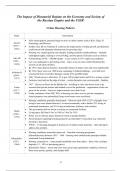
The Impact of Dictatorial Regime on the Economy and Society of
the Russian Empire and the USSR
Urban Housing Policies
Ruler Information
• After emancipation, peasants began to move to urban centres such as Kiev, Riga, St
Alex II Petersburg, and Moscow
(1855 – • Neither Alex III nor Nicholas II could see the implications of urban growth, and therefore
1881) could not provide adequate infrastructure for growing cities
• Housing was created quickly and cheaply, leading to public health problems – demand
outstripped supply, leading to overcrowding, and the spread of diseases such as cholera
Alex III • St Petersburg (1910) – 100,000 deaths – a new system in 1911 improved conditions
(1881 – • Law was inadequate in preventing crime – led to a rise in crime which threatened the
1894) security of all urban dwellers
• By 1914, slum districts became a noticeable feature of major cities and were unpoliceable
• By 1914, there were over 1000 towns containing 2 million buildings – over half were
Nicholas II
constructed from wood (fire damage), mostly lit by paraffin lamps
(1894 –
• Only 74 had access to electricity, 35 to gas, 200 to piped water and 38 to a sewage system
1917)
• Factories were built on the edge of cities – worker barracks were overcrowded – families
• 1917 – Decree on Peace by the Bolsheviks – dwelling in cities and towns were to be
Lenin wrested from private owners and handed over to the proletariat – organisation of the was
(1917 – given to the soviets – however, improvements were short lived
1924) • Under conditions of the NEP, 89% of housing was taken over by private companies,
church property was nationalised, large town houses were socialised -
• Housing conditions generally deteriorated – Moscow (mid-1930’s) 25% of people were
living in one room shared between 2 or more households, with a further 25% living in
communal dormitories, and 5% living in bathrooms, kitchens, and corridors
• The government did not invest in sewage or communal facilities
Stalin
• Living space fell from 8.5m2 in 1905 to 5.8m2 by 1935
(1928 –
• Policy was to allocate space instead of rooms to people/families
1953)
• Social projects regarding housing paused to accommodate 5-year plans (e.g. materials
diverted to factories)
• WWII – 1/3 housing damaged or destroyed, 25 million made homeless – little attempt to
address this problem
• Housing conditions somewhat improved – launched a housing programme
(Khrushchyovka) between 1955 – 1964 – housing stock doubled and principles behind
Khrushchev communal living abandoned
(1953 – • Housing cooperatives – some people benefitted more than others – those who could pay
1964) deposits (15 – 30% of purchasing price)
• Khrushchev Slums – towns and cities were given large apartments complexes; however
these were poorly, quickly, and cheaply built
19
, Rural Housing Policies
Ruler Information
Alex II • Rural housing remains the same under all rulers, with very little change or improvement
(1855 – • Consisted of a single room, wooden hut, heated by an over
1881) - • Usually overcrowded, animals were housed in the same hut
Lenin • The houses were cheap to construct, and peasants had total control over its use
(1917 – • However, conditions were horrendous – no access to electricity, clean water, sewage
1924) systems, gas
• Stalin created special housing blocks which were located on the periphery of collective
Stalin
farms
(1928 –
• However, displaced kulaks were dumped in barracks or given tents for accommodation –
1953)
poor security and facilities – not consistent across all rural people
• Khrushchev planned to build self-contained agro towns for the rural population in order to
Khrushchev
improve conditions
(1953 –
• However, houses were built cheaply, quickly, and poorly and became very overcrowded –
1964)
this led to an increase in public health problems
20
, Urban Working Conditions
Ruler Information
• Industrial working conditions (in factories) were dangerous and unhealthy throughout Alex
Alex II
II’s reign
(1855 –
• There was no factory inspectorate, leading to injury and health problems remaining
1881)
unaddressed, child labour, and exploitation of labour was common
• A factory inspectorate was introduced in 1882 – in theory this was good, but in practice
rules were rarely followed due to a lack of factory inspectors
Alex III • One important laws introduced was prohibiting night-time employment of women and
(1881 – children (1885)
1894) • Similarly, child labour/employment was banned in 1882, but children were still used in
many places and were not found out
• 1890 – 245 deaths, 3508 injuries
• Nicholas II’s rule saw an increase in death and injury – 1910 – 556 deaths, 66608 injuries
• Another important law introduced – restricting the working day to 11 hours (1897) – this
was forced from the government
• Small workshops were excluded from these laws even though they made up a significant
proportion of the workforce
Nicholas II
• Shopfloors were crammed with dangerous machinery – frequent accidents – most workers
(1894 –
denied legal right to insurance, and could not expect much compensation
1917)
• Worker’s strikes were illegal, and trade unions were illegal until 1905
• Poor conditions evidence through 1905 Bloody Sunday protest when workers wanted
better working conditions
• Lena Gold Fields – crowd of 5000 fried upon, 270 died, 200 wounded
• Strikes peak in 1899 – 97,000 workers, 1905 – 2,863,000 workers, and 1,337,000 in 1914
• New work discipline was introduced – 1920 – Workers and Peasants Inspectorate was
introduced which was backward step
Lenin
• Did little to enforce industrial law – long hours, low pay, discipline was harsh
(1917 –
• Fines used – 10% of wages, punishments for wrongdoings, workers purged if considered
1924)
anti-revolutionary (purposefully wrecking machinery or working slow)
• 1917 – 8 hours day
• Working hours strictly controlled by the state
• Wages strictly controlled by the state – low during the period, women received less
• 1932 – 10 – 12 hour working day
Stalin
• Some workers earned more because they made more – a piece rate system was used to
(1928 –
provide an incentive for workers to be more productive
1953)
• However, wages fell by 50% during the first Five Year Plan
• 1924 and 1936, communist constitutions – against ill health, old age, and unemployment
insurance cover
Khrushchev
• Working hours were at their lowest – 1958 – 7 hours
(1953 –
• 1962 Novocherkassk Riots against shortages and conditions – 20 killed
1964)
21
the Russian Empire and the USSR
Urban Housing Policies
Ruler Information
• After emancipation, peasants began to move to urban centres such as Kiev, Riga, St
Alex II Petersburg, and Moscow
(1855 – • Neither Alex III nor Nicholas II could see the implications of urban growth, and therefore
1881) could not provide adequate infrastructure for growing cities
• Housing was created quickly and cheaply, leading to public health problems – demand
outstripped supply, leading to overcrowding, and the spread of diseases such as cholera
Alex III • St Petersburg (1910) – 100,000 deaths – a new system in 1911 improved conditions
(1881 – • Law was inadequate in preventing crime – led to a rise in crime which threatened the
1894) security of all urban dwellers
• By 1914, slum districts became a noticeable feature of major cities and were unpoliceable
• By 1914, there were over 1000 towns containing 2 million buildings – over half were
Nicholas II
constructed from wood (fire damage), mostly lit by paraffin lamps
(1894 –
• Only 74 had access to electricity, 35 to gas, 200 to piped water and 38 to a sewage system
1917)
• Factories were built on the edge of cities – worker barracks were overcrowded – families
• 1917 – Decree on Peace by the Bolsheviks – dwelling in cities and towns were to be
Lenin wrested from private owners and handed over to the proletariat – organisation of the was
(1917 – given to the soviets – however, improvements were short lived
1924) • Under conditions of the NEP, 89% of housing was taken over by private companies,
church property was nationalised, large town houses were socialised -
• Housing conditions generally deteriorated – Moscow (mid-1930’s) 25% of people were
living in one room shared between 2 or more households, with a further 25% living in
communal dormitories, and 5% living in bathrooms, kitchens, and corridors
• The government did not invest in sewage or communal facilities
Stalin
• Living space fell from 8.5m2 in 1905 to 5.8m2 by 1935
(1928 –
• Policy was to allocate space instead of rooms to people/families
1953)
• Social projects regarding housing paused to accommodate 5-year plans (e.g. materials
diverted to factories)
• WWII – 1/3 housing damaged or destroyed, 25 million made homeless – little attempt to
address this problem
• Housing conditions somewhat improved – launched a housing programme
(Khrushchyovka) between 1955 – 1964 – housing stock doubled and principles behind
Khrushchev communal living abandoned
(1953 – • Housing cooperatives – some people benefitted more than others – those who could pay
1964) deposits (15 – 30% of purchasing price)
• Khrushchev Slums – towns and cities were given large apartments complexes; however
these were poorly, quickly, and cheaply built
19
, Rural Housing Policies
Ruler Information
Alex II • Rural housing remains the same under all rulers, with very little change or improvement
(1855 – • Consisted of a single room, wooden hut, heated by an over
1881) - • Usually overcrowded, animals were housed in the same hut
Lenin • The houses were cheap to construct, and peasants had total control over its use
(1917 – • However, conditions were horrendous – no access to electricity, clean water, sewage
1924) systems, gas
• Stalin created special housing blocks which were located on the periphery of collective
Stalin
farms
(1928 –
• However, displaced kulaks were dumped in barracks or given tents for accommodation –
1953)
poor security and facilities – not consistent across all rural people
• Khrushchev planned to build self-contained agro towns for the rural population in order to
Khrushchev
improve conditions
(1953 –
• However, houses were built cheaply, quickly, and poorly and became very overcrowded –
1964)
this led to an increase in public health problems
20
, Urban Working Conditions
Ruler Information
• Industrial working conditions (in factories) were dangerous and unhealthy throughout Alex
Alex II
II’s reign
(1855 –
• There was no factory inspectorate, leading to injury and health problems remaining
1881)
unaddressed, child labour, and exploitation of labour was common
• A factory inspectorate was introduced in 1882 – in theory this was good, but in practice
rules were rarely followed due to a lack of factory inspectors
Alex III • One important laws introduced was prohibiting night-time employment of women and
(1881 – children (1885)
1894) • Similarly, child labour/employment was banned in 1882, but children were still used in
many places and were not found out
• 1890 – 245 deaths, 3508 injuries
• Nicholas II’s rule saw an increase in death and injury – 1910 – 556 deaths, 66608 injuries
• Another important law introduced – restricting the working day to 11 hours (1897) – this
was forced from the government
• Small workshops were excluded from these laws even though they made up a significant
proportion of the workforce
Nicholas II
• Shopfloors were crammed with dangerous machinery – frequent accidents – most workers
(1894 –
denied legal right to insurance, and could not expect much compensation
1917)
• Worker’s strikes were illegal, and trade unions were illegal until 1905
• Poor conditions evidence through 1905 Bloody Sunday protest when workers wanted
better working conditions
• Lena Gold Fields – crowd of 5000 fried upon, 270 died, 200 wounded
• Strikes peak in 1899 – 97,000 workers, 1905 – 2,863,000 workers, and 1,337,000 in 1914
• New work discipline was introduced – 1920 – Workers and Peasants Inspectorate was
introduced which was backward step
Lenin
• Did little to enforce industrial law – long hours, low pay, discipline was harsh
(1917 –
• Fines used – 10% of wages, punishments for wrongdoings, workers purged if considered
1924)
anti-revolutionary (purposefully wrecking machinery or working slow)
• 1917 – 8 hours day
• Working hours strictly controlled by the state
• Wages strictly controlled by the state – low during the period, women received less
• 1932 – 10 – 12 hour working day
Stalin
• Some workers earned more because they made more – a piece rate system was used to
(1928 –
provide an incentive for workers to be more productive
1953)
• However, wages fell by 50% during the first Five Year Plan
• 1924 and 1936, communist constitutions – against ill health, old age, and unemployment
insurance cover
Khrushchev
• Working hours were at their lowest – 1958 – 7 hours
(1953 –
• 1962 Novocherkassk Riots against shortages and conditions – 20 killed
1964)
21