

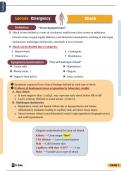
Lecture Emergency Shock
Definition “Tissue hypoperfusion”
Shock is best defined as a state of circulatory insufficiency that creates an imbalance
between tissue oxygen supply (delivery) and demand (consumption), resulting in end-organ
dysfunction, multiorgan dysfunction, and death, if not corrected.
Shock can be divided into 4 categories:
Hypovolemic Cardiogenic
Obstructive Distributive
Symptoms/examination “Vary with each type of shock”
Tachycardia Hypotension
Mental status ↓ Oliguria
Negative base deficit Lactic acidosis.
Symptoms suspected from clinical findings defined by each type of shock
Evidence of inadequate tissue oxygenation by laboratory studies
A. Base deficit
o If more negative than -2 mEq/L may represent early shock before HR or BP
o Lactic acidosis: Defined as serum lactate >4 mm l/L
B. Multiorgan dysfunction
o Respiratory, renal, and hepatic failure due to hypoperfusion and release
inflammatory mediators leading to capillary leak and direct tissue injury.
o Stress hormone release (catecholamines) results in glycogenolysis (hyperglycemia)
and mild hypokalemia.
Organs exanimated in case of shock
Kidney → Urine output “Best”
CNS (Brain) → Loss of consciousness
Skin → Cold clammy skin
Capillary refill time “CRT” → ˃ 3 sec
Pulse → Variable acc to type of shock
, Treatment
Improve tissue perfusion and reduce tissue demand by maximizing cardiac output (fluids,
blood, vasopressors) and increasing oxygenation (intubation or noninvasive ventilation)
Resuscitation goals
CVP → 8-12 mm Hg UOP > 0.5 /kg
Mean arterial pressure (MAP) → 65-90 mm Hg Sv02 > 70%
Hypovolemic shock
Associated with decreased cardiac preload (blood return to the right ventricle due to
low vascular volume), decreased preload results in decreased cardiac output due to
ineffective heart filling.
The physiological reaction to this condition is diversion of blood from the splanchnic
(peripheral) circulation areas to vital organs by ↑ systemic vascular resistance (SVR).
Hypovolemia could be due to
1) Hemorrhagic shock
2) Non-Hemorrhagic shock
Definition
Acute hemorrhage causing rapid reduction in blood volume (red blood cell mass & plasma)
Causes
External bleeding, usually due to trauma
Internal bleeding due to abdominal aortic aneurysm (AAA), GI sources, blunt trauma,
fractures, arterial or venous injury, ectopic pregnancy
Diagnosis Diagnosis is mostly clinical (History + clinical signs).
Hemoglobin/hematocrit (HCT) will be normal until compensatory fluid shifting or fluid
resuscitation has occurred.
Focused Assessment with Sonography for Trauma (FAST) scan, chest and pelvis x-rays
Definition “Tissue hypoperfusion”
Shock is best defined as a state of circulatory insufficiency that creates an imbalance
between tissue oxygen supply (delivery) and demand (consumption), resulting in end-organ
dysfunction, multiorgan dysfunction, and death, if not corrected.
Shock can be divided into 4 categories:
Hypovolemic Cardiogenic
Obstructive Distributive
Symptoms/examination “Vary with each type of shock”
Tachycardia Hypotension
Mental status ↓ Oliguria
Negative base deficit Lactic acidosis.
Symptoms suspected from clinical findings defined by each type of shock
Evidence of inadequate tissue oxygenation by laboratory studies
A. Base deficit
o If more negative than -2 mEq/L may represent early shock before HR or BP
o Lactic acidosis: Defined as serum lactate >4 mm l/L
B. Multiorgan dysfunction
o Respiratory, renal, and hepatic failure due to hypoperfusion and release
inflammatory mediators leading to capillary leak and direct tissue injury.
o Stress hormone release (catecholamines) results in glycogenolysis (hyperglycemia)
and mild hypokalemia.
Organs exanimated in case of shock
Kidney → Urine output “Best”
CNS (Brain) → Loss of consciousness
Skin → Cold clammy skin
Capillary refill time “CRT” → ˃ 3 sec
Pulse → Variable acc to type of shock
, Treatment
Improve tissue perfusion and reduce tissue demand by maximizing cardiac output (fluids,
blood, vasopressors) and increasing oxygenation (intubation or noninvasive ventilation)
Resuscitation goals
CVP → 8-12 mm Hg UOP > 0.5 /kg
Mean arterial pressure (MAP) → 65-90 mm Hg Sv02 > 70%
Hypovolemic shock
Associated with decreased cardiac preload (blood return to the right ventricle due to
low vascular volume), decreased preload results in decreased cardiac output due to
ineffective heart filling.
The physiological reaction to this condition is diversion of blood from the splanchnic
(peripheral) circulation areas to vital organs by ↑ systemic vascular resistance (SVR).
Hypovolemia could be due to
1) Hemorrhagic shock
2) Non-Hemorrhagic shock
Definition
Acute hemorrhage causing rapid reduction in blood volume (red blood cell mass & plasma)
Causes
External bleeding, usually due to trauma
Internal bleeding due to abdominal aortic aneurysm (AAA), GI sources, blunt trauma,
fractures, arterial or venous injury, ectopic pregnancy
Diagnosis Diagnosis is mostly clinical (History + clinical signs).
Hemoglobin/hematocrit (HCT) will be normal until compensatory fluid shifting or fluid
resuscitation has occurred.
Focused Assessment with Sonography for Trauma (FAST) scan, chest and pelvis x-rays


