

Cornell notes template
Reasoning:
- Distinguish between different types of reasoning.
- Describe some experiments designed to test reasoning and the possible explanations
for behaviour.
- Identify strengths/limitations of research methodology.
- Definition
of
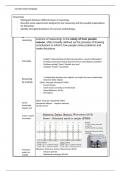
The psychology of reasoning (also known as the cognitive
reasoning science of reasoning) is the study of how people
reason, often broadly defined as the process of drawing
conclusions to inform how people solve problems and
make decisions.
- Insight? Understanding of physical properties, causal relationships?
- Concepts - Forming conclusions that go beyond what is immediately available?
- Problem solving? Rules? Flexible tool use?
- Uniquely ‘human’ reasoning?
- A relationship between two objects can imply the same relationship
- Reasoning between other objects
by analogy Gillan, Premack, Woodruff (1981)
- Forced choice:
- Sarah chose correctly on 45/60 trials
- Same/different: 26/36
- Perceptual
Gillan, Premack, Woodruff (1981)
- Sarah: Household objects – requires memory
household 15/18 correct
objects test
- Crows: match
to sample
- Amazons: Obozova, Smirnova, Zorina, Wasserman (2015)
match to - Amazon parrots
sample - Relational matching: 80.56%
Reasoning:
- Distinguish between different types of reasoning.
- Describe some experiments designed to test reasoning and the possible explanations
for behaviour.
- Identify strengths/limitations of research methodology.
- Definition
of
The psychology of reasoning (also known as the cognitive
reasoning science of reasoning) is the study of how people
reason, often broadly defined as the process of drawing
conclusions to inform how people solve problems and
make decisions.
- Insight? Understanding of physical properties, causal relationships?
- Concepts - Forming conclusions that go beyond what is immediately available?
- Problem solving? Rules? Flexible tool use?
- Uniquely ‘human’ reasoning?
- A relationship between two objects can imply the same relationship
- Reasoning between other objects
by analogy Gillan, Premack, Woodruff (1981)
- Forced choice:
- Sarah chose correctly on 45/60 trials
- Same/different: 26/36
- Perceptual
Gillan, Premack, Woodruff (1981)
- Sarah: Household objects – requires memory
household 15/18 correct
objects test
- Crows: match
to sample
- Amazons: Obozova, Smirnova, Zorina, Wasserman (2015)
match to - Amazon parrots
sample - Relational matching: 80.56%


