

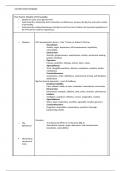
Cornell notes template
Five Factor Models of Personality:
•o FFM andthe
Identify BigtraitsBoth made
of the up of 5 domains:
Big Five/FFM
• Five – the -
Understand the relationship, bothNeuroticism
continuities and differences, between the Big Five and earlier models
same
of personality. - Extraversion
• domains the relationship
Understand - between
Opennessthe Big Five and Five Factor Models, the theoretical predictions of
- Conscientiousness
the FFM and the evidence supporting it.
- Agreeableness
o Domains FFM (questionnaire items) – Paul T Costa Jnr, Robert R McCrae
- Neuroticism:
- Anxiety, anger, depression, self-consciousness, impulsivity,
vulnerability
- Extraversion:
- Warmth, gregariousness, assertiveness, activity, excitement seeking,
positive emotions
- Openness:
- Fantasy, aesthetics, feelings, actions, ideas, values
- Agreeableness:
- Trust, straightforwardness, altruism, compliance, modesty, tender-
mindedness
- Conscientiousness:
- Competence, order, dutifulness, achievement striving, self-discipline,
deliberation
Big Five (Lexical Approach) – Lewis R Goldberg
- Emotional stability:
- Calm, relaxed, stable, at ease, contented, unemotional, not envious
- Extraversion:
- Extraverted, energetic, talkative, bold, active, assertive, adventurous
- Intellect:
- Intelligent, analytical, reflective, curious, imaginative, creative
- Agreeableness:
- Warm, kind, cooperative, unselfish, agreeable, trustful, generous
- Conscientiousness:
- Organised, responsible, conscientious, practical, thorough,
hardworking, thrifty
Structure
o The - Trait hierarchy (FFM) or no hierarchy (Big 5)
differences - Neuroticism (anxiety, anger, depression, self-consciousness,
impulsivity, vulnerability)
Hierarchical
structure of
traits
, Cornell notes template
The
differences
Measurement
- FFM
- Via questionnaire items designed to reflect the casual role in
behaviour at the facet levels
- 6 facets underlie each of the domains e.g. ‘I am easily frightened’, ‘I
rarely feel fearful or anxious’
- Big 5
- Via adjectives: calm, agreeable etc
Empirical basis
– Big 5
• Lexical approach
– FFM
• Exploratory factor analysis
– Statistical approach to go from lots of individual
item responses to shared dimensions based on
shared variance – you’ll cover in stats this/next
few weeks
Because they didn’t learn about factor analysis yet, might be good to include a
figure to illustrate the idea. Something like the one here:
https://statisticsbyjim.com/basics/factor-analysis/
Causality
– FFM
• Traits cause behaviour
– Big 5
• No formal causal statement. They just represent natural
language.
Origins
Five Factor Models of Personality:
•o FFM andthe
Identify BigtraitsBoth made
of the up of 5 domains:
Big Five/FFM
• Five – the -
Understand the relationship, bothNeuroticism
continuities and differences, between the Big Five and earlier models
same
of personality. - Extraversion
• domains the relationship
Understand - between
Opennessthe Big Five and Five Factor Models, the theoretical predictions of
- Conscientiousness
the FFM and the evidence supporting it.
- Agreeableness
o Domains FFM (questionnaire items) – Paul T Costa Jnr, Robert R McCrae
- Neuroticism:
- Anxiety, anger, depression, self-consciousness, impulsivity,
vulnerability
- Extraversion:
- Warmth, gregariousness, assertiveness, activity, excitement seeking,
positive emotions
- Openness:
- Fantasy, aesthetics, feelings, actions, ideas, values
- Agreeableness:
- Trust, straightforwardness, altruism, compliance, modesty, tender-
mindedness
- Conscientiousness:
- Competence, order, dutifulness, achievement striving, self-discipline,
deliberation
Big Five (Lexical Approach) – Lewis R Goldberg
- Emotional stability:
- Calm, relaxed, stable, at ease, contented, unemotional, not envious
- Extraversion:
- Extraverted, energetic, talkative, bold, active, assertive, adventurous
- Intellect:
- Intelligent, analytical, reflective, curious, imaginative, creative
- Agreeableness:
- Warm, kind, cooperative, unselfish, agreeable, trustful, generous
- Conscientiousness:
- Organised, responsible, conscientious, practical, thorough,
hardworking, thrifty
Structure
o The - Trait hierarchy (FFM) or no hierarchy (Big 5)
differences - Neuroticism (anxiety, anger, depression, self-consciousness,
impulsivity, vulnerability)
Hierarchical
structure of
traits
, Cornell notes template
The
differences
Measurement
- FFM
- Via questionnaire items designed to reflect the casual role in
behaviour at the facet levels
- 6 facets underlie each of the domains e.g. ‘I am easily frightened’, ‘I
rarely feel fearful or anxious’
- Big 5
- Via adjectives: calm, agreeable etc
Empirical basis
– Big 5
• Lexical approach
– FFM
• Exploratory factor analysis
– Statistical approach to go from lots of individual
item responses to shared dimensions based on
shared variance – you’ll cover in stats this/next
few weeks
Because they didn’t learn about factor analysis yet, might be good to include a
figure to illustrate the idea. Something like the one here:
https://statisticsbyjim.com/basics/factor-analysis/
Causality
– FFM
• Traits cause behaviour
– Big 5
• No formal causal statement. They just represent natural
language.
Origins


