

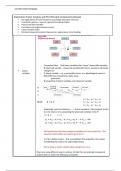
Cornell notes template
Exploratory Factor Analysis and PCA (Principle Component Analysis)
Factor
Key applications ofPersonality questionnaires:
Factor Analysis in psychology (and other sciences)
analysis and - Dozens or hundreds
Coordinate systems – basis of a geometrical of questions about particular behaviours or preferences
interpretation
personality -
Vectors and data variables Are there any patterns in these features?
traits – Gray - Can people
Correlation and angles between vectors be roughly be described by “types”?
and Eyesenck
Latent variable model - Or are there continuous dimensions?
Principal component analysis: Eigenvectors, eigenvalues, factor loadings
- Conceptual idea: Find latent variables that “cause” observable variables
- X: observed variable – measured questionnaire items, measures electrode
Latent voltages etc
variables - Y: latent variable – e.g. a personality factor, or a physiological source in
EEG/MEG (eye-movements, alpha-wave-
generator)
- U: projection of latent variables onto observed variable
- Empirically, need to estimate y … -> find a transform V that projects X into Y
(i.e. the inverse of U, projecting the observed variables X into Y)
-
-
- We hypothesise that these empirical variables of X are caused by Y. The
assumed model states we need to go to X to Y.
- V is the rotation matrix – that accomplishes this projection, the vectors
constituting this matrix are called eigenvectors
- We’re doing a metric rotation when going from x to y.
There are many different ways to achieve sth like this, but principle component
analysis does so under the following constraints:
, Cornell notes template
- The extracted variables (principle components) successively explain
maximum variance
- All principle components are mutually orthogonal (= uncorrelated)
- This ensures that as much information is captured in as few variables as
possible, and that these provide non-redundant information
Orthogonal means uncorrelated
New variables are uncorrelated
Empirical variables are generally correlated
Formula you
don’t need to
understand in
detail
V is the rotation matrix so tends to diagonalise the matrix
The factor loadings reflect the correlations between variables and new factors Y
X contain the original raw data, e.g. the participants’ responses to the questionnaire
item
Y are the factor scores – each individual’s values (‘score’) in the new coordinate
system / variables, e.g. how neurotic someone is, how conscientious etc. These
factors are mutually orthogonal, i.e. uncorrelated
The geometry
of
correlations
“When
something unforseen happes I freak out” – points in a very different
direction to the other two arrows
Example of
PCA/factor
analysis
Exploratory Factor Analysis and PCA (Principle Component Analysis)
Factor
Key applications ofPersonality questionnaires:
Factor Analysis in psychology (and other sciences)
analysis and - Dozens or hundreds
Coordinate systems – basis of a geometrical of questions about particular behaviours or preferences
interpretation
personality -
Vectors and data variables Are there any patterns in these features?
traits – Gray - Can people
Correlation and angles between vectors be roughly be described by “types”?
and Eyesenck
Latent variable model - Or are there continuous dimensions?
Principal component analysis: Eigenvectors, eigenvalues, factor loadings
- Conceptual idea: Find latent variables that “cause” observable variables
- X: observed variable – measured questionnaire items, measures electrode
Latent voltages etc
variables - Y: latent variable – e.g. a personality factor, or a physiological source in
EEG/MEG (eye-movements, alpha-wave-
generator)
- U: projection of latent variables onto observed variable
- Empirically, need to estimate y … -> find a transform V that projects X into Y
(i.e. the inverse of U, projecting the observed variables X into Y)
-
-
- We hypothesise that these empirical variables of X are caused by Y. The
assumed model states we need to go to X to Y.
- V is the rotation matrix – that accomplishes this projection, the vectors
constituting this matrix are called eigenvectors
- We’re doing a metric rotation when going from x to y.
There are many different ways to achieve sth like this, but principle component
analysis does so under the following constraints:
, Cornell notes template
- The extracted variables (principle components) successively explain
maximum variance
- All principle components are mutually orthogonal (= uncorrelated)
- This ensures that as much information is captured in as few variables as
possible, and that these provide non-redundant information
Orthogonal means uncorrelated
New variables are uncorrelated
Empirical variables are generally correlated
Formula you
don’t need to
understand in
detail
V is the rotation matrix so tends to diagonalise the matrix
The factor loadings reflect the correlations between variables and new factors Y
X contain the original raw data, e.g. the participants’ responses to the questionnaire
item
Y are the factor scores – each individual’s values (‘score’) in the new coordinate
system / variables, e.g. how neurotic someone is, how conscientious etc. These
factors are mutually orthogonal, i.e. uncorrelated
The geometry
of
correlations
“When
something unforseen happes I freak out” – points in a very different
direction to the other two arrows
Example of
PCA/factor
analysis


