

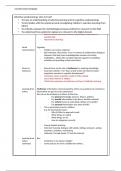
Cornell notes template
Selective social learning: who to trust?
- Perspectives - Piaget saw the child as an “autodidact”
• To have an understanding of selective learning and its cognitive underpinnings
on children’s - Children learn primarily from their own exploration and active
• To be familiar with the interpretation
learning: empirical work investigating
of the children’s
data that they selective
themselves gather learning from
others
focus on - Learning from verbal input likely to be superficial
• To critically evaluate- the
autonomous methodological
Autodidact issues pertinent to research in this field
means self-taught
• To understand how-epistemic
learning Believedvigilance is relevant
childrens learning is toto
bethe digital –domain
superficial echo back what a
parent has told them but whether they actually understood it I
questionable
- Autonomous learning
- Social Vygotsky:
constructivism - Children are curious explorers
- But important ‘discoveries’ occur in context of collaborative dialogues
between child and more knowledgeable members of society
- Scaffolding – adults offer carefully tailored support by modelling
activities and providing verbal instructions
- Focus on - Recent focus on the role of testimony for acquiring knowledge
testimony - Paul Harris (2012): “Isn’t there a limit to the role that first-hand
experience can play in cognitive development?”
- Testimony means assertions made by other people
- Learn about history or religion
- Clarify the importance of testimony and how it facilitates learning
- Learning from Testimony: information communicated by others via assertions (in contrast to
others information we gain by sense experience)
We rely on the testimony of others all the time:
For general knowledge (science, history, politics)
- For specific information (train times, weather outlook)
- For cultural norms & rules (keep clothes on in public)
- For personal information (our date of birth)
- This is particularly true for children..
E.g. for learning the basics:
- Who & What to approach/avoid
- What things are called
- What things are for
- How to categorise correctly
- Formal: Explicit teaching
- Informal: Everyday dialogue with adults, siblings and peers, asking
questions, imitation, overhearing
- Indirectly: Through books, TV and the internet
- Learning from But:
others - Testimony is not always reliable!
continued - Some sources are more credible than others..
, Cornell notes template
- Epistemic • Although trust is beneficial, blind trust is not.
vigilance • “Epistemic vigilance” (Sperber et al., 2010) – to evaluate the credibility
of the information source and the plausibility of claims, and calibrate
trust in testimony accordingly.
• Needed to achieve effective social learning
- Confidence &
benevolence
- Historical
perspective
Reid, Russel, Wittgenstein
- More recent
perspective
Selective social learning: who to trust?
- Perspectives - Piaget saw the child as an “autodidact”
• To have an understanding of selective learning and its cognitive underpinnings
on children’s - Children learn primarily from their own exploration and active
• To be familiar with the interpretation
learning: empirical work investigating
of the children’s
data that they selective
themselves gather learning from
others
focus on - Learning from verbal input likely to be superficial
• To critically evaluate- the
autonomous methodological
Autodidact issues pertinent to research in this field
means self-taught
• To understand how-epistemic
learning Believedvigilance is relevant
childrens learning is toto
bethe digital –domain
superficial echo back what a
parent has told them but whether they actually understood it I
questionable
- Autonomous learning
- Social Vygotsky:
constructivism - Children are curious explorers
- But important ‘discoveries’ occur in context of collaborative dialogues
between child and more knowledgeable members of society
- Scaffolding – adults offer carefully tailored support by modelling
activities and providing verbal instructions
- Focus on - Recent focus on the role of testimony for acquiring knowledge
testimony - Paul Harris (2012): “Isn’t there a limit to the role that first-hand
experience can play in cognitive development?”
- Testimony means assertions made by other people
- Learn about history or religion
- Clarify the importance of testimony and how it facilitates learning
- Learning from Testimony: information communicated by others via assertions (in contrast to
others information we gain by sense experience)
We rely on the testimony of others all the time:
For general knowledge (science, history, politics)
- For specific information (train times, weather outlook)
- For cultural norms & rules (keep clothes on in public)
- For personal information (our date of birth)
- This is particularly true for children..
E.g. for learning the basics:
- Who & What to approach/avoid
- What things are called
- What things are for
- How to categorise correctly
- Formal: Explicit teaching
- Informal: Everyday dialogue with adults, siblings and peers, asking
questions, imitation, overhearing
- Indirectly: Through books, TV and the internet
- Learning from But:
others - Testimony is not always reliable!
continued - Some sources are more credible than others..
, Cornell notes template
- Epistemic • Although trust is beneficial, blind trust is not.
vigilance • “Epistemic vigilance” (Sperber et al., 2010) – to evaluate the credibility
of the information source and the plausibility of claims, and calibrate
trust in testimony accordingly.
• Needed to achieve effective social learning
- Confidence &
benevolence
- Historical
perspective
Reid, Russel, Wittgenstein
- More recent
perspective


