WGU C954 Information Technology Management - UCertify Flashcards
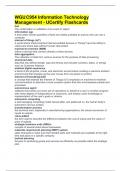
WGU C954 Information Technology Management - UCertify Flashcards fact The confirmation or validation of an event or object information age A time when infinite quantities of facts are widely available to anyone who can use a computer internet of things (IoT) A world where interconnected Internet-enabled devices or "things" have the ability to collect and share data without human intervention machine-to-machine (M2M) refers to devices that connect directly to there devices data aggregation The collection of data from various sources for the purpose of data processing structured data data that has defined length, type and format and includes numbers, dates, or strings such as Customer Address ambient digital experience a blend of the physical, virtual, and electronic environments creating a real-time ambient environment that changes as the user moves form one place to another Internet of Everything (IoE) a concept that extends the Internet of Things (IoT) emphasis on machine-to-machine communications to describe a more complex system that also encompasses people and processes autonomous agent software that carries out some set of operations on behalf of a user or another program with some degree of independence or autonomy, and employ some knowledge or representation of the user's goals or desires autonomic computing a self-managing computing model named after, and patterned on, the human body's autonomic nervous system transformation process the technical core, especially in manufacturing organizations; the actual conversion of inputs to outputs value-added the term used to describe the difference between the cost of inputs and the value of price of outputs strategic business units (SBUs) consists of several stand alone businesses materials requirement planning (MRP) system sales forecasts to make sure that needed parts and materials are available at the right time and place in a specific company tactical planning focuses on producing goods and services as efficiently as possible within the strategic plan operational planning and control (OP&C) deals with the day to day procedures for performing work, including scheduling, inventory, and process management International Organization for Standardization (ISO) a non-governmental organization established in 1947 to promote the development of world standards to facilitate the international exchange of goods and services process quality main goal is to produce defect free products six sigma quality the goal is to detect potential problems to prevent their occurrence and achieve no more than 3.4 defects per million opportunities malcolm baldric national quality awards 1987 U.S. standard awarding quality awards in seven key areas: leadership, strategic planning, customer/market focus, information and analysis, human resources focus, process management, and business results ISO 900 international organization for standardization (1947) requiring a company to determine customer needs, including regulatory and legal requirements including communication arrangements. Other standards involve process control, product testing, storage and delivery. ISO 14000 collection of best practices for managing an organizations impact on the environment CMMI capability maturity integration is a framework for best practices. Does not describe the processes themselves; it describes the characteristics of good processes, thus providing efficient guidelines. inputs land, labor, capital, information transformation conversion process outputs goods & services storage virtualization combines multiple network storage devices so that they appear to be a single storage device network virtualization combines networks by splitting the available bandwidth into independent channels that an be assigned in real time to a specific device server virtualization combines the physical resources, such as servers, processors, and operating systems, from the applications system virtualization the ability to present the resources of a single computer as if it is a collation of separate computers (virtual machines) multi-tenancy a single instance of a system serves multiple customers cloud fabric controller an individual who monitors and provisions cloud resources similar to a server administrator at an individual company cloud fabric the software that makes the benefits of cloud computing possible hybrid cloud includes two or more private, public, or community clouds, but each cloud remains separate and is only linked by technology that enables data and application portability cloud bursting when a company uses its own computing infrastructure for normal usage and accesses the cloud when it needs to sale for high/peak load requirements, ensuring a sudden spike in usage does not result in poor performance or system crashes utility computing offers a pay-per-use revenue model similar to a metered service such as gas or electricity Infrastructure as a Service (IaaS) delivers hardware networking capabilities, including use of servers, networking, and storage, over the cloud using a pay-per-use revenue model Disaster Recovery as a Device (DRaaS) Offers backup services that use cloud resources to protect applications and data form disruption caused by disaster Data as a Service (DaaS) facilitates the accessibility of business-critical data in a timely, secure, and affordable manner Moore's Law refers to the computer chip performance per dollar doubling every 18 months upcycle reuses or refurbishes waste and creates new product governance method or system of government for management or control information systems audit and control association (USACA) a set of guidelines and supporting tools for IT governance that is accepted worldwide and generally used by auditors and companies as a way to integrate technology to implement controls and meet specific business objectives internet technology infrastructure library (ITIL) a framework provided by the government of the UK that offers eight sets of management procedures committee of sponsoring organizations (COSO) key for evaluating internal controls such as human resources, logistics, IT, risk, legal, marketing and sales, operations, financial functions, procurement, and reporting capability maturity model integration (CMMI) method a process improvement approach that contains 22 process areas enterprise architecture a process for how an organization will build, deploy, use, and share its data, processes, and MIS assets deperimeterization occurs when an organization moves employees outside its firewall, a growing movement to change the way corporations address technology security transborder data flows (TDF) when business data flows across international boundaries over the telecommunications networks of global information systems carbon emission includes the carbon dioxide & carbon monoxide in the atmosphere produced by processes and systems grid computing a collection of computers coordinated to solve a common problem smart grid delivers electricity using two-way digital technology virtualization the creation of a virtual (rather than actual) version of computing resources, such as an operating system, a server, a storage device, or other network resources data center a facility used to house management information systems and associated components, such as telecommunications and storage systems public cloud promotes massive, global, industrywide applications offered to the general public private cloud serves only one customer or organization and can be located on the customer's premises or off premises community cloud serves a specific community with common business models, security requirements, and compliance considerations big data as a service (BDaaS) offers cloud-based big data service to help organizations analyze massive amounts of data to solve business dilemmas child online protection act (COPA) a law that protects minors from accessing inappropriate material on the internet threat an act or object that poses a danger to assets competitive click-fraud a computer crime where a competitor or disgruntled employee increases a company's search advertising costs by repeatedlyclickingon the advertiser's link fair information practices a general term for a set of standards governing the collection and use of personal data and addressing issues of privacy and accuracy acceptable use policy (AUP) a policy that a user must agree to follow in order to be provided access to a network or to the internet nonrepudiation contractual stipulation to ensure that business participants do not deny (repudiate) their online actions mail bomb a massive amount email to a specific person or system that can cause that user's server to stop functioning teergrubbing anti-spamming approach where the receiving computer launches a return attack against the spammer, sending email messages back to the computer that originated the suspected spam workplace mis monitoring tracks people's activities by such measures as number of keystrokes, error rate, and number of transactions processed mis infrastructure includes the plans for how a firm will build, deploy, use, and share its data, processes, and mis assets client computer that is designed yo request information from a server server computer that is dedicated to providing information in response to external requests enterprise architect (EA) person grounded in technology, fluent in business, a patient diplomat, ad provides the important bridge between IT and the business information mis infrastructure identifies where and how important information, such as customer records, is maintained and secured agile mis infrastructure includes the hardware, software, and telecommunications equipment that, when combined, provides the underlying foundation to support the organization's goals sustainable mis infrastructure identifies ways that a company can grow in terms of computing resources while simultaneously becoming less dependent on the hardware and energy consumption fault tolerance the ability for a system to respond to unexpected failures or system crashes as the backup system immediately and automatically takes over with no loss of service failover occurs when redundant storage server offers an exact replica of the real time data, and if the primary server crashes, the users are automatically directed to the secondary server or backup server failback occurs when the privy machine recovers and resumes operations, taking over from the secondary server hot site a separate and fully equipped facility where the company can move immediately after a disaster and resume business cold site a separate facility that does not have any computer equipment, but is a place where employees can move after a disaster warm site a separate facility with computer equipment that requires installation and configuration
Written for
- Institution
- Western Governors University
- Module
- WGU C954 Information Technology Management
Document information
- Uploaded on
- January 17, 2024
- Number of pages
- 32
- Written in
- 2023/2024
- Type
- Exam (elaborations)
- Contains
- Questions & answers
Subjects
-
wgu c954 information technology management ucert

Also available in package deal