Biophysics Techniques - Fluorescence
Conventional Fluorescent Microscopy
What is it? How does it work?
An optical microscope that uses fluorescence to study the properties of organic substances.
1. The sample is labelled with a fluorescent dye
2. The specimen is illuminated with a specific wavelength of light
3. This is absorbed by fluorophores, which emit a lower wavelength of light
4. The illumination wavelength is separated from the emitted wavelength using a spectral
emission filter
Resolution: higher than 250 nm
Set Up and Results:
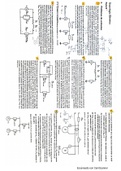
Endothelial cells under the Epifluorescent imaging of
the three components in a
microscope
dividing human cancer cell
Schematic of a fluorescence microscope
Pros Cons
Can be used on living samples Living cells can be suceptible to the phototoxic
effect
Does not have limitations due to the wavelength Photobleaching can limit the time that a sample
of light can be viewed for
You do not lose the sample after imaging Only allows observation of specific structures
labelled for fluorescence
What is it used for?
• Often used to image specific features of small specimens such as microbes
• Can be used to enhance 3-D features at small scales
• Used to image protein expression and activity in living cells
• Used for imagine cell structure, genetic material, and particular cells in a larger population
, Biophysics Techniques - Fluorescence
Confocal Fluorescent Microscopy
What is it? How does it work?
Confocal fluorescent microscopy introduces the use of a pinhole into fluorescent microscopy in
order to improve the resolution of the image
1. Preparation and measurement is carried out as in typical fluorescent microscopy
2. A pinhole is placed in front of the detector
3. The pinhole limits light input, so it is only collected from the focal point - light emitted above
and below this point is blocked
Set Up:
Schematic of confocal fluorescence microscope.
Pros Cons
Enhances fluorescent imaging Intensity is lessened, so long exposure times are
needed
Allows detection down to the single molecular To get 3D images, multiple images in the z
level direction must be collected and stacked on top
of each other to reconstruct the image
Spinning-disk confocal instruments can
greatly speed up image capture
Conventional Fluorescent Microscopy
What is it? How does it work?
An optical microscope that uses fluorescence to study the properties of organic substances.
1. The sample is labelled with a fluorescent dye
2. The specimen is illuminated with a specific wavelength of light
3. This is absorbed by fluorophores, which emit a lower wavelength of light
4. The illumination wavelength is separated from the emitted wavelength using a spectral
emission filter
Resolution: higher than 250 nm
Set Up and Results:
Endothelial cells under the Epifluorescent imaging of
the three components in a
microscope
dividing human cancer cell
Schematic of a fluorescence microscope
Pros Cons
Can be used on living samples Living cells can be suceptible to the phototoxic
effect
Does not have limitations due to the wavelength Photobleaching can limit the time that a sample
of light can be viewed for
You do not lose the sample after imaging Only allows observation of specific structures
labelled for fluorescence
What is it used for?
• Often used to image specific features of small specimens such as microbes
• Can be used to enhance 3-D features at small scales
• Used to image protein expression and activity in living cells
• Used for imagine cell structure, genetic material, and particular cells in a larger population
, Biophysics Techniques - Fluorescence
Confocal Fluorescent Microscopy
What is it? How does it work?
Confocal fluorescent microscopy introduces the use of a pinhole into fluorescent microscopy in
order to improve the resolution of the image
1. Preparation and measurement is carried out as in typical fluorescent microscopy
2. A pinhole is placed in front of the detector
3. The pinhole limits light input, so it is only collected from the focal point - light emitted above
and below this point is blocked
Set Up:
Schematic of confocal fluorescence microscope.
Pros Cons
Enhances fluorescent imaging Intensity is lessened, so long exposure times are
needed
Allows detection down to the single molecular To get 3D images, multiple images in the z
level direction must be collected and stacked on top
of each other to reconstruct the image
Spinning-disk confocal instruments can
greatly speed up image capture