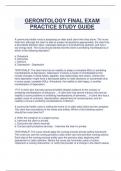
GERONTOLOGY FINAL EXAM PRACTICE STUDY GUIDE
A community health nurse is assessing an older adult client who lives alone. The nurse finds that, although the client is able to answer all questions appropriately, the client has a decreased attention span, expresses feelings of overwhelming sadness, and has a low energy level. The nurse should identify that the client is exhibiting manifestations of which of the following disorders? a. Delusions b. Dementia c. Delirium d. Depression - Depression *RATIONALE* The client who has an inability to sleep or complete ADLs is exhibiting manifestations of depression. Depression involves a cluster of manifestations that include changes in sleep habits, appetite, and relationships with others. Clients who have depression might have a decreased ability to make decisions or concentrate and, in some cases, complete ADLs. Anhedonia, the inability to feel happy, is another manifestation of depression. *FYI* A client who has false personal beliefs despite evidence to the contrary is exhibiting manifestations of delusions ... A client who has severe memory loss and an inability to solve problems is exhibiting manifestations of dementia ... A client who has a sudden onset of confusion, disorientation, altered level of consciousness, and an inability to focus is exhibiting manifestations of delirium. A community health nurse is visiting the home of an older adult client and her caregiver. The client has excoriations to her wrists and ankles. Which of the following actions should the nurse take first? a. Refer the caregiver to a support group. b. Interview the client in private. c. Document the client's wounds. d. Contact adult protective services. - Interview the client in private. *RATIONALE* The nurse should apply the nursing process priority-setting framework. The nurse can use the nursing process to plan client care and prioritize nursing actions. Each step of the nursing process builds upon the previous step, beginning with assessment or data collection. Before the nurse can formulate a plan of action, implement a nursing intervention, or notify the provider of a change in the client's status, she must first collect adequate data from the client. Assessing or collecting additional data will provide the nurse with knowledge to make an appropriate decision. The nurse should interview the client in private to gain information about possible abuse because the client might be reluctant to talk with the caregiver present. A home-health nurse is caring for a client who has cancer and is using a fentanyl transdermal patch for pain control. Which of the following actions should the nurse take when caring for this client? a. Avoid using a heating pad on the area with the patch. b. To decrease the dose, cut the patch in half. c. Dispose of the used patch by placing it in the trash can. d. Assess the client for urinary retention every 8 hr. - Avoid using a heating pad on the area with the patch. *RATIONALE* Applying heat over the site of the transdermal patch will increase the rate of absorption of the opioid medication and might cause respiratory depression. *FYI* The nurse should dispose of a used patch by folding it with the adhesive edges together and placing it in a tamper-proof receptacle ... The nurse should assess the client using a fentanyl patch for urinary retention every 4 to 6 hr. A nurse at a long-term care facility is planning care for a client who has Alzheimer's disease and wanders at night. Which of the following interventions should the nurse include in the plan? a. Place the client in wrist restraints at night. b. Request a prescription for a psychotropic medication. c. Assign the client to a room closer to the nurse's station. d. Keep the television on at night. - Assign the client to a room closer to the nurse's station. *RATIONALE* The nurse should place the client who wanders in a room that allows for close observation. The nurse should provide clients who wander a safe place to walk and supervision when the client is ambulating. *FYI* The nurse should avoid the use of excessive light and sound stimulation for the client who has Alzheimer's disease; this can cause further agitation and confusion for the client. A nurse at a long-term care facility is planning care for an older adult client who has dementia. Which of the following interventions should the nurse include in the plan? a. Vary the staff m
Written for
- Institution
- GERONTOLOGY
- Module
- GERONTOLOGY
Document information
- Uploaded on
- January 1, 2024
- Number of pages
- 18
- Written in
- 2023/2024
- Type
- Exam (elaborations)
- Contains
- Questions & answers
Subjects
-
gerontology final exam practice study guide
-
a community health nurse is assessing an older adu
-
a nurse at a long term care facility is teaching a

Also available in package deal