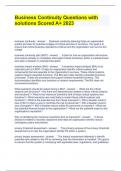
Business Continuity Questions with solutions Scored A+ 2023
Business Continuity Questions with solutions Scored A+ 2023 business continuity Business continuity planning helps an organization predict and plan for potential outages of critical services or functions. The goal is to ensure that critical business operations continue and the organization can survive the outage. business continuity plan (BCP) A plan for how an organization will recover and restore partially or completely interrupted critical function(s) within a predetermined time after a disaster or extended disruption business impact analysis (BIA) A business impact analysis (BIA) is an important part of a BCP. It helps an organization identify critical systems and components that are essential to the organization's success. These critical systems support mission-essential functions. The BIA also helps identify vulnerable business processes. These are processes that support mission-essential functions. This documentation identifies core business or mission requirements. The BIA does not recommend solutions. What questions should be asked during a BIA? What are the critical systems and functions? • Are there any dependencies related to these critical systems and functions? • What is the maximum downtime limit of these critical systems and functions? • What scenarios are most likely to impact these critical systems and functions? • What is the potential loss from these scenarios? • Will a disaster result in loss of life? Is there a way to minimize the risk to personnel? • Will a disaster result in loss of property? • Will a disaster reduce safety for personnel or property? • What are the potential financial losses to the organization? • What are the potential losses to the organization's reputation? Why is identifying the maximum downtime limit so important? It drives decisions related to recovery objectives and helps an organization identify various contingency plans and policies. privacy threshold assessment The primary purpose of the privacy threshold assessment is to help the organization identify PII within a system. privacy impact assessment The impact assessment attempts to identify potential risks related to the PII by reviewing how the information is handled. The goal is to ensure that the system is complying with applicable laws, regulations, and guidelines. Recovery Time Objective (RTO) The recovery time objective (RTO) identifies the maximum amount of time it can take to restore a system after an outage. Recovery Point Objective (RPO) A recovery point objective (RPO) identifies a point in time where data loss is acceptable. Mean Time Between Failures (MTBF) The MTBF identifies the average (the arithmetic mean) time between failures. Higher MTBF numbers indicate a higher reliability of a product or system. mean time to recover (MTTR) The mean time to recover (MTTR) identifies the average (the arithmetic mean) time it takes to restore a failed system. continuity of operations planning Continuity of operations planning focuses on restoring mission-essential functions at a recovery site after a critical outage. failover Failover is the process of moving mission-essential functions to the alternate site. hot site A hot site would be up and operational 24 hours a day, seven days a week and would be able to take over functionality from the primary site quickly after a primary site failure. It would include all the equipment, software, and communication capabilities of the primary site, and all the data would be up to date. cold site A cold site requires power and connectivity but not much else. Generally, if it has a roof, electricity, running water, and Internet access, you're good to go. The organization brings all the equipment, software, and data to the site when it activates it. warm site The warm site provides a compromise that an organization can tailor to meet its needs. For example, an organization can place all the necessary hardware at the warm site location but not include up-to-date data. If a disaster occurs, the organization can copy the data to the warm site and take over operations. This is only one example, but there are many different possibilities of warm site configurations. mobile site A mobile site is a self-contained transportable unit with all the equipment needed for specific requirements. mirrored site Mirrored sites are identical to the primary location and provide 100 percent availability. They use real-time transfers to send modifications from the primary location to the mirrored site. Although a hot site can be up and operational within an hour, the mirrored site is always up and operational. What is the best order of operations for returning operations to the primary site from a disaster recovery site? As a best practice, organizations return the least critical functions to the primary site first. Remember, the critical functions are operational at the alternate site and can stay there as long as necessary. If a site has just gone through a disaster, it's very likely that there are still some unknown problems. By moving the least critical functions first, undiscovered problems will appear and can be resolved without significantly affecting mission-essential functions. disaster recovery Disaster recovery is a part of an overall business continuity plan. Often, the organization will use the business impact analysis to identify the critical systems and components and then develop disaster recovery strategies and disaster recovery plans (DRPs) to address the systems hosting these functions. In some cases, an organization will have multiple DRPs within a BCP, and in other cases, the organization will have a single DRP. What are the phases of a disaster recovery plan? Activate the disaster recovery plan. Implement contingencies. If the recovery plan requires implementation of an alternate site, critical functions are moved to these sites. If the disaster destroyed on-site backups, this step retrieves the off-site backups from the off-site location. • Recover critical systems. After the disaster has passed, the organization begins recovering critical systems. This also includes reviewing change management documentation to ensure that recovered systems include approved changes. • Test recovered systems. Before bringing systems online, administrators test and verify them. systems online, administrators test and verify them.
Written for
- Institution
- BCP
- Module
- BCP
Document information
- Uploaded on
- December 19, 2023
- Number of pages
- 4
- Written in
- 2023/2024
- Type
- Exam (elaborations)
- Contains
- Questions & answers
Subjects
-
business continuity questions with solutions score
-
business continuity business continuity planning h
-
business impact analysis bia a business impact a
-
why is identifying the maximum downtime limit so

Also available in package deal