Abstract Webber chapter 1-6
Containment strategies
Chapter 1
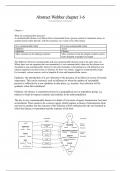
What are communicable diseases?
A communicable disease is an illness that is transmitted from a person, animal or inanimate source to
another person either directly, with the assistance of a vector or by other means.
It is communicable when It is non-commincable when
Endemic Acute
Epidemic Chronic
More common in developing countries More common in the developed countries and is
more frequent as people live longer
The difference between communicable and non-communicable diseases used to be quite clear-cut.
Where there was an organism that was transmitted, it was communicable; otherwise the disease was
classified as non-communicable. However, this strict boundary is becoming less well defined as new
suspect organisms are discovered, or diseases, by their very nature, suggest a communicable origin.
For example, various cancers, such as hepatitis B virus and hepatocellular cancer
Epidemic- the introduction of a new infection or the presence of an illness in excess of normal
expectancy. This can be seasonal, such as influenza or when the number of susceptible
persons is sufficient for a new epidemic to take place e.g. measles. Any infection will be
epidemic when first introduced.
Endemic- the disease is constantly present in a geographical area or population group, e.g.
malaria is found in tropical countries and endemic in the adult population.
The key to any communicable disease is to think of it in terms of agent, transmission, host and
environment. There needs to be a causive agent, which requires a means of transmission from
one host to another, but the outcome of the infection will be influenced by the environment in
which the disease is transmitted and the response of the host.
, 1. The agent
Is the cause of the disease. The agent can be an organism (virus, prion, bacteria etc) or a
physical or chemical agent (toxin or poson). If it is an organism, the agent needs to multiply,
find a means of transmission and surviving.
- Multiplication:
Seksual: great scope of variety and variations occur, in sexual reproducing
organisms’ certain individuals will succeed in invading the host while others
will not and both male and female adults must meet before reproduction.
Aseksual: succession of exact or almost exact replicas. the strain of the
organism is either successful or unsuccessfully in invading the host. For the
reproduction only one organism of the asexuals parasite requires to be
transmitted.
- Survival: parasitic agents survive by finding a suitable host within a certain time,
methods to survive or improve their chances
Reservoirs: when the parasite attack a new species, the host attempts to
eliminate. Adaptation occurs were de adaptability of the parasite increases and
the host acts as a new reservoir in which the parasite can colonize different
species and attack new hosts. it can be humans, animals, vectors or inanimate
environment. It is a strange irony that it may be preferable in some cases to
actually introduce parasites to combat some allergic reactions
Persistent: development of special stages that resist destruction in adverse
environment (cysts and spores for example). Destruction of these phases is
possible due to antiseptics or sufficient heat.
Latency: the production of a developmental stage in the environment that is not
infective for a new host, allows the parasite to wait for suitable conditions
(inactive form)
Main objective: treatment and control. If a treatment is successful in destroying an asexually
reproducing organism, it will also be successful against all individuals (unless a mutation
occurs). in contrast, with sexual treatment some individuals will succumb to treatment, while
others will not. However, having two sexes can be a disadvantage for the organism in that
methods of control can be devised to attack only one of the sexes or prevent them from
meeting
The severity of an illness caused by an agent depends on two thing 1) virulence and 2)
toxicity. For each infectious agent, a minimum number of organisms infective dose is required
to overcome the defenses of the host and cause the disease. in most infections, once this
number is surpassed, the severity of the disease is the same whether a few or large number of
organisms is introduced. While in others, there is a correlation between dose and severity of
the illness. Infections with a low infective dose can spread person to person but when a high
dose is needed, such as cholera, the improvement of water quality can be beneficial to
prevent outbreaks.
2. Transmission
Communicable disease falls into a number of different transmissions patterns.
Direct Autoinfection (enterobius)
Human reservoir with intermediate host Intermediate host snail (schistosomiasis)
Animals as intermediate host or reservoir Animals intermediate host (taenia
Containment strategies
Chapter 1
What are communicable diseases?
A communicable disease is an illness that is transmitted from a person, animal or inanimate source to
another person either directly, with the assistance of a vector or by other means.
It is communicable when It is non-commincable when
Endemic Acute
Epidemic Chronic
More common in developing countries More common in the developed countries and is
more frequent as people live longer
The difference between communicable and non-communicable diseases used to be quite clear-cut.
Where there was an organism that was transmitted, it was communicable; otherwise the disease was
classified as non-communicable. However, this strict boundary is becoming less well defined as new
suspect organisms are discovered, or diseases, by their very nature, suggest a communicable origin.
For example, various cancers, such as hepatitis B virus and hepatocellular cancer
Epidemic- the introduction of a new infection or the presence of an illness in excess of normal
expectancy. This can be seasonal, such as influenza or when the number of susceptible
persons is sufficient for a new epidemic to take place e.g. measles. Any infection will be
epidemic when first introduced.
Endemic- the disease is constantly present in a geographical area or population group, e.g.
malaria is found in tropical countries and endemic in the adult population.
The key to any communicable disease is to think of it in terms of agent, transmission, host and
environment. There needs to be a causive agent, which requires a means of transmission from
one host to another, but the outcome of the infection will be influenced by the environment in
which the disease is transmitted and the response of the host.
, 1. The agent
Is the cause of the disease. The agent can be an organism (virus, prion, bacteria etc) or a
physical or chemical agent (toxin or poson). If it is an organism, the agent needs to multiply,
find a means of transmission and surviving.
- Multiplication:
Seksual: great scope of variety and variations occur, in sexual reproducing
organisms’ certain individuals will succeed in invading the host while others
will not and both male and female adults must meet before reproduction.
Aseksual: succession of exact or almost exact replicas. the strain of the
organism is either successful or unsuccessfully in invading the host. For the
reproduction only one organism of the asexuals parasite requires to be
transmitted.
- Survival: parasitic agents survive by finding a suitable host within a certain time,
methods to survive or improve their chances
Reservoirs: when the parasite attack a new species, the host attempts to
eliminate. Adaptation occurs were de adaptability of the parasite increases and
the host acts as a new reservoir in which the parasite can colonize different
species and attack new hosts. it can be humans, animals, vectors or inanimate
environment. It is a strange irony that it may be preferable in some cases to
actually introduce parasites to combat some allergic reactions
Persistent: development of special stages that resist destruction in adverse
environment (cysts and spores for example). Destruction of these phases is
possible due to antiseptics or sufficient heat.
Latency: the production of a developmental stage in the environment that is not
infective for a new host, allows the parasite to wait for suitable conditions
(inactive form)
Main objective: treatment and control. If a treatment is successful in destroying an asexually
reproducing organism, it will also be successful against all individuals (unless a mutation
occurs). in contrast, with sexual treatment some individuals will succumb to treatment, while
others will not. However, having two sexes can be a disadvantage for the organism in that
methods of control can be devised to attack only one of the sexes or prevent them from
meeting
The severity of an illness caused by an agent depends on two thing 1) virulence and 2)
toxicity. For each infectious agent, a minimum number of organisms infective dose is required
to overcome the defenses of the host and cause the disease. in most infections, once this
number is surpassed, the severity of the disease is the same whether a few or large number of
organisms is introduced. While in others, there is a correlation between dose and severity of
the illness. Infections with a low infective dose can spread person to person but when a high
dose is needed, such as cholera, the improvement of water quality can be beneficial to
prevent outbreaks.
2. Transmission
Communicable disease falls into a number of different transmissions patterns.
Direct Autoinfection (enterobius)
Human reservoir with intermediate host Intermediate host snail (schistosomiasis)
Animals as intermediate host or reservoir Animals intermediate host (taenia