

31/10/23
PSY4033 – week 6 Bruce notes
Objectives:
1. Understand the basic principles of the Humanistic approach.
2. Understand some of the skills and techniques used in humanistic counselling.
1.
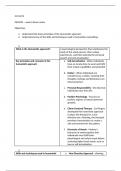
What is the Humanistic approach? A psychological perspective that emphasizes the
study of the whole person, their unique
experiences, and their potential for personal
growth and self-actualization.
Key principles and concepts of the a. Self-Actualization - When individuals
humanistic approach have an innate drive to excel and fulfil
their unique capabilities and potential
b. Holism - When individuals are
considered as a whole, meaning their
thoughts, feelings and behaviours are
interconnected.
c. Personal Responsibility - the idea that
individuals have free will.
d. Positive Psychology - Focuses on
positive aspects of nature (personal
growth).
e. Client-Centered Therapy - Carl Rogers
developed this humanistic approach
to place the therapist in a non-
directive role. Meaning, the therapist
provides characteristics to create a
safe environment for the patient.
f. Hierarchy of Needs - Maslow's
hierarchy of needs explains that
individuals must fulfil basic
physiological and safety needs before
achieving higher-level needs, such as
love or self-actualization.
2.
Skills and techniques used in humanistic a. Non-Directive Approach - allowing
PSY4033 – week 6 Bruce notes
Objectives:
1. Understand the basic principles of the Humanistic approach.
2. Understand some of the skills and techniques used in humanistic counselling.
1.
What is the Humanistic approach? A psychological perspective that emphasizes the
study of the whole person, their unique
experiences, and their potential for personal
growth and self-actualization.
Key principles and concepts of the a. Self-Actualization - When individuals
humanistic approach have an innate drive to excel and fulfil
their unique capabilities and potential
b. Holism - When individuals are
considered as a whole, meaning their
thoughts, feelings and behaviours are
interconnected.
c. Personal Responsibility - the idea that
individuals have free will.
d. Positive Psychology - Focuses on
positive aspects of nature (personal
growth).
e. Client-Centered Therapy - Carl Rogers
developed this humanistic approach
to place the therapist in a non-
directive role. Meaning, the therapist
provides characteristics to create a
safe environment for the patient.
f. Hierarchy of Needs - Maslow's
hierarchy of needs explains that
individuals must fulfil basic
physiological and safety needs before
achieving higher-level needs, such as
love or self-actualization.
2.
Skills and techniques used in humanistic a. Non-Directive Approach - allowing


