

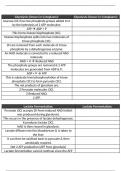
Glycolysis (Occurs in Cytoplasm): Glycolysis (Occurs in Cytoplasm):
Glucose (6C) has two phosphate groups added to it
by the hydrolysis of 2 ATP molecules:
ATP ADP + P
This forms hexose bisphosphate (6C).
Hexose bisphosphate splits into two molecules of
triose phosphate (3C).
2H are removed from each molecule of triose
phosphate by a dehydrogenase enzyme.
An NAD molecule is converted to a reduced NAD
molecule:
NAD + H Reduced NAD
The phosphate groups are removed & 2 ATP
molecules are generated from ADP & P:
ADP + P ATP
This is substrate level phosphorylation of triose
phosphate (3C) to form pyruvate (3C).
The net products of glycolysis are:
2 Pyruvate molecules (3C).
2 Reduced NAD.
2 ATP.
Lactate Fermentation: Lactate Fermentation:
Pyruvate (3C) accepts 2H from reduced NAD (which
was produced during glycolysis).
This occurs in the presence of lactate dehydrogenase.
It produces lactate (3C).
NAD is then reused in glycolysis.
Lactate diffuses into the bloodstream & is taken to
the liver.
It can then be oxidised back to pyruvate & then
aerobically respired.
Net 2 ATP production (ATP from glycolysis)
Lactate fermentation cannot continue since the ATP
Glucose (6C) has two phosphate groups added to it
by the hydrolysis of 2 ATP molecules:
ATP ADP + P
This forms hexose bisphosphate (6C).
Hexose bisphosphate splits into two molecules of
triose phosphate (3C).
2H are removed from each molecule of triose
phosphate by a dehydrogenase enzyme.
An NAD molecule is converted to a reduced NAD
molecule:
NAD + H Reduced NAD
The phosphate groups are removed & 2 ATP
molecules are generated from ADP & P:
ADP + P ATP
This is substrate level phosphorylation of triose
phosphate (3C) to form pyruvate (3C).
The net products of glycolysis are:
2 Pyruvate molecules (3C).
2 Reduced NAD.
2 ATP.
Lactate Fermentation: Lactate Fermentation:
Pyruvate (3C) accepts 2H from reduced NAD (which
was produced during glycolysis).
This occurs in the presence of lactate dehydrogenase.
It produces lactate (3C).
NAD is then reused in glycolysis.
Lactate diffuses into the bloodstream & is taken to
the liver.
It can then be oxidised back to pyruvate & then
aerobically respired.
Net 2 ATP production (ATP from glycolysis)
Lactate fermentation cannot continue since the ATP


