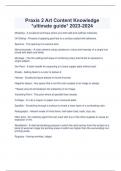
Praxis 2 Art Content Knowledge *ultimate guide*
Modeling - A sculpture technique where you both add and subtract materials. Oil Gliding - Process of applying gold leaf to a surface coated with adhesive. Aperture - The opening of a camera lens. Monochromatic - A color scheme using variations in value and intensity of a single hue mixed with black and white. Montage - The film editing technique of combining many brief shots to represent a single subject. Dry Point - A steel needle for engraving on a bare copper plate without acid. Shade - Adding black to a color to darken it. Haniwa - Sculptured figure placed on burial mounds. Negative Space - Any space that is not the main subject of an image or design. **Space around and between the subject(s) of an image. Vanishing Point - The point where all parallel lines recede. Frottage - To rub a crayon on paper over a textured plate. Sgraffito - Scratching through a surface to reveal a lower layer of a contrasting color. Robography - Artwork made of trivial items: half eaten food, trash, toys, etc. Nitric Acid - An oxidizing agent that can react with any of the other supplies to cause an explosion or fire. Woodblock - A relief printmaking process in which the artist carves from the surface of a block of wood an image the printing areas of which are higher than the surrounding non-printing areas. Rugosity - Having wrinkles, ridged. Baren - A flat; round Japanese device that is used in printmaking in lieu of a mechanical press. *used to rub the relief onto the paper evenly. Art Deco - Applied design from the 1920s and 1930s derived from French, African, Aztec, and Chinese motifs. Masonry - Creating pattern using stone held together by mortar. Aquatint - Etching process to obtain shaded areas in black, white, or color prints. Greenware - When clay is hard, but not yet fired. Flange - Used to strengthen an object, hold it in place, or attach it to another object. Parsemage - Refers to the process of collecting dust from charcoal or chalk that has been sprinkled on the water's surface by skimming a piece of paper under it. Gild - to cover a surface with a thin layer of gold. Acanthus - An ambiguous flower and a style of plant used for the caps of the Corinthian columns. Value - The amount of light reflected by a hue, darkness or lightness of a color. Sulfur - harmful substance printmaking plastalina contains. Pastels - pigment and a binder usually cellulose based, pressed into sticks. Encaustic - Greek word meaning "to heat or burn in". Heat is used throughout the process. The medium is melted and applied with a brush or any tool. Each layer is then reheated to fuse it to the previous layer. Use of colored wax for painting, often done on walls. Neoclassical - Moticello (primary plantation of Thomas Jefferson, on the nickel) was built in what architectural style? Formalism - The study of art by analyzing and comparing form and style. *the way objects are made and their purely visual aspects. Bisque - Clay that has been fired once, halfway, but NOT glazed. Classical Art - peak of Greek art and architecture, idealized figures exemplify order and harmony. Fibula - pin or broach Hierarchical Scale - Use of unnatural proportions to show importance of figures. Representationalism - The doctrine that the immediate object of knowledge is an idea in the mind from external object which is the occasion of perception. Soldering - A process where 2 pieces of metal are joined by melting and flowing a filler metal into the joint. Cloisonne' - Metalwork where fine metal wire separates colors on an enamel surface. *A style of enamel decoration in which the enamel is applied and fired in raised cells. Expressionism - An artistic style that departs from the conventions of realism and naturalism and seeks to convey inner experience by distorting rather than directly representing natural images. Recto and Verso - in terms of manuscript, the front and rear sides of paper. Dry Masonry - Patterning with stones, but with NO mortar. Isometric perspective - The use of parallel lines to draw *all dimensions parallel to the three principal spatial axes are shown in their TRUE proportions. Deconstructivsim - an architectural movement or style influenced by deconstruction that encourages radical freedom of form and the open manifestation of complexity in a building rather than the strict attention to functional concerns and conventional design elements. Crazing - surface cracks on oil paintings due to unequal drying times. Iconography - The symbolic meaning of assigns, subjects, and images. High Relief - Sculpture where more than 50% of depth is shown and there are some undercut areas. Cantilever - Architectural technique where a beam or slab is extended far beyond a support column or wall.
Written for
- Institution
- Praxis 2 Art
- Module
- Praxis 2 Art
Document information
- Uploaded on
- December 5, 2023
- Number of pages
- 25
- Written in
- 2023/2024
- Type
- Exam (elaborations)
- Contains
- Questions & answers
Subjects
-
praxis 2 art
-
praxis 2 art content knowledge ultimate guide
-
praxis 2 art content knowledge

Also available in package deal