
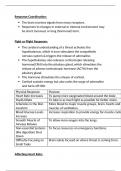
Response Coordination:
The brain receives signals from many receptors.
Responses to changes in external or internal environment may
be short (nervous) or long (hormonal) term.
Fight or Flight Response:
The cerebral understanding of a threat activates the
hypothalamus, which in turn stimulates the sympathetic
nervous system & triggers the release of adrenaline.
The hypothalamus also releases corticotropin releasing
hormone(CRH) into the pituitary gland, which stimulates the
release of adreno-corticotropic hormone (ACTH) from the
pituitary gland.
This hormone stimulates the release of cortisol.
Cortisol sustains energy but also curbs the surge of adrenaline
and turns off CRH.
Physical Response Purpose
Heart Rate Increases To pump more oxygenated blood around the body.
Pupils Dilate To take in as much light as possible for better vision.
Arterioles in the Skin More blood to major muscle groups, brain, hearts and
Constrict muscles of ventilation.
Blood Glucose Levels Increase respiration to provide energy for muscle contr
Increase
Smooth Muscle of To allow more oxygen into the lungs.
Airways Relaxes
Non-essential Systems To focus resources on emergency functions.
(like digestion) Shut
Down
Difficulty Focusing on Brain solely focused on where threat is coming from.
Small Tasks
Affecting Heart Rate:
The brain receives signals from many receptors.
Responses to changes in external or internal environment may
be short (nervous) or long (hormonal) term.
Fight or Flight Response:
The cerebral understanding of a threat activates the
hypothalamus, which in turn stimulates the sympathetic
nervous system & triggers the release of adrenaline.
The hypothalamus also releases corticotropin releasing
hormone(CRH) into the pituitary gland, which stimulates the
release of adreno-corticotropic hormone (ACTH) from the
pituitary gland.
This hormone stimulates the release of cortisol.
Cortisol sustains energy but also curbs the surge of adrenaline
and turns off CRH.
Physical Response Purpose
Heart Rate Increases To pump more oxygenated blood around the body.
Pupils Dilate To take in as much light as possible for better vision.
Arterioles in the Skin More blood to major muscle groups, brain, hearts and
Constrict muscles of ventilation.
Blood Glucose Levels Increase respiration to provide energy for muscle contr
Increase
Smooth Muscle of To allow more oxygen into the lungs.
Airways Relaxes
Non-essential Systems To focus resources on emergency functions.
(like digestion) Shut
Down
Difficulty Focusing on Brain solely focused on where threat is coming from.
Small Tasks
Affecting Heart Rate:


