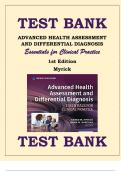
Test Bank to Accompany Life The Science of Biology, 10th Edition Sadava, Hillis, Heller, Berenbaum
Test Bank to Accompany Life The Science of Biology, 10th Edition Sadava, Hillis, Heller, BerenbaumTable of Contents Chapter 1: Studying Life ................................................................................................................. 1 STUDY GUIDE QUESTIONS .................................................................................................... 60 Chapter 2: Small Molecules and the Chemistry of Life ........................................................ 67 STUDY GUIDE QUESTIONS .................................................................................................. 127 Chapter 3: Proteins, Carbohydrates, and Lipids ................................................................... 133 STUDY GUIDE QUESTIONS .................................................................................................. 192 Chapter 4: Nucleic Acids and the Origin of Life .................................................................. 199 STUDY GUIDE QUESTIONS ................................................................................................. 260 Chapter 5: Cells: The Working Units of Life ........................................................................ 268 STUDY GUIDE QUESTIONS ................................................................................................. 288 Chapter 6: Cell Membranes ...................................................................................................... 295 STUDY GUIDE QUESTIONS ................................................................................................. 320 Chapter 7: Cell Communication and Multicellularity ........................................................... 328 STUDY GUIDE QUESTIONS ................................................................................................. 390 Chapter 8: Energy, Enzymes, and Metabolism ..................................................................... 399 STUDY GUIDE QUESTIONS .................................................................................................. 451 Chapter 9: Pathways That Harvest Chemical Energy ......................................................... 459 STUDY GUIDE QUESTIONS .................................................................................................. 510 Chapter 10: Photosynthesis: Energy from Sunlight ............................................................. 515 STUDY GUIDE QUESTIONS ................................................................................................. 572 Test Bank to accompany Life: The Science of Biology, Tenth Edition Sadava • Hillis • Heller • Berenbaum Chapter 1: Studying Life TEST FILE QUESTIONS (By Richard Shingles) Multiple Choice 1. The basic structural and physiological unit of all living organisms is the a. aggregate. 1 | P a g eb. organelle. c. organism. d. membrane. e. cell. Answer: e Textbook Reference: 1.1 What Is Biology? Bloom’s Category: 1. Remembering 2. A cell a. can be composed of many types of tissues. b. is found only in plants and animals. c. is the smallest entity studied by biologists. d. may be a distinct entity or a building block of a more complex organism. e. All of the above Answer: d Textbook Reference: 1.1 What Is Biology? Bloom’s Category: 2. Understanding 3. The Curiosity rover is currently searching for signs of life on Mars. What kind of evidence would most likely indicate the presence of living organisms on Mars? a. Fossilized prokaryotic cells b. Different nucleic acids and amino acids than those found on Earth c. Fatty acid molecules d. Complex molecules containing genetic information e. Simple organic molecules Answer: d Textbook Reference: 1.1 What Is Biology? Bloom’s Category: 5. Evaluating 4. Which of the following is not true of life? a. Life has a common ancestry. b. Life is made up of living organisms. c. Living organisms are all descended from a common origin. d. Life has multiple origins. e. Life has striking similarities across gene sequences. Answer: d Textbook Reference: 1.1 What Is Biology? Bloom’s Category: 2. Understanding 5. Earth is approximately a. 5.5 million b. 40–50 million 2 | P a g e years old.c. 4.5 billion d. 5 trillion e. 40 trillion Answer: c Textbook Reference: 1.1 What Is Biology? Bloom’s Category: 1. Remembering 6. There has been life on Earth for approximately a. 10 thousand b. 4 million c. 100 million d. 1 billion e. 4 billion Answer: e Textbook Reference: 1.1 What Is Biology? Bloom’s Category: 1. Remembering 7. The oldest rocks on Earth are approximately a. 4,000‒5,000 b. 400,000‒500,000 c. 2–3 million d. 4–5 billion e. 8 billion Answer: d Textbook Reference: 1.1 What Is Biology? Bloom’s Category: 2. Understanding 8. The seed of a desert plant may be dormant for many years without growing, but is still considered to be alive because it a. is always converting molecules. b. possesses heritable information. c. is always regulating its internal environment. d. is reproducing. e. is extracting energy from its environment. Answer: b Textbook Reference: 1.1 What Is Biology? Bloom’s Category: 2. Understanding 9. Which of the following statements about viruses is true? a. They do not mutate and evolve. b. They do not contain genetic information. c. They carry out physiological functions on their own. d. Their existence depends on cells. 3 | P a g e years old. years.e. Biologists do not consider viruses to be part of life. Answer: d Textbook Reference: 1.1 What Is Biology? Bloom’s Category: 4. Analyzing 10. The critical step for the evolution of life was the a. formation of fatty acids. b. formation of simple molecules. c. appearance of proteins that could replicate themselves. d. appearance of nucleic acids that could replicate themselves. e. synthesis of proteins. Answer: d Textbook Reference: 1.1 What Is Biology? Bloom’s Category: 2. Understanding 11. Cellular structure occurs due to a. an aggregation of cells. b. the synthesis of proteins with stable shapes. c. the enclosure of biological molecules by a membrane. d. complex proteins being dissolved in water. e. the formation of reactants and products. Answer: c Textbook Reference: 1.1 What Is Biology? Bloom’s Category: 2. Understanding 12. To fuel cellular metabolism, early prokaryotes a. took in small molecules directly from the environment. b. fed on other prokaryotes. c. converted oxygen into biological energy. d. transformed the energy of sunlight into biological energy. e. Both a and d Answer: a Textbook Reference: 1.1 What Is Biology? Bloom’s Category: 2. Understanding 13. The chemical formula for oxygen gas is a. O. b. O2. c. H2O2. d. O3. e. CO2. Answer: b Textbook Reference: 1.1 What Is Biology? 4 | P a g eBloom’s Category: 1. Remembering 14. The abundance of O2 led to the evolution of a. anaerobic eukaryotes. b. aerobic eukaryotes. c. anaerobic prokaryotes. d. aerobic prokaryotes. e. Both b and d Answer: e Textbook Reference: 1.1 What Is Biology? Bloom’s Category: 4. Analyzing 15. The chemical formula for ozone is a. O. b. O2. c. H2O2. d. O3. e. None of the above Answer: d Textbook Reference: 1.1 What Is Biology? Bloom’s Category: 1. Remembering 16. O2 is important to life on Earth because it a. allows for anaerobic metabolism. b. blocks UV radiation. c. produces ozone in the upper atmosphere. d. provides energy to some basic forms of life. e. provides food for early prokaryotes. Answer: c Textbook Reference: 1.1 What Is Biology? Bloom’s Category: 2. Understanding 17. The accumulation of allowed organisms to grow larger. a. O2 in the atmosphere b. CO2 in the atmosphere c. CO2 in the water d. O3 in the atmosphere e. Both b and c Answer: a Textbook Reference: 1.1 What Is Biology? Bloom’s Category: 1. Remembering 18. Which of the following statements about aerobic metabolism is false? a. It is more efficient than anaerobic metabolism. 5 | P a g eb. It can occur in O2-rich environments. c. It allows organisms to grow. d. It is used by the majority of organisms on Earth today. e. It provides protection from UV radiation. Answer: e Textbook Reference: 1.1 What Is Biology? Bloom’s Category: 2. Understanding 19. The diversity of organisms that have descended from a single kind of unicellular ancestor is mainly due to a. replication of the genome. b. mating. c. artificial selection. d. mutations in the genome. e. structural adaptations. Answer: d Textbook Reference: 1.1 What Is Biology? Bloom’s Category: 2. Understanding 20. Natural selection functions a. by causing mutations in the genome. b. by producing structural and functional changes within organisms. c. through differential probabilities of survival and reproductive success. d. through sexual selection and genetic drift. e. by allowing unlimited growth of populations. Answer: c Textbook Reference: 1.1 What Is Biology? Bloom’s Category: 2. Understanding 21. Which of the following features is the same in muscle cells and gut cells? a. Cell function b. Local cell environment c. Expressed genes d. Genome e. Proteins formed Answer: d Textbook Reference: 1.1 What Is Biology? Bloom’s Category: 4. Analyzing 22. The process of evolution acts on a. populations. b. species. c. individual organisms. 6 | P a g ed. communities. e. ecosystems. Answer: a Textbook Reference: 1.1 What Is Biology? Bloom’s Category: 2. Understanding 23. A species consists of a. all the populations of different organisms that live together in a particular area. b. all the populations found in a community. c. a group of individuals of the same type of organism that can successfully interbreed. d. all the populations found in an ecosystem. e. a group of individual organisms in an area that do not interact. Answer: c Textbook Reference: 1.1 What Is Biology? Bloom’s Category: 2. Understanding 24. Adaptations are traits. a. structural b. physiological c. behavioral d. reproductive e. All of the above Answer: e Textbook Reference: 1.1 What Is Biology? Bloom’s Category: 4. Analyzing 25. The toe pads of arboreal (tree) frogs and the webbed feet of aquatic frogs are examples of a. genetic drift. b. structural adaptations. c. sexual selection. d. artificial selection. e. cooperation. Answer: b Textbook Reference: 1.1 What Is Biology? Bloom’s Category: 3. Applying 26. Refer to the figure below. Which of the following statements concerning the “tree of life” is true? 7 | P a g ea. All protists are most closely related to other protists. b. Only one domain includes single-celled prokaryotes. c. Two of the domains had endosymbiotic events leading to the formation of mitochondria and chloroplasts. d. All three domains split from one common ancestor. e. Two of the domains have multicellular organisms. Answer: d Textbook Reference: 1.1 What Is Biology? Bloom’s Category: 4. Analyzing 27. All living organisms can be assigned to one of three separate a. species. b. genus groups. c. domains. d. ancestors. e. genomes. Answer: c Textbook Reference: 1.1 What Is Biology? Bloom’s Category: 1. Remembering 8 | P a g e28. Species are given a distinctive scientific name formed from two Latin names called a a. minimali. b. biannual. c. normal. d. binomial. e. polynomial. Answer: d Textbook Reference: 1.1 What Is Biology? Bloom’s Category: 1. Remembering 29. Which of the scientific names below is written incorrectly? a. Homo sapiens b. Branta Canadensis c. Acer saccharum d. H. neanderthalensis e. Canis lupis Answer: b Textbook Reference: 1.1 What Is Biology? Bloom’s Category: 2. Understanding 30. A phylogenetic tree a. classifies all plant species based on their habitats. b. diagrams the evolutionary history of a particular group of organisms. c. is based on binomial nomenclature. d. only catalogues fossil plants. e. only uses genome sequencing data. Answer: b Textbook Reference: 1.1 What Is Biology? Bloom’s Category: 2. Understanding 31. The branching patterns of the evolutionary tree of life are based on a rich array of a. fossil evidence. b. molecular evidence. c. information about metabolic processes. d. All of the above e. None of the above Answer: d Textbook Reference: 1.1 What Is Biology? Bloom’s Category: 1. Remembering 32. Scientists group species on an evolutionary tree that is based on 9 | P a g ea. the fossil record. b. physical structures. c. genomic sequencing. d. All of the above e. None of the above Answer: d Textbook Reference: 1.1 What Is Biology? Bloom’s Category: 1. Remembering 33. Evolutionary relationships among living organisms can best be determined by comparing a. the genomes of both extinct and living organisms. b. the genomes of living organisms. c. samples from the fossil record. d. anatomical features of living organisms. e. anatomical features of fossils. Answer: b Textbook Reference: 1.1 What Is Biology? Bloom’s Category: 2. Understanding 34. You propose a set of experiments to test whether present-day chloroplasts originated from a single or multiple endosymbiotic events. Which experimental approach would provide the most detailed test of the hypothesis? a. Testing whether plants and algae have similar pigments in their chloroplasts b. Testing whether the chloroplasts of plants and algae have the same structure c. Performing an instrumental test to determine if the wavelengths of light absorption by chloroplast pigments are the same in both plants and algae d. Using structural chemistry to test if the light-absorbing pigments in plants and algae are the same e. Comparing the genomes of plant and algal chloroplasts to determine how closely related the genome-encoded molecules are Answer: e Textbook Reference: 1.1 What Is Biology?; 1.2 How Do Biologists Investigate Life? Bloom’s Category: 5. Evaluating 35. Plants, fungi, and animals have evolved from ancestral a. protists. b. endosymbiotic bacteria. c. Archaea. d. cyanobacteria. e. inorganic molecules. Answer: a Textbook Reference: 1.1 What Is Biology? 10 | P a g eBloom’s Category: 1. Remembering 36. Plants are a. eukaryotic unicellular aerobes. b. eukaryotic multicellular aerobes. c. eukaryotic multicellular anaerobes. d. prokaryotic unicellular anaerobes. e. prokaryotic multicellular aerobes. Answer: b Textbook Reference: 1.1 What Is Biology? Bloom’s Category: 2. Understanding 37. Which of the following did not evolve from protists? a. Plants b. Archaea c. Animal d. Fungi e. All of the above evolved from protists. Answer: b Textbook Reference: 1.1 What Is Biology? Bloom’s Category: 1. Remembering 38. Which of the following had independent origins of multicellularity from protists? a. Plants b. Fungi c. Animals d. Plants and fungi e. Plants, fungi, and animals Answer: e Textbook Reference: 1.1 What Is Biology? Bloom’s Category: 2. Understanding 39. Which of the following represents the correct order of the levels of complexity at which life is studied, from most inclusive to least inclusive? a. Cell, tissue, organ, organism, population, community b. Community, population, organism, tissue, cell c. Community, population, organism, organ, tissue, cell d. Community, organism, population, organ, tissue, cell e. Community, organism population, cell, organ, tissue Answer: c Textbook Reference: 1.1 What Is Biology? Bloom’s Category: 4. Analyzing 11 | P a g e40. In the image below, what is the smallest (lowest) level of biological organization that is visible? a. Community b. Organism c. Molecule d. Cell e. Population Answer: b Textbook Reference: 1.1 What Is Biology? Bloom’s Category: 3. Applying 41. Which of the following is not an example of the mechanical work of cells? a. Transporting molecules around inside cells b. Moving whole cells around c. Moving whole tissues d. Locomotion in an organism e. Processing information in nervous systems Answer: e Textbook Reference: 1.1 What Is Biology? Bloom’s Category: 2. Understanding 42. Which of the following is not one of the functions of homeostatic regulation? a. The processing of sensory information b. The regulation of salinity across the plasma membrane c. The maintenance of a wide range for each physiological condition d. The maintenance of physical conditions such as temperature e. The sending of signals to components of physiological systems Answer: c Textbook Reference: 1.1 What Is Biology? Bloom’s Category: 2. Understanding 43. Homeostasis is 12 | P a g ea. the mechanism by which organisms acquire nutrients from the environment. b. the maintenance of a narrow range of internal conditions. c. the sensory system of an organism. d. the mechanical movement of molecules from one cellular location to another. e. the maintenance of extracellular fluids. Answer: b Textbook Reference: 1.1 What Is Biology? Bloom’s Category: 1. Remembering 44. Which of the following always results from a scientific investigation? a. Proof of the hypothesis b. Refinement of the experimental design to produce qualitative data c. Formulation of new questions that result in additional experimentation d. Repetition of statistical tests to verify results e. Development of additional technologies to meet the needs of scientists Answer: c Textbook Reference: 1.2 How Do Biologists Investigate Life? Bloom’s Category: 4. Analyzing 45. Which of the following is not one of the major steps in the hypothesis‒ prediction approach? a. Stating an opinion b. Forming a hypothesis c. Making an observation d. Asking a question e. Testing a prediction Answer: a Textbook Reference: 1.2 How Do Biologists Investigate Life? Bloom’s Category: 1. Remembering 46. After observing that fish live in clean water but not in polluted water, researchers state that “polluted water kills fish.” This statement is an example of a(n) a. fact. b. observation. c. prediction. d. theory. e. hypothesis. Answer: e Textbook Reference: 1.2 How Do Biologists Investigate Life? Bloom’s Category: 3. Applying 47. A biologist listens to frogs singing at a local pond and hypothesizes that the 13 | P a g esounds may be mating calls. What would be the next step in the hypothesis– prediction method? a. Controlling an environment b. Making an observation c. Forming a hypothesis d. Making a prediction e. Testing a prediction Answer: d Textbook Reference: 1.2 How Do Biologists Investigate Life? Bloom’s Category: 2. Understanding 48. A biologist hypothesizes that the sounds made by lions at night in the Serengeti may be territoriality calls and predicts that two lions inhabiting the same territory will roar even louder. She selects an area inhabited by one lion, records its calls, and plays them back in the same area. She records her observations, and notes that the lion does indeed roar more often as a result of this experiment. What would be the next step in the hypothesis–prediction method? a. Asking new questions b. Making an observation c. Forming a hypothesis d. Making a prediction e. Testing a prediction Answer: a Textbook Reference: 1.2 How Do Biologists Investigate Life? Bloom’s Category: 3. Applying 49. The main purpose of any single experiment is to a. obtain accurate quantitative measurements. b. prove unambiguously that a particular hypothesis is correct. c. avoid a merely comparative analysis. d. answer as many key questions as possible. e. test a prediction that is based on a hypothesis. Answer: e Textbook Reference: 1.2 How Do Biologists Investigate Life? Bloom’s Category: 2. Understanding 50. The advantage of controlled scientific experiments is that a. all variables except one are held constant. b. the hypothesis can be proven correct. c. patterns can be predicted. d. investigations can be carried out in the field. e. a massive amount of data can be synthesized. 14 | P a g eAnswer: a Textbook Reference: 1.2 How Do Biologists Investigate Life? Bloom’s Category: 5. Evaluating 51. Which of the following is a characteristic of a comparative experiment? a. It has only independent variables. b. It has only one dependent variable. c. It compares one independent variable with one dependent variable. d. It starts with groups or samples that are as similar as possible. e. It starts with the prediction that there will be a difference between groups or samples. Answer: e Textbook Reference: 1.2 How Do Biologists Investigate Life? Bloom’s Category: 2. Understanding 52. A rapid decline of amphibian populations has been observed worldwide. Which of the following could not be one of the proposed hypotheses related to this decline? a. A fungal disease could be a cause. b. Increased exposure to ultraviolet radiation could be a cause. c. Exposure to agricultural chemicals could be a cause. d. Exposure to atrazine could be a cause. e. Frogs die naturally. Answer: e Textbook Reference: 1.2 How Do Biologists Investigate Life? Bloom’s Category: 2. Understanding 53. Which of the following statements about the experiments of Tyrone Hayes on abnormalities of male frog sex organs is true? a. Based on a set of controlled experiments, Hayes had to reject his hypothesis that atrazine was causing abnormalities in male frogs. b. Based on comparative experiments, Hayes formed a new hypothesis that UV radiation was causing abnormalities in frogs. c. Hayes used controlled experiments to compare the effects of various atrazine concentrations on reproductive tissues. d. Hayes reasoned, by means of inductive logic, that if atrazine caused abnormal testes development, then such deformities could be caused simply by exposing developing tadpoles to various concentrations of atrazine. e. The experiments showed that the abnormality rate was proportional to the level of atrazine exposure. Answer: c Textbook Reference: 1.2 How Do Biologists Investigate Life? Bloom’s Category: 4. Analyzing 54. Tyrone Hayes collected frog and water samples from eight widely separated 15 | P a g esites across the U.S. and studied the incidence of abnormalities in frogs exposed to different levels of atrazine. This was a(n) experiment. a. comparative b. controlled c. inductive d. logic e. deductive Answer: a Textbook Reference: 1.2 How Do Biologists Investigate Life? Bloom’s Category: 2. Understanding 55. A statistical test starts with a. a null hypothesis. b. deductive logic. c. inductive logic. d. a hypothesis. e. a model system. Answer: a Textbook Reference: 1.2 How Do Biologists Investigate Life? Bloom’s Category: 2. Understanding 56. Bacteria can be used as a model system to study chemical reactions in cells. These reactions can be related to similar processes in humans because bacteria and humans a. share a genetic code. b. are both prokaryotes. c. have exactly the same genome. d. have the same number of chromosomes. e. Both a and d Answer: a Textbook Reference: 1.2 How Do Biologists Investigate Life? Bloom’s Category: 2. Understanding 57. Much of what we know about the biochemistry of photosynthesis was discovered in experiments with a. fruit flies. b. zebrafish. c. roundworms. d. Arabidopsis. e. Chlorella. Answer: e Textbook Reference: 1.2 How Do Biologists Investigate Life? Bloom’s Category: 1. Remembering 16 | P a g e58. Which of the following questions cannot be answered by means of the hypothesis‒ prediction approach? a. Are eastern meadowlark populations declining faster than western meadowlark populations? b. Is the song of the western meadowlark prettier than that of the eastern meadowlark? c. Do eastern and western meadowlarks interbreed? d. Do meadowlarks benefit from prairie habitat restoration? e. Have the migration paths of western meadowlarks been affected by climate change? Answer: b Textbook Reference: 1.2 How Do Biologists Investigate Life? Bloom’s Category: 3. Applying 59. Which of the following is not part of the basis for the scientific conclusion that evolution is a fact? a. Evolution can be observed and measured directly. b. Predictions about future developments in the natural world can be made based on the principles of evolution. c. The process of evolution can be observed in the fossil record. d. Changes in the genetic composition of populations can be observed over relatively short periods of time. e. The fossil record can be observed over an almost unimaginably long period of time. Answer: b Textbook Reference: 1.2 How Do Biologists Investigate Life? Bloom’s Category: 5. Evaluating 60. Scientific explanations for a natural phenomenon a. can be tested only in the laboratory. b. are always based on an ethical point of view. c. are based on reproducible and quantifiable observations. d. are based on untested hypotheses. e. cannot be rejected. Answer: c Textbook Reference: 1.2 How Do Biologists Investigate Life? Bloom’s Category: 4. Analyzing 61. Which of the following statements represents a scientific point of view? a. Earth was created by a supernatural force. b. The positions of the sun, moon, and stars provide guidance for making decisions. c. Inner strength comes from the beauty in nature. d. Meditation helps to solve health problems. 17 | P a g ee. Testing the effect of antibiotics on E. coli can help prevent deaths from food poisoning. Answer: e Textbook Reference: 1.2 How Do Biologists Investigate Life? Bloom’s Category: 3. Applying 62. Many possible applications of scientific knowledge raise ethical issues for some people. Which of the following applications, however, would be rejected by all responsible scientists? a. Selecting the sex of one’s children b. Using stem cells as part of medical treatments c. Modifying the human genome d. Using scientific knowledge to dictate how the world ought to be e. All of the above would be rejected by scientists. Answer: d Textbook Reference: 1.2 How Do Biologists Investigate Life? Bloom’s Category: 5. Evaluating 63. In which of the following organisms have modern agricultural practices been used to develop new breeds or strains? a. Animals b. Plants c. Fungi d. Both a and b e. All of the above Answer: e Textbook Reference: 1.3 Why Does Biology Matter? Bloom’s Category: 1. Remembering 64. Which of the following scientific fields is providing us with knowledge that will help in the control of possible future tuberculosis epidemics? a. Molecular biology b. Physiology c. Microbial ecology d. Evolution e. All of the above Answer: e Textbook Reference: 1.3 Why Does Biology Matter? Bloom’s Category: 1. Remembering 65. New vaccines to protect against the influenza virus are developed every year because of the the virus. a. high rate of infection caused by 18 | P a g eb. high rate of evolution of c. long generation time of d. low mutation rate of e. Both a and c Answer: b Textbook Reference: 1.3 Why Does Biology Matter? Bloom’s Category: 2. Understanding 66. Which of the following problems is directly related to global climate change? a. Development of antibiotic-resistant bacteria b. Overfishing of bluefin tuna c. Engineering of drought-resistant crops d. Consumption of fossil fuels e. Genetic diseases Answer: d Textbook Reference: 1.3 Why Does Biology Matter? Bloom’s Category: 3. Applying 67. Overfishing in the Atlantic bluefin tuna breeding ground has resulted in a serious decline in the tuna’s population. In response, an international commission drew a line down the middle of the Atlantic Ocean with the intent of allowing western populations of bluefin tuna to recover by restricting fishing quotas in that hemisphere. Why did this policy fail to achieve the desired result? a. Tracking data showed that the tuna’s breeding ground is not identical to its feeding ground. b. Tracking data showed that western bluefin tuna feed all across the Atlantic Ocean. c. Tracking data showed that eastern and western bluefin tuna populations are not, as was initially believed, geographically isolated in terms of their feeding grounds. d. Many tuna caught on the eastern side of the line were from the western breeding population. e. All of the above Answer: e Textbook Reference: 1.3 Why Does Biology Matter? Bloom’s Category: 4. Analyzing 68. Despite numerous studies showing the negative effects of atrazine on frog development, the Environmental Protection Agency continues to allow restricted use of atrazine as long as environmental levels do not exceed 30 to 40 ppb. What will be the likely result of this policy? a. The occurrences of frog abnormalities will gradually decline. b. Abnormalities will continue to appear in frogs. c. No new abnormalities in frogs will appear. d. Abnormal frogs that reproduce will have offspring that all develop normally. 19 | P a g ee. Both c and d Answer: b Textbook Reference: 1.3 Why Does Biology Matter? Bloom’s Category: 5. Evaluating 69. Which of the following is not a direct concern for biologists? a. The origin of the universe b. The extraction and consumption of fossil fuels c. The rate of change in the world’s ecosystems d. The increase in anthropogenic carbon dioxide in the atmosphere e. The rapid rate of climate warming Answer: a Textbook Reference: 1.3 Why Does Biology Matter? Bloom’s Category: 2. Understanding Fill in the Blank 1. are the basic structural and physiological units of living organisms. Answer: Cells Textbook Reference: 1.1 What Is Biology? Bloom’s Category: 1. Remembering 2. In the course of evolution, fatty acids were the critical ingredient in the enclosure of biological molecules in because these molecules are not water. Answer: membranous (or membrane); soluble Textbook Reference: 1.1 What Is Biology? Bloom’s Category: 1. Remembering 3. The use of energy from sunlight to synthesize complex molecules is known as . Answer: photosynthesis Textbook Reference: 1.1 What Is Biology? Bloom’s Category: 1. Remembering 4. The sum total of all the chemical transformations and other work done in a living organism is called its . Answer: metabolism Textbook Reference: 1.1 What Is Biology? Bloom’s Category: 1. Remembering 5. In contrast to eukaryotic cells, prokaryotes lack intracellular compartments referred to as . 20 | P a g e films inAnswer: organelles Textbook Reference: 1.1 What Is Biology? Bloom’s Category: 1. Remembering 6. The total of all the information encoded by an organism’s genes constitutes its . Answer: genome Textbook Reference: 1.1 What Is Biology? Bloom’s Category: 1. Remembering 7. The change in genetic makeup of biological populations through time is called . Answer: evolution Textbook Reference: 1.1 What Is Biology? Bloom’s Category: 1. Remembering 8. Charles Darwin called the differential survival and reproduction among individuals in a population . Answer: natural selection Textbook Reference: 1.1 What Is Biology? Bloom’s Category: 1. Remembering
Written for
- Institution
- Chamberlian School Of Nursing
- Module
- Unknown
Document information
- Uploaded on
- December 2, 2023
- Number of pages
- 580
- Written in
- 2023/2024
- Type
- Exam (elaborations)
- Contains
- Questions & answers
Subjects
-
test bank to accompany life the science of biology