LAND LAW CRYPT SHEET
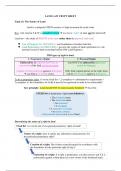
Topic (1) The Nature of Land
Land is a uniquely FIXED resource w/ high economic & social value
Key: ALL land in E & W is owned by Crown we own a “right” in land, not the land itself
Land law = the study of RIGHTS in the land rather than the physical land itself.
© Law of Property Act 1925 (LPA) = real foundation of modern land law
© Land Registration Act 2002 (LRA) = governs the system of land registration (i.e. the
national record of land ownership held by HM Land Registry)
TWO types of right in land:
1. Proprietary Rights 2. Personal Rights
Enforced by an action in rem = use or Can ONLY be enforced by a personal
possession of the land can be recovered. action for damages.
Capable of being enforced against a third party Only bind original parties to the right, there
can bind a FUTURE owner. can be NO recourse against a third party.
To be a proprietary right: 1) on the fixed list + 2) complies w/ substantiative requirements +
3) complies w/ the formalities 4) did it need to be registered in order to be enforceable?
Key principle: Land should NOT be unnecessarily burdened fixed list:
FIXED list of proprietary rights (not definitive):
• The freehold estate
• The leasehold estate
• An easement
• A mortgage
• A restrictive covenant
• An estate contract
• A beneficial interest in a trust of land
Determining the status of a right in land:
Fixed list: is it on the list of recognised proprietary rights in land?
Nature of a right: does it satisfy any substantive characteristics for
the particular proprietary right?
Creation of a right: Has it been created/acquired in accordance with
the formalities for the particular right (if any)?
Protection of a right: if a right is proprietary, you then need to ask if it is
enforceable against a third party (ie a new owner of the burdened land.)
,Proprietary right: an estate = a right to possess and use the land (freehold or leasehold)
Freehold estate Leasehold estate
fee simple absolute in possession ‘Terms of years absolute’
Equivalent to absolute ownership of land Aka a lease. You are a tenant if you own
LPA 1925, s 1(1)(a)) one of these estate (N.B. you own a
A piece of land will only be subject to one of lesser estate)
these estate Lasts for a certain duration
Lasts indefinitely = only extinguished if LPA 1925, s 1(1)(b)
landowner dies without next of kin + without Granted out of a freehold estate. Can
a will land regarded as bona vacantia & have more than one leasehold for a piece
estate reverts to the Crown (v. rare) of land= subleases
Physical possession not necessary
N.B. A commonhold = a TYPE of freehold (Commonhold and Leasehold Reform Act 2002)
® Freehold owner = a company called a commonhold association
® Owner of each flat is a member of the association
® Alternative to a LONG lease (declining asset) but commonholds not popular.
Hierarchy of rights: Crown Freehold estate Leasehold estate
*Freehold reversion: the residue of the estate AFTER the granting of a lease.
- When lease ends: right to physical possession automatically reverts to the landlord
*Leasehold reversion: the residue when the grantor HOLDS a leasehold estate.
Interest in Land
Interest in land = right to use/enjoyment of the land (‘incumbrances on an estate’)
CAN adversely affect the value & saleability of land fixed list under LPA 1925, s1(2):
MORTGAGE: © A loan of cash, which is secured by rights granted OVER property.
o Includes right to possess & sell land in the event of default in mortgage
s 1(2)(c) repayments.
Legal © Borrower grants the mortgage, not the lender.
EASEMENT: © A proprietary right to use land which belongs to somebody else.
© Use is more limited than an exclusive right to occupy or use.
s 1(2)(a) © Examples: rights of way, drainage, storage + parking on neighbouring land.
Legal only if
term is
certain/forever
RIGHT OF © A right of entry is either:
ENTRY: o 1) a right for landlord to re-enter leased premises end leasehold
estate in event of tenant default or occurrence of other specified event
s 1(2)(e) o 2) a rentcharge owner’s right to hold land if money owed is NOT paid.
Legal © A right of entry in a lease = ‘forfeiture clause’
, RESTRICTIVE © A promise: prevents anything affecting amenity & value of land.
COVENANT: © Negative prevent a land owner from doing something on their land.
© Examples: promise not to sell alcohol from the land, promise not to build
Equitable on the land, promise to only use the land for residential purposes.
ESTATE © A contractual right to a legal estate (freehold or leasehold)
CONTRACT: © Equity orders specific performance because each piece of land = unique.
© Subject to maxim: ‘equity sees that as done what ought to be done’
Equitable © Examples: a contract to buy land, a contract to grant a lease, an option to
purchase land, a right of pre-emption.
INTERESTS © A trust exists where one person (the trustee) holds property FOR the benefit
IN A TRUST: of another (the beneficiary). SPLIT in the legal and equitable title
© The trustees and beneficiaries can be the same or different people.
Equitable
Legal interests (LPA 1925, s 1(2)): Equitable interests (LPA 1925, s 1(3)):
- Mortgages - Freehold covenants
- Easements granted for a forever or - Estate contracts
certain term - Interests in a trust of land
- Rights of entry - Easements granted for an uncertain term
Key point 1. Remedies DIFFER
® Legal interest has a WIDE range of remedies w/ damages = an automatic right
® Equitable interest is NOT entitled to damages as of right – court has discretion!
Key point 2. Enforcement of the interest against third parties DIFFERS
Land Transfer
Conveyancing: legal process of transferring title to freehold/leasehold estate.
Transfer can be achieved by 1) sale 2) will 3) gift and 4) operation of the law (bankruptcy)
Can still walk Pre-exchange
away without Point at which parties become
incurring legal Exchange of Contracts contractually committed to deal
liability Voluntary
Contract must comply w/ LP(MP)A
1989, s 2 (in writing, all express terms
+ signed by both parties) Unregistered land: legal title
passes
When buyer PAYS Completion of the Deed
the purchase money Required by LPA 1925, s 52 Valid execution = seller +
collects keys Deed must comply w/ LP(MP)A signs w/ witness attesting
1989, s 1 (clearly intended to be
a deed + validly executed +
Unregistered land: 1st delivered Registered land:
registration must occur legal title passes
within 2 months or legal title Registration once transfer is
reverts back to seller Registered land: LRA 2002, s 27(2) registered
(1)(a)
Unregistered land: LRA 2002 ss
4&6)
Topic (1) The Nature of Land
Land is a uniquely FIXED resource w/ high economic & social value
Key: ALL land in E & W is owned by Crown we own a “right” in land, not the land itself
Land law = the study of RIGHTS in the land rather than the physical land itself.
© Law of Property Act 1925 (LPA) = real foundation of modern land law
© Land Registration Act 2002 (LRA) = governs the system of land registration (i.e. the
national record of land ownership held by HM Land Registry)
TWO types of right in land:
1. Proprietary Rights 2. Personal Rights
Enforced by an action in rem = use or Can ONLY be enforced by a personal
possession of the land can be recovered. action for damages.
Capable of being enforced against a third party Only bind original parties to the right, there
can bind a FUTURE owner. can be NO recourse against a third party.
To be a proprietary right: 1) on the fixed list + 2) complies w/ substantiative requirements +
3) complies w/ the formalities 4) did it need to be registered in order to be enforceable?
Key principle: Land should NOT be unnecessarily burdened fixed list:
FIXED list of proprietary rights (not definitive):
• The freehold estate
• The leasehold estate
• An easement
• A mortgage
• A restrictive covenant
• An estate contract
• A beneficial interest in a trust of land
Determining the status of a right in land:
Fixed list: is it on the list of recognised proprietary rights in land?
Nature of a right: does it satisfy any substantive characteristics for
the particular proprietary right?
Creation of a right: Has it been created/acquired in accordance with
the formalities for the particular right (if any)?
Protection of a right: if a right is proprietary, you then need to ask if it is
enforceable against a third party (ie a new owner of the burdened land.)
,Proprietary right: an estate = a right to possess and use the land (freehold or leasehold)
Freehold estate Leasehold estate
fee simple absolute in possession ‘Terms of years absolute’
Equivalent to absolute ownership of land Aka a lease. You are a tenant if you own
LPA 1925, s 1(1)(a)) one of these estate (N.B. you own a
A piece of land will only be subject to one of lesser estate)
these estate Lasts for a certain duration
Lasts indefinitely = only extinguished if LPA 1925, s 1(1)(b)
landowner dies without next of kin + without Granted out of a freehold estate. Can
a will land regarded as bona vacantia & have more than one leasehold for a piece
estate reverts to the Crown (v. rare) of land= subleases
Physical possession not necessary
N.B. A commonhold = a TYPE of freehold (Commonhold and Leasehold Reform Act 2002)
® Freehold owner = a company called a commonhold association
® Owner of each flat is a member of the association
® Alternative to a LONG lease (declining asset) but commonholds not popular.
Hierarchy of rights: Crown Freehold estate Leasehold estate
*Freehold reversion: the residue of the estate AFTER the granting of a lease.
- When lease ends: right to physical possession automatically reverts to the landlord
*Leasehold reversion: the residue when the grantor HOLDS a leasehold estate.
Interest in Land
Interest in land = right to use/enjoyment of the land (‘incumbrances on an estate’)
CAN adversely affect the value & saleability of land fixed list under LPA 1925, s1(2):
MORTGAGE: © A loan of cash, which is secured by rights granted OVER property.
o Includes right to possess & sell land in the event of default in mortgage
s 1(2)(c) repayments.
Legal © Borrower grants the mortgage, not the lender.
EASEMENT: © A proprietary right to use land which belongs to somebody else.
© Use is more limited than an exclusive right to occupy or use.
s 1(2)(a) © Examples: rights of way, drainage, storage + parking on neighbouring land.
Legal only if
term is
certain/forever
RIGHT OF © A right of entry is either:
ENTRY: o 1) a right for landlord to re-enter leased premises end leasehold
estate in event of tenant default or occurrence of other specified event
s 1(2)(e) o 2) a rentcharge owner’s right to hold land if money owed is NOT paid.
Legal © A right of entry in a lease = ‘forfeiture clause’
, RESTRICTIVE © A promise: prevents anything affecting amenity & value of land.
COVENANT: © Negative prevent a land owner from doing something on their land.
© Examples: promise not to sell alcohol from the land, promise not to build
Equitable on the land, promise to only use the land for residential purposes.
ESTATE © A contractual right to a legal estate (freehold or leasehold)
CONTRACT: © Equity orders specific performance because each piece of land = unique.
© Subject to maxim: ‘equity sees that as done what ought to be done’
Equitable © Examples: a contract to buy land, a contract to grant a lease, an option to
purchase land, a right of pre-emption.
INTERESTS © A trust exists where one person (the trustee) holds property FOR the benefit
IN A TRUST: of another (the beneficiary). SPLIT in the legal and equitable title
© The trustees and beneficiaries can be the same or different people.
Equitable
Legal interests (LPA 1925, s 1(2)): Equitable interests (LPA 1925, s 1(3)):
- Mortgages - Freehold covenants
- Easements granted for a forever or - Estate contracts
certain term - Interests in a trust of land
- Rights of entry - Easements granted for an uncertain term
Key point 1. Remedies DIFFER
® Legal interest has a WIDE range of remedies w/ damages = an automatic right
® Equitable interest is NOT entitled to damages as of right – court has discretion!
Key point 2. Enforcement of the interest against third parties DIFFERS
Land Transfer
Conveyancing: legal process of transferring title to freehold/leasehold estate.
Transfer can be achieved by 1) sale 2) will 3) gift and 4) operation of the law (bankruptcy)
Can still walk Pre-exchange
away without Point at which parties become
incurring legal Exchange of Contracts contractually committed to deal
liability Voluntary
Contract must comply w/ LP(MP)A
1989, s 2 (in writing, all express terms
+ signed by both parties) Unregistered land: legal title
passes
When buyer PAYS Completion of the Deed
the purchase money Required by LPA 1925, s 52 Valid execution = seller +
collects keys Deed must comply w/ LP(MP)A signs w/ witness attesting
1989, s 1 (clearly intended to be
a deed + validly executed +
Unregistered land: 1st delivered Registered land:
registration must occur legal title passes
within 2 months or legal title Registration once transfer is
reverts back to seller Registered land: LRA 2002, s 27(2) registered
(1)(a)
Unregistered land: LRA 2002 ss
4&6)