Loudon Ch. 5 Review: Alkene Reactions
Jacquie Richardson, CU Boulder – Last updated 10/4/2019
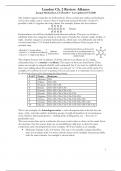
This entire chapter consists of more reactions of alkenes. Most of them are along the lines of
the addition reactions that we saw in Ch. 4:
Dihalogenation
In this reaction, X & Y are both halogens. This works best for Cl2 or Br2 – F2 and I2 don’t
work as well. Since Br2 is a liquid, it’s easier to do the reaction with than Cl2, which is a gas.
Here are a couple of examples of the overall reaction:
The products of this reaction are called vicinal dihalides, since the two halogens are vicinal
(in the vicinity of each other, or on neighboring carbons). The mechanism for this reaction
starts out looking a little like HX addition, but there’s a difference. With HX addition, we
showed the alkene attacking a proton, creating a carbocation. We could show an equivalent
step here, with the alkene attacking a halogen, but if we did, the lone pair on the halogen
would immediately attack the carbocation. This is because a halogen with a positive charge is
more stable than a carbon with a positive charge, since at least the halogen has a full octet.
Instead, rather than occurring as two separate mechanistic steps, these three arrows occur all
at once – the alkene attacks the halogen atom, the halogen drops the other halogen atom and
simultaneously back-attacks onto the more substituted carbon of the alkene. This
immediately makes a three-membered halonium ring (bromonium, in this case), which can
then be attacked by the second halogen atom in the next step.
Note that we showed the second halogen atom attacking the more substituted carbon – this
has to do with charge distribution on the molecule. We can show a couple of alternative
forms. If we break the ring we can show the positive charge on the bromine (the best
option), or on the more substituted C (bad), or on the less substituted carbon (even worse).
This means we can distribute a little of the positive charge out to the more substituted
carbon, so any attack will happen there.
1
, Loudon Ch. 5 Review: Alkene Reactions
Jacquie Richardson, CU Boulder – Last updated 10/4/2019
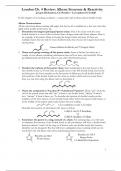
Halohydrin Formation
Once the halonium ring forms, other nucleophiles can react with it as well if they’re added to
the reaction. Water is one example. This creates a halohydrin – something with a halogen
and a hydroxyl group (OH) on adjacent carbons.
The first step of the mechanism is the same, but once the ring forms, water comes in and
attacks it. However, since water was neutral before the attack, it is now positive. This charge
needs to be removed to get a stable, neutral product, but sending electrons directly at the
oxygen won’t help – it’s already got a full octet. Instead, it needs to be deprotonated. Just
like for acid-catalyzed hydration, you can show this being performed by another water
molecule, or just happening on its own.
Note that just like in dehalogenation, the attack on the bromonium ring occurs at the more
substituted carbon.
Haloether Formation
This is another reaction that starts by forming a halonium ring and then attacks it with a
different nucleophile – an alcohol, in this case. This creates a haloether - something with a
halogen and an alkoxy group (OR) on adjacent carbons. The product is an ether – you can
view the entire starting molecule as one of two R groups that make up the ether molecule.
The mechanism is the same as for halohydrin formation, but we only have one choice of
which H to remove in the last step (R doesn’t detach so easily).
Intramolecular Reactions
This reaction is one case we’ll see where we’re connecting two different alkyl groups (one
with an OH, and one with an alkene). There’s no reason these two groups can’t be on the
same molecule. Intramolecular reactions like this will make a new ring.
2
Jacquie Richardson, CU Boulder – Last updated 10/4/2019
This entire chapter consists of more reactions of alkenes. Most of them are along the lines of
the addition reactions that we saw in Ch. 4:
Dihalogenation
In this reaction, X & Y are both halogens. This works best for Cl2 or Br2 – F2 and I2 don’t
work as well. Since Br2 is a liquid, it’s easier to do the reaction with than Cl2, which is a gas.
Here are a couple of examples of the overall reaction:
The products of this reaction are called vicinal dihalides, since the two halogens are vicinal
(in the vicinity of each other, or on neighboring carbons). The mechanism for this reaction
starts out looking a little like HX addition, but there’s a difference. With HX addition, we
showed the alkene attacking a proton, creating a carbocation. We could show an equivalent
step here, with the alkene attacking a halogen, but if we did, the lone pair on the halogen
would immediately attack the carbocation. This is because a halogen with a positive charge is
more stable than a carbon with a positive charge, since at least the halogen has a full octet.
Instead, rather than occurring as two separate mechanistic steps, these three arrows occur all
at once – the alkene attacks the halogen atom, the halogen drops the other halogen atom and
simultaneously back-attacks onto the more substituted carbon of the alkene. This
immediately makes a three-membered halonium ring (bromonium, in this case), which can
then be attacked by the second halogen atom in the next step.
Note that we showed the second halogen atom attacking the more substituted carbon – this
has to do with charge distribution on the molecule. We can show a couple of alternative
forms. If we break the ring we can show the positive charge on the bromine (the best
option), or on the more substituted C (bad), or on the less substituted carbon (even worse).
This means we can distribute a little of the positive charge out to the more substituted
carbon, so any attack will happen there.
1
, Loudon Ch. 5 Review: Alkene Reactions
Jacquie Richardson, CU Boulder – Last updated 10/4/2019
Halohydrin Formation
Once the halonium ring forms, other nucleophiles can react with it as well if they’re added to
the reaction. Water is one example. This creates a halohydrin – something with a halogen
and a hydroxyl group (OH) on adjacent carbons.
The first step of the mechanism is the same, but once the ring forms, water comes in and
attacks it. However, since water was neutral before the attack, it is now positive. This charge
needs to be removed to get a stable, neutral product, but sending electrons directly at the
oxygen won’t help – it’s already got a full octet. Instead, it needs to be deprotonated. Just
like for acid-catalyzed hydration, you can show this being performed by another water
molecule, or just happening on its own.
Note that just like in dehalogenation, the attack on the bromonium ring occurs at the more
substituted carbon.
Haloether Formation
This is another reaction that starts by forming a halonium ring and then attacks it with a
different nucleophile – an alcohol, in this case. This creates a haloether - something with a
halogen and an alkoxy group (OR) on adjacent carbons. The product is an ether – you can
view the entire starting molecule as one of two R groups that make up the ether molecule.
The mechanism is the same as for halohydrin formation, but we only have one choice of
which H to remove in the last step (R doesn’t detach so easily).
Intramolecular Reactions
This reaction is one case we’ll see where we’re connecting two different alkyl groups (one
with an OH, and one with an alkene). There’s no reason these two groups can’t be on the
same molecule. Intramolecular reactions like this will make a new ring.
2