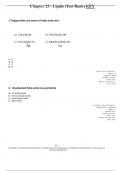
1.Triglycerides are esters of fatty acids and:
A. A
B. B
C. C
D. D
Bloom's Level: 2. Understand
Chapter: 25
Difficulty: Medium
Gradable: automatic
Section: 25.02
Subtopic: Triacylglycerols
Topic: Lipids
2. Unsaturated fatty acids have primarily
A. cis double bonds.
B. terminal double bonds.
C. trans double bonds.
D. triple bonds.
Accessibility: Keyboard Navigation
Bloom's Level: 1. Remember
Chapter: 25
Difficulty: Easy
Gradable: automatic
Section: 25.02
Subtopic: Triacylglycerols
Topic: Lipids
25-1
Copyright © 2016 McGraw-Hill Education. All rights reserved. No reproduction or distribution without the prior written consent of
McGraw-Hill Education.
,3. Which of the following reagents can be used for the saponification of a fat or oil?
A. H2, Ni
B. LiAlH4 followed by H2O
C. H2O, NaOH
D. H2O, HCl
Accessibility: Keyboard Navigation
Bloom's Level: 2. Understand
Chapter: 25
Difficulty: Medium
Gradable: automatic
Section: 25.02
Subtopic: Triacylglycerols
Topic: Lipids
4.Which of the following has the highest melting point?
A. A
B. B
C. C
D. D
Bloom's Level: 4. Analyze
Chapter: 25
Difficulty: Medium
Gradable: automatic
Section: 25.02
Subtopic: Triacylglycerols
Topic: Lipids
25-2
Copyright © 2016 McGraw-Hill Education. All rights reserved. No reproduction or distribution without the prior written consent of
McGraw-Hill Education.
, 5. Lipids, by definition, are
A. fats.
B. nonpolymeric biomolecules.
C.biomolecules that form micelles.
D.biomolecules that are water-insoluble and extractable(soluble) with nonpolar solvents.
Accessibility: Keyboard Navigation
Bloom's Level: 1. Remember
Chapter: 25
Difficulty: Easy
Gradable: automatic
Section: 25.01
Subtopic: Triacylglycerols
Topic: Lipids
6. Fatty acids are biosynthesized from
A. isopentyl pyrophosphate.
B.acetic acid derivatives.
C.glycerol.
D. terpenes.
Accessibility: Keyboard Navigation
Bloom's Level: 1. Remember
Chapter: 25
Difficulty: Medium
Gradable: automatic
Section: 25.03
Subtopic: Triacylglycerols
Topic: Lipids
25-3
Copyright © 2016 McGraw-Hill Education. All rights reserved. No reproduction or distribution without the prior written consent of
McGraw-Hill Education.
A. A
B. B
C. C
D. D
Bloom's Level: 2. Understand
Chapter: 25
Difficulty: Medium
Gradable: automatic
Section: 25.02
Subtopic: Triacylglycerols
Topic: Lipids
2. Unsaturated fatty acids have primarily
A. cis double bonds.
B. terminal double bonds.
C. trans double bonds.
D. triple bonds.
Accessibility: Keyboard Navigation
Bloom's Level: 1. Remember
Chapter: 25
Difficulty: Easy
Gradable: automatic
Section: 25.02
Subtopic: Triacylglycerols
Topic: Lipids
25-1
Copyright © 2016 McGraw-Hill Education. All rights reserved. No reproduction or distribution without the prior written consent of
McGraw-Hill Education.
,3. Which of the following reagents can be used for the saponification of a fat or oil?
A. H2, Ni
B. LiAlH4 followed by H2O
C. H2O, NaOH
D. H2O, HCl
Accessibility: Keyboard Navigation
Bloom's Level: 2. Understand
Chapter: 25
Difficulty: Medium
Gradable: automatic
Section: 25.02
Subtopic: Triacylglycerols
Topic: Lipids
4.Which of the following has the highest melting point?
A. A
B. B
C. C
D. D
Bloom's Level: 4. Analyze
Chapter: 25
Difficulty: Medium
Gradable: automatic
Section: 25.02
Subtopic: Triacylglycerols
Topic: Lipids
25-2
Copyright © 2016 McGraw-Hill Education. All rights reserved. No reproduction or distribution without the prior written consent of
McGraw-Hill Education.
, 5. Lipids, by definition, are
A. fats.
B. nonpolymeric biomolecules.
C.biomolecules that form micelles.
D.biomolecules that are water-insoluble and extractable(soluble) with nonpolar solvents.
Accessibility: Keyboard Navigation
Bloom's Level: 1. Remember
Chapter: 25
Difficulty: Easy
Gradable: automatic
Section: 25.01
Subtopic: Triacylglycerols
Topic: Lipids
6. Fatty acids are biosynthesized from
A. isopentyl pyrophosphate.
B.acetic acid derivatives.
C.glycerol.
D. terpenes.
Accessibility: Keyboard Navigation
Bloom's Level: 1. Remember
Chapter: 25
Difficulty: Medium
Gradable: automatic
Section: 25.03
Subtopic: Triacylglycerols
Topic: Lipids
25-3
Copyright © 2016 McGraw-Hill Education. All rights reserved. No reproduction or distribution without the prior written consent of
McGraw-Hill Education.