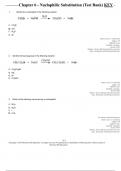
1. Identify the nucleophile in the following reaction.
A. CH3Br
¯
B. OH
C. H2O
¯
D. Br
Bloom's Level: 2. Understand
Chapter: 06
Difficulty: Easy
Gradable: automatic
Section: 06.05
Subtopic: Factors affecting substitution reactions
Topic: Substitution and Elimination Reactions
2. Identify the leaving group in the following reaction.
A. CH3CH2Br
¯
B. HS
¯
C. Br
D. CH3OH
Bloom's Level: 2. Understand
Chapter: 06
Difficulty: Easy
Gradable: automatic
Section: 06.02
Subtopic: Factors affecting substitution reactions
Topic: Substitution and Elimination Reactions
3. Which of the following cannot act as a nucleophile?
A. NH3
B. H2O
¯
C. I
D. CH4
Accessibility: Keyboard Navigation
Bloom's Level: 2. Understand
Chapter: 06
Difficulty: Easy
Gradable: automatic
Section: 06.05
Subtopic: Factors affecting substitution reactions
Topic: Substitution and Elimination Reactions
6-1
Copyright © 2016 McGraw-Hill Education. All rights reserved. No reproduction or distribution without the prior written consent of
McGraw-Hill Education.
,4.
In the SN2 reaction, the "2" stands for
A. two reactants in the reaction.
B.two steps in the reaction.
C.two intermediates in the reaction.
D.bimolecular kinetics for the reaction.
Accessibility: Keyboard Navigation
Bloom's Level: 1. Remember
Chapter: 06
Difficulty: Medium
Gradable: automatic
Section: 06.03
Subtopic: Substitution reaction mechanisms: SN1 and SN2
Topic: Substitution and Elimination Reactions
5. Which of the following undergoes a substitution reaction with sodium cyanide in DMSO at the fastest rate?
A. CH3CH2F
B. CH3CH2Cl
C. CH3CH2Br
D. CH3CH2I
Accessibility: Keyboard Navigation
Bloom's Level: 4. Analyze
Chapter: 06
Difficulty: Medium
Gradable: automatic
Section: 06.02
Subtopic: Factors affecting substitution reactions
Topic: Substitution and Elimination Reactions
6. 1-Chloro-4-fluorobutane is reacted with one equivalent of sodium iodide in acetone. During the reaction a precipitate forms.
What is the precipitate?
A. FCH2CH2CH2CH2I
B. ClCH2CH2CH2CH2I
C. NaCl
D. NaF
Accessibility: Keyboard Navigation
Bloom's Level: 2. Understand
Chapter: 06
Difficulty: Hard
Gradable: automatic
Section: 06.02
Subtopic: Factors affecting substitution reactions
Topic: Substitution and Elimination Reactio
6-2
Copyright © 2016 McGraw-Hill Education. All rights reserved. No reproduction or distribution without the prior written consent of
McGraw-Hill Education.
, 7.The
rate
law for
the
followi
ng
reactio
n is
A. rate = k[CH3CH2CH2Cl].
B.rate = k[CH3CH2CH2Cl][NaCN].
2
C.rate = k[CH3CH2CH2Cl][NaCN] .
D. rate = k[NaCN].
Bloom's Level: 2. Understand
Chapter: 06
Difficulty: Medium
Gradable: automatic
Section: 06.03
Section: 06.04
Subtopic: Substitution reaction mechanisms: SN1 and SN2
Topic: Substitution and Elimination Reactions
8 Which of the following reacts the fastest by the SN2 mechanism?
.
A. CH3Br
B. CH3CH2Br
C. (CH3)2CHBr
D. (CH3)3CBr
Accessibility: Keyboard
Navigation
Bloom's Level: 4.
Analyze
Chapt
er: 06
Difficulty: Medium
Gradable:
automatic
Subtopic: Factors affecting substitution
reactions
Subtopic: Substitution reaction mechanisms: SN1 and
SN2
Topic: Substitution and Elimination
Reactions
6-3
Copyright © 2016 McGraw-Hill Education. All rights reserved. No reproduction or distribution without the prior written consent of
McGraw-Hill Education.
A. CH3Br
¯
B. OH
C. H2O
¯
D. Br
Bloom's Level: 2. Understand
Chapter: 06
Difficulty: Easy
Gradable: automatic
Section: 06.05
Subtopic: Factors affecting substitution reactions
Topic: Substitution and Elimination Reactions
2. Identify the leaving group in the following reaction.
A. CH3CH2Br
¯
B. HS
¯
C. Br
D. CH3OH
Bloom's Level: 2. Understand
Chapter: 06
Difficulty: Easy
Gradable: automatic
Section: 06.02
Subtopic: Factors affecting substitution reactions
Topic: Substitution and Elimination Reactions
3. Which of the following cannot act as a nucleophile?
A. NH3
B. H2O
¯
C. I
D. CH4
Accessibility: Keyboard Navigation
Bloom's Level: 2. Understand
Chapter: 06
Difficulty: Easy
Gradable: automatic
Section: 06.05
Subtopic: Factors affecting substitution reactions
Topic: Substitution and Elimination Reactions
6-1
Copyright © 2016 McGraw-Hill Education. All rights reserved. No reproduction or distribution without the prior written consent of
McGraw-Hill Education.
,4.
In the SN2 reaction, the "2" stands for
A. two reactants in the reaction.
B.two steps in the reaction.
C.two intermediates in the reaction.
D.bimolecular kinetics for the reaction.
Accessibility: Keyboard Navigation
Bloom's Level: 1. Remember
Chapter: 06
Difficulty: Medium
Gradable: automatic
Section: 06.03
Subtopic: Substitution reaction mechanisms: SN1 and SN2
Topic: Substitution and Elimination Reactions
5. Which of the following undergoes a substitution reaction with sodium cyanide in DMSO at the fastest rate?
A. CH3CH2F
B. CH3CH2Cl
C. CH3CH2Br
D. CH3CH2I
Accessibility: Keyboard Navigation
Bloom's Level: 4. Analyze
Chapter: 06
Difficulty: Medium
Gradable: automatic
Section: 06.02
Subtopic: Factors affecting substitution reactions
Topic: Substitution and Elimination Reactions
6. 1-Chloro-4-fluorobutane is reacted with one equivalent of sodium iodide in acetone. During the reaction a precipitate forms.
What is the precipitate?
A. FCH2CH2CH2CH2I
B. ClCH2CH2CH2CH2I
C. NaCl
D. NaF
Accessibility: Keyboard Navigation
Bloom's Level: 2. Understand
Chapter: 06
Difficulty: Hard
Gradable: automatic
Section: 06.02
Subtopic: Factors affecting substitution reactions
Topic: Substitution and Elimination Reactio
6-2
Copyright © 2016 McGraw-Hill Education. All rights reserved. No reproduction or distribution without the prior written consent of
McGraw-Hill Education.
, 7.The
rate
law for
the
followi
ng
reactio
n is
A. rate = k[CH3CH2CH2Cl].
B.rate = k[CH3CH2CH2Cl][NaCN].
2
C.rate = k[CH3CH2CH2Cl][NaCN] .
D. rate = k[NaCN].
Bloom's Level: 2. Understand
Chapter: 06
Difficulty: Medium
Gradable: automatic
Section: 06.03
Section: 06.04
Subtopic: Substitution reaction mechanisms: SN1 and SN2
Topic: Substitution and Elimination Reactions
8 Which of the following reacts the fastest by the SN2 mechanism?
.
A. CH3Br
B. CH3CH2Br
C. (CH3)2CHBr
D. (CH3)3CBr
Accessibility: Keyboard
Navigation
Bloom's Level: 4.
Analyze
Chapt
er: 06
Difficulty: Medium
Gradable:
automatic
Subtopic: Factors affecting substitution
reactions
Subtopic: Substitution reaction mechanisms: SN1 and
SN2
Topic: Substitution and Elimination
Reactions
6-3
Copyright © 2016 McGraw-Hill Education. All rights reserved. No reproduction or distribution without the prior written consent of
McGraw-Hill Education.