HESI A2 Practice test questions 100% ACCURATE GRADE A+ GUARANTEED
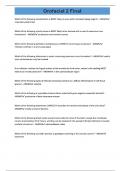
Which of the following is NOT a function of the digestive tract? a) to use enzymes to break down food b) to perform gas exchange c) to remove waste from the body d) to use peristalsis to move food along b) to perform gas exchange Gas exchange is a function of the respiratory system The body, at all times, attempts to maintain homeostasis. The best definition of homeostasis is: a) a process that maintains the stability of the human body's internal environment in response to changes in internal and external conditions b) a function via which the body breaks down glucose to use as energy c)a process that maintains the immune system's defenses d) a process in which the body resists change to genetic structure a) a process that maintains the stability of the human body's internal environment in response to changes in internal and external conditions The endocrine system of the body is responsible for: a) defense through the use of antibodies b) communication through the use of hormones c) metabolism through the use of enzymes d) blood flow through the use of the heart muscle b) communication through the use of hormones Anatomical position shows the body in a(n) ________ position. a) lateral b) superior c) anterior d) posterior c) anterior Vitamin K is created in the: a) liver b) lungs c) intestinal tract d) pancreas c) intestinal tract The largest organ in the body is the ________. a) skin b) GI tract c) femur d) stomach a) skin A medical scientists wants to study the parenchyma of the kidney. This scientist would correctly be known, most specifically, as a: a) biologist b) doctor c) anatomist d) histologist d) histologist Histology is the study of tissues. What is Erythropoiesis? a) red blood cell formation b) white blood cell formation c) the destruction of red blood cells d) the destruction of white blood cells a) red blood cell formation Blood cell formation is called Hemopoiesis. Erythro- red blood cells In which part of the body is keratin NOT found? a) hair b) skin c) nails d) teeth d) teeth Keratin is a family of fibrous structural proteins. Keratin is the key structural component of hair, nails, and the outer layer of human skin What is the relationship between sarcomeres and muscle cells? a) sarcomeres are muscle cells b) sarcomeres contain muscle cells c) muscle cells contain myofibrils, which in turn are made up of sarcomeres d) muscle cells contain sarcomeres, which in turn are made up of myofibrils CONTINUED......
Written for
- Institution
- HESI A2 Practice tst qustions
- Module
- HESI A2 Practice tst qustions
Document information
- Uploaded on
- November 29, 2023
- Number of pages
- 8
- Written in
- 2023/2024
- Type
- Exam (elaborations)
- Contains
- Questions & answers
Subjects
-
which of the following is not a function of the di
-
gas exchange is a function of the respiratory syst
-
the endocrine system of the body is responsible fo
-
anatomical position shows the body in an