Maternity and Pediatric Nursing, Second Edition: Chapter 15: Postpartum Adaptations; 100% ACCURATE GRADE A+ GUARANTEED
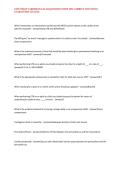
A woman who is breastfeeding her newborn reports that her breasts seem quite full. Assessment reveals that her breasts are engorged. Which factor would the nurse identify as the most likely cause for this development? inability of infant to empty breasts For the breastfeeding mother, engorgement is often the result of vascular congestion and milk stasis, primarily caused by the infant not fully emptying the mother's breasts at each feeding. Cracking of the nipple could lead to infection. Improper positioning may lead to nipple tenderness or pain. Inadequate secretion of prolactin causes a decrease in the production of milk. The nurse is caring for a client in the postpartum period. The client has difficulty in voiding and is catheterized. The nurse then would monitor the client for which condition? urinary tract infection The nurse would need to monitor the client for signs and symptoms of a urinary tract infection, a risk associated with catheterization. Stress incontinence is caused due to loss of pelvic muscle tone after birth. Increased urinary output is observed in diuresis. Catheterization does not cause loss of pelvic muscle tone, increased urine output, or stress incontinence. A nurse is caring for a nonbreastfeeding client in the postpartum period. The client reports engorgement. What suggestion should the nurse provide to alleviate breast discomfort? Wear a well-fitting bra. The nurse should suggest the client wear a well-fitting bra to provide support and help alleviate breast discomfort. Application of warm compresses and expressing milk frequently is suggested to alleviate breast engorgement in breastfeeding clients. Hydrogel dressings are used prophylactically in treating nipple pain. A client in her sixth week postpartum reports general weakness. The client has stopped taking iron supplements that were prescribed to her during pregnancy. The nurse would assess the client for which condition? hypovolemia The nurse should assess the client for hypovolemia as the client must have had hemorrhage during birth and puerperium. Additionally, the client also has discontinued iron supplements. Hyperglycemia can be considered if the client has a history of diabetes. Hypertension and hyperthyroidism are not related to discontinuation of iron supplements. A concerned client tells the nurse that her husband, who was very excited about the baby before its birth, is apparently happy but seems to be afraid of caring for the baby. What suggestion should the nurse give to the client's husband to resolve the issue? Hold the baby frequently. The nurse should suggest that the father care for the newborn by holding and talking to the child. Reading up on parental care and speaking to his friends or the primary care provider will not help the father resolve his fears about caring for the child. During a postpartum exam on the day of birth, the woman reports that she is still so sore that she cannot sit comfortably. The nurse examines her perineum and find the edges of the episiotomy approximated without signs of a hematoma. Which intervention will be most beneficial at this point? Place an ice pack. The labia and perineum may be edematous after birth and bruised; the use of ice would assist in decreasing the pain and swelling. Applying a warm washcloth would bring more blood as well as fluid to the sore area, thereby increasing the edema and the soreness. Applying a witch hazel pad needs the order of the primary care provider. Notifying a care provider is not necessary at this time as this is considered a normal finding. A woman who gave birth to a healthy newborn 2 months ago comes to the clinic and reports discomfort during sexual intercourse. Which suggestion by the nurse would be most appropriate? "You might try using a water-soluble lubricant to ease the discomfort." Coital discomfort and localized dryness usually plague most postpartum women until menstruation returns. Water-soluble lubricants can reduce discomfort during intercourse. Although it may take some time for the woman's body to return to its prepregnant state, telling the woman this does not address her concern. Telling her that dyspareunia is normal and that it takes time to resolve also ignores her concern. Kegel exercises are helpful for improving pelvic floor tone but would have no effect on vaginal dryness. For the first hour after birth, the height of the fundus is at the umbilicus or even slightly above it. True A client who gave birth about 12 hours ago informs the nurse that she has been voiding small amounts of urine frequently. The nurse examines the client and notes the displacement of the uterus from the midline to the right. What intervention would the nurse perform next? Perform urinary catheterization. Displacement of the uterus from the midline to the right and frequent voiding of small amounts suggests urinary retention with overflow. Catheterization may be necessary to empty the bladder to restore tone. An IV and oxytocin are indicated if the client experiences hemorrhage due to uterine atony from being displaced. The healthcare provider would be notified if no other interventions help the client. While caring for a client following a lengthy labor and birth, the nurse notes that the client repeatedly reviews her labor and birth and is very dependent on her family for care. The nurse is correct in identifying the client to be in which phase of maternal role adjustment? taking-in The taking-in phase occurs during the first 24 to 48 hours following the birth of the newborn and is characterized by the mother taking on a very passive role in caring for herself, as well as recounting her labor experience. The second maternal adjustment phase is the taking-hold phase and usually lasts several weeks after the birth. This phase is characterized by both dependent and independent behavior, with increasing autonomy. During the letting-go phase the mother reestablishes relationships with others and accepts her new role as a parent. Acquaintance/attachment phase is a newer term that refers to the first 2 to 6 weeks following birth when the mother is learning to care for her baby and is physically recuperating from the pregnancy and birth. A woman is bottle-feeding her baby. When the nurse comes into the room the woman says that her breasts are painful and engorged. Which nursing intervention is appropriate? Assist the woman in placing ice packs on her breasts. If the breasts are engorged and the woman is bottle-feeding her newborn, instruct her to keep a support bra on 24 hours per day. Cool compresses or an ice pack wrapped in a towel will usually be soothing and help to suppress milk production. Which instruction should the nurse provide to a breastfeeding woman experiencing breast engorgement? "Take a warm shower just before feeding your infant." Standing in a warm shower or applying warm compresses immediately before feedings will help soften the breasts and nipples to allow the newborn to latch on more easily and will enhance the let-down reflex. Wearing a tight supportive bra all day is appropriate for the woman who is not breastfeeding. Frequent emptying of the breasts helps to resolve engorgement, so the mother should be encouraged to feed the newborn, which would involve touching her breasts and nipples. The breastfeeding woman should apply cold compresses but not ice to her breasts between feedings to reduce swelling. A nurse is caring for a breastfeeding client who reports engorgement. The nurse identifies that the client's condition is due to not fully emptying her breasts at each feeding. Which suggestion should the nurse make to help her prevent engorgement? Feed the baby at least every two or three hours. The nurse should suggest the client feed the baby every two or three hours to help her reduce and prevent further engorgement. Application of cold compresses to the breasts is suggested to reduce engorgement for nonbreastfeeding clients. If the mother has developed a candidal infection on the nipples, the treatment involves application of an antifungal cream to the nipples following feedings and providing the infant with oral nystatin. The nurse can suggest drying the nipples following feedings if the client experiences nipple pain. A client gave birth to a healthy boy 2 days ago. Both mother and baby have had a smooth recovery. The nurse enters the room and tells the client that she and her baby will be discharged home today. The client states, "I do not want to go home." What is the nurse's most appropriate response? Ask the client why she does not want to go home. It is important for the nurse to identify the client's concerns and reasons for wanting to stay in the hospital. Open-ended questioning facilitates both effective and therapeutic communication and allows the nurse to address concerns appropriately. Asking about supports at home implies that the nurse has made assumptions about why the client may not want to go home. Informing the care provider or telling the client that discharge is hospital policy is not appropriate at this time because the nurse has not addressed the underlying reason for the client's comment. The client may have safety-related concerns, undisclosed fears, or a need for increased support before discharge. It is imperative that the nurse not make assumptions but further explore concerns. A breastfeeding client informs the nurse that she is unable to maintain her milk supply. What instruction should the nurse give to the client to improve milk supply? Empty the breasts frequently. The nurse should tell the client to frequently empty the breasts to improve milk supply. Encouraging cold baths and applying ice on the breasts are recommended to relieve engorgement in nonbreastfeeding clients. Kegel exercises are encouraged to promote pelvic floor tone. We have an expert-written solution to this problem! The nurse assesses a postpartum woman's perineum and notices that her lochial discharge is moderate in amount and red. The nurse would record this as what type of lochia? lochia rubra Lochia rubra is red; it lasts for the first few days of the postpartal period. After teaching a group of pregnant women about the skin changes that will occur after the birth of their newborn, the nurse understands there is a need for additional teaching when one of the women makes which statement? "I can't wait for these stretch marks to disappear after I give birth." Stretch marks gradually fade to silvery lines but do not disappear completely. As estrogen and progesterone levels decrease, the darkened pigmentation on the abdomen, face, and nipples gradually fades. A nurse is assessing a client's lochia every 15 minutes for the first hour during the fourth stage of labor. Which finding would the nurse expect to assess? CONTINUED......
Written for
- Institution
- Maternity and Pediatric Nursing, Second Edition
- Module
- Maternity and Pediatric Nursing, Second Edition
Document information
- Uploaded on
- November 29, 2023
- Number of pages
- 20
- Written in
- 2023/2024
- Type
- Exam (elaborations)
- Contains
- Questions & answers
Subjects
-
a woman who is breastfeeding her newborn reports t
-
the nurse would need to monitor the client for sig
-
a nurse is caring for a nonbreastfeeding client in
-
a client in her sixth week postpartum reports g