4.2- Assignment (Unit 1): Explain ways to involve learners in sustainable woodland
management
To identify the opportunities provided to learners to increase their knowledge of wood-
lands.
To understand how regular, long-term opportunities can influence perceptions of
nature.
To explore and communicate how as a Practitioner, we can support learner's explora-
tion of nature and our impacts on it.
Although not a necessary activity, I really like the thought of having an entry level question-
naire to establish basic concepts when clients / users begin a forest school course. It can be
written in such a way that quantitative data can be collected and then analysed to perhaps
demonstrate a progression in knowledge, mental health and happiness and provide data to
help support evaluation and validation for using these courses (For those who need data to
justify finance allocation / spending/budgets) or to inform the way courses progress and
changes: first steps, next steps…etc.
The forms / questionnaires would need to be adapted in order to facilitate the cognitive and
linguistic abilities and other variables of the client group along with their age groups …etc
and questions adapted in order to gain quantitative data to perhaps evaluate and feedback to
Heads of Schools, Departments and Managers. (see following questionnaire):
A younger participant questionnaire, alternatively the questions could be posed verbally, and
each child could place an emoji card in a box / on a wall…etc
With older or more able participants I would expect lengthier answers and different questions
based on identifying their initial need or want for accessing a Forest school experience. I may
perhaps use a scale of 1 to 10 to enable the collected data to be more quantifiable. Tools such
as Typeform, SurveyMonkey and Qualtrics can be used to achieve this.
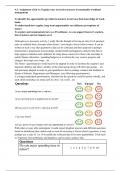
Questions
Do you enjoy spending time in
nature? 1 2 3 4 5 6 7 8 9 10
, 4.2- Assignment (Unit 1): Explain ways to involve learners in sustainable woodland
management
Do you actively pursue
experiences in nature? 1 2 3 4 5 6 7 8 9 10
Did you spend much time in
nature as a child? 1 2 3 4 5 6 7 8 9 10
If so, how often?
1 2 3 4 5 6 7 8 9 10
Are you aware of your impact
when you spend time in nature? 1 2 3 4 5 6 7 8 9 10
There are benefits to be had from immersing a participant in nature and the outdoors:
“…new research suggests that the way to connect to nature is not necessarily
through knowledge, but through beauty, emotion, and sustained contact”
(Lumber et al., 2017).
Other benefits could be:
Increased self-esteem and self-confidence
Improved Social Skills
The development of Language and communication
Improved Physical motor skills.
Improved motivation and concentration
Increased knowledge and understanding
New perspectives for all involved.
The following table also identifies other areas of development that may be experienced
from Forest school participation:
management
To identify the opportunities provided to learners to increase their knowledge of wood-
lands.
To understand how regular, long-term opportunities can influence perceptions of
nature.
To explore and communicate how as a Practitioner, we can support learner's explora-
tion of nature and our impacts on it.
Although not a necessary activity, I really like the thought of having an entry level question-
naire to establish basic concepts when clients / users begin a forest school course. It can be
written in such a way that quantitative data can be collected and then analysed to perhaps
demonstrate a progression in knowledge, mental health and happiness and provide data to
help support evaluation and validation for using these courses (For those who need data to
justify finance allocation / spending/budgets) or to inform the way courses progress and
changes: first steps, next steps…etc.
The forms / questionnaires would need to be adapted in order to facilitate the cognitive and
linguistic abilities and other variables of the client group along with their age groups …etc
and questions adapted in order to gain quantitative data to perhaps evaluate and feedback to
Heads of Schools, Departments and Managers. (see following questionnaire):
A younger participant questionnaire, alternatively the questions could be posed verbally, and
each child could place an emoji card in a box / on a wall…etc
With older or more able participants I would expect lengthier answers and different questions
based on identifying their initial need or want for accessing a Forest school experience. I may
perhaps use a scale of 1 to 10 to enable the collected data to be more quantifiable. Tools such
as Typeform, SurveyMonkey and Qualtrics can be used to achieve this.
Questions
Do you enjoy spending time in
nature? 1 2 3 4 5 6 7 8 9 10
, 4.2- Assignment (Unit 1): Explain ways to involve learners in sustainable woodland
management
Do you actively pursue
experiences in nature? 1 2 3 4 5 6 7 8 9 10
Did you spend much time in
nature as a child? 1 2 3 4 5 6 7 8 9 10
If so, how often?
1 2 3 4 5 6 7 8 9 10
Are you aware of your impact
when you spend time in nature? 1 2 3 4 5 6 7 8 9 10
There are benefits to be had from immersing a participant in nature and the outdoors:
“…new research suggests that the way to connect to nature is not necessarily
through knowledge, but through beauty, emotion, and sustained contact”
(Lumber et al., 2017).
Other benefits could be:
Increased self-esteem and self-confidence
Improved Social Skills
The development of Language and communication
Improved Physical motor skills.
Improved motivation and concentration
Increased knowledge and understanding
New perspectives for all involved.
The following table also identifies other areas of development that may be experienced
from Forest school participation: