Unit 1 2.1 How to identify a range of flora and fauna, detailing identifying traits for
each of them.
The following information is presented from internet research as I’m working in Bavaria and
although I could conduct my studies here in Bavaria, it is my intention to use my Forest School
portfolio back in the UK, in Devon therefore I’d rather my knowledge was garnered and utilised
within the locale of which it may possibly be delivered.
Generic types of Flora to be found in a typical Devon woodland:
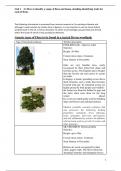
Type of tree photo evidence Written description
ENGLISH OAK – Quercus robur
Statistics
Height: 20-40m
Conservation status :Common.
Seen January to December
Oaks are very familiar trees, easily
recognised by their lobed leaf shape and
tell-tale acorns. The English oak is broader
than the Sessile oak and carries its acorns
on stalks.
It displays a broad, spreading crown above
thick branches and a trunk that becomes
fissured with age. Its autumnal acorns are
highly prized by both people and wildlife -
the former use them for fodder for pigs and
the latter often store them for the long
winter ahead.
Its wood was traditionally used for building
ships and houses and making furniture.
Modern scientific research confirms that
oak possesses the following healing
properties: astringent, fever reducing,
tonic, antiseptic, anti-viral, anti-tumour,
and anti-inflammatory actions. In addition,
oak has been used to get rid of worms and
other parasites.
SILVER BIRCH -Betula pendula
Statistics
Height: up to 30m
Conservation status: Common.
Seen January to December.
Birches are easily recognised by their
white, papery bark. The Silver birch has
'drooping' branches and triangular leaves,
1
,Unit 1 2.1 How to identify a range of flora and fauna, detailing identifying traits for
each of them.
with jagged teeth that grow from hairless
leaf stalks. The leaves of the similar
Downy Birch grow from hairy stalks and
more rounded; it also has more upright
branches.
The Silver birch is a familiar, small,
spindly tree with thin branches and papery
bark. It is found on heathland, moorland
and mountainsides, as well as on dry,
sandy soils. In spring, the male catkins (or
'lamb's tails') turn yellow and shed their
pollen, which is carried by the wind to the
short, green, female catkins that appear on
the same tree. One of the first trees to
recolonise the UK after the last glacial
period, it is an opportunistic species; its
seeds are produced in huge numbers and
dispersed easily by the wind.
The Silver Birch tree has a multitude of
medicinal properties and has also
previously been used for boat building.
ROWAN TREE – Sorbus Aucuparia
Statistics
Height: 8-15m
Conservation status: Common.
Seen January to December
Rowan has Ash-like leaves (15 leaflets
arranged in pairs) with toothed edges. It
displays five-petalled, creamy-white
flowers in clusters, followed by masses of
red berries.
Often found on mountains and heathland,
and along woodland edges; it is also
frequently planted in towns and gardens. It
is slender tree, with creamy-white, spring
flowers and clusters of bright red, autumn
berries - a favourite food of birds, such as
visiting Waxwings, Redwings and other
thrushes.
By eating the berries, these birds help the
tree to disperse its seeds.
2
,Unit 1 2.1 How to identify a range of flora and fauna, detailing identifying traits for
each of them.
Preparations from rowan berries can help
get rid of phlegm stuck in the throat, boost
immunity and combat nausea, but also
promote eye health and skin health,
initiating reparative processes at cell level.
Hazel – Corylus avellana
Family – Betulaceae
Type – shrub
Height – 13 to 20 feet (4 to 6 meters)
Exposure – full sun
Soil – ordinary, rather light
Foliage – deciduous
Flowering – February to April
Harvest – Autumn
Has shiny, brown bark and almost circu-
lar, toothed leaves with soft hairs on their
undersides. It displays long, yellow cat-
kins in spring, and provides a crop of ha-
zelnuts in late summer.
Its a small, shrubby tree that can be found
in a variety of habitats, such as wood-
lands, gardens and grasslands. It is famous
for its long, yellow, male catkins (known
as 'lamb's-tails') that appear in spring, and
its green, ripening to brown, fruits (famil-
iar to us as 'hazelnuts') that appear in late
summer. These nuts are a favourite food
of grey squirrels, dormice and wood mice,
and some small mammals will cache their
finds, storing them in burrows or old birds'
nests.
Known to produce a very strong antioxi-
dant, which can reduce damage caused in
the body by free radicals which are in-
volved in triggering diseases such as car-
diovascular, cancers and illnesses due to
aging.
HOLLY – Ilex aquifolium
Statistics
3
, Unit 1 2.1 How to identify a range of flora and fauna, detailing identifying traits for
each of them.
Height: up to 15m
Conservation status: Common.
Seen January to December
Recognised by its combination of dark
green, spiny, evergreen leaves and small,
bright red berries.
Holly is one of our most familiar ever-
green trees, its bright red berries and
glossy leaves bringing colour and life into
our gardens and homes in winter, particu-
larly at Christmas (the berries and thorny
leaves are said to symbolise Jesus's blood
on the crown of thorns). Our wildlife en-
joys Holly, too: the berries are an im-
portant food source for many birds like
Redwings and Fieldfares; indeed, Mistle
thrushes guard their own berry-laden
bushes with such voracity that they'll
chase off any potential thieves. Holly can
be found in a variety of habitats, from re-
mote woodland to urban gardens.
The fresh or dried leaves can be used in
herbal medicine in the form of tea or
alcohol-based extract THE FRUIT IS
POISONOUS.
Type of plant photo evidence Written description
4
each of them.
The following information is presented from internet research as I’m working in Bavaria and
although I could conduct my studies here in Bavaria, it is my intention to use my Forest School
portfolio back in the UK, in Devon therefore I’d rather my knowledge was garnered and utilised
within the locale of which it may possibly be delivered.
Generic types of Flora to be found in a typical Devon woodland:
Type of tree photo evidence Written description
ENGLISH OAK – Quercus robur
Statistics
Height: 20-40m
Conservation status :Common.
Seen January to December
Oaks are very familiar trees, easily
recognised by their lobed leaf shape and
tell-tale acorns. The English oak is broader
than the Sessile oak and carries its acorns
on stalks.
It displays a broad, spreading crown above
thick branches and a trunk that becomes
fissured with age. Its autumnal acorns are
highly prized by both people and wildlife -
the former use them for fodder for pigs and
the latter often store them for the long
winter ahead.
Its wood was traditionally used for building
ships and houses and making furniture.
Modern scientific research confirms that
oak possesses the following healing
properties: astringent, fever reducing,
tonic, antiseptic, anti-viral, anti-tumour,
and anti-inflammatory actions. In addition,
oak has been used to get rid of worms and
other parasites.
SILVER BIRCH -Betula pendula
Statistics
Height: up to 30m
Conservation status: Common.
Seen January to December.
Birches are easily recognised by their
white, papery bark. The Silver birch has
'drooping' branches and triangular leaves,
1
,Unit 1 2.1 How to identify a range of flora and fauna, detailing identifying traits for
each of them.
with jagged teeth that grow from hairless
leaf stalks. The leaves of the similar
Downy Birch grow from hairy stalks and
more rounded; it also has more upright
branches.
The Silver birch is a familiar, small,
spindly tree with thin branches and papery
bark. It is found on heathland, moorland
and mountainsides, as well as on dry,
sandy soils. In spring, the male catkins (or
'lamb's tails') turn yellow and shed their
pollen, which is carried by the wind to the
short, green, female catkins that appear on
the same tree. One of the first trees to
recolonise the UK after the last glacial
period, it is an opportunistic species; its
seeds are produced in huge numbers and
dispersed easily by the wind.
The Silver Birch tree has a multitude of
medicinal properties and has also
previously been used for boat building.
ROWAN TREE – Sorbus Aucuparia
Statistics
Height: 8-15m
Conservation status: Common.
Seen January to December
Rowan has Ash-like leaves (15 leaflets
arranged in pairs) with toothed edges. It
displays five-petalled, creamy-white
flowers in clusters, followed by masses of
red berries.
Often found on mountains and heathland,
and along woodland edges; it is also
frequently planted in towns and gardens. It
is slender tree, with creamy-white, spring
flowers and clusters of bright red, autumn
berries - a favourite food of birds, such as
visiting Waxwings, Redwings and other
thrushes.
By eating the berries, these birds help the
tree to disperse its seeds.
2
,Unit 1 2.1 How to identify a range of flora and fauna, detailing identifying traits for
each of them.
Preparations from rowan berries can help
get rid of phlegm stuck in the throat, boost
immunity and combat nausea, but also
promote eye health and skin health,
initiating reparative processes at cell level.
Hazel – Corylus avellana
Family – Betulaceae
Type – shrub
Height – 13 to 20 feet (4 to 6 meters)
Exposure – full sun
Soil – ordinary, rather light
Foliage – deciduous
Flowering – February to April
Harvest – Autumn
Has shiny, brown bark and almost circu-
lar, toothed leaves with soft hairs on their
undersides. It displays long, yellow cat-
kins in spring, and provides a crop of ha-
zelnuts in late summer.
Its a small, shrubby tree that can be found
in a variety of habitats, such as wood-
lands, gardens and grasslands. It is famous
for its long, yellow, male catkins (known
as 'lamb's-tails') that appear in spring, and
its green, ripening to brown, fruits (famil-
iar to us as 'hazelnuts') that appear in late
summer. These nuts are a favourite food
of grey squirrels, dormice and wood mice,
and some small mammals will cache their
finds, storing them in burrows or old birds'
nests.
Known to produce a very strong antioxi-
dant, which can reduce damage caused in
the body by free radicals which are in-
volved in triggering diseases such as car-
diovascular, cancers and illnesses due to
aging.
HOLLY – Ilex aquifolium
Statistics
3
, Unit 1 2.1 How to identify a range of flora and fauna, detailing identifying traits for
each of them.
Height: up to 15m
Conservation status: Common.
Seen January to December
Recognised by its combination of dark
green, spiny, evergreen leaves and small,
bright red berries.
Holly is one of our most familiar ever-
green trees, its bright red berries and
glossy leaves bringing colour and life into
our gardens and homes in winter, particu-
larly at Christmas (the berries and thorny
leaves are said to symbolise Jesus's blood
on the crown of thorns). Our wildlife en-
joys Holly, too: the berries are an im-
portant food source for many birds like
Redwings and Fieldfares; indeed, Mistle
thrushes guard their own berry-laden
bushes with such voracity that they'll
chase off any potential thieves. Holly can
be found in a variety of habitats, from re-
mote woodland to urban gardens.
The fresh or dried leaves can be used in
herbal medicine in the form of tea or
alcohol-based extract THE FRUIT IS
POISONOUS.
Type of plant photo evidence Written description
4