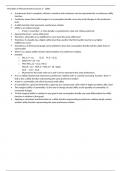
Principles of Microeconomics Lecture 3 – utility
A preference that is complete, reflexive, transitive and continuous can be represented by a continuous utility
function
Continuity means that small changes to a consumption bundle cause only small changes to the preference
level
A utility function U(x) represents a preference relation
Utility is an ordinal concept
o If U(x) = 6 and U(y) = 2, then bundle x is preferred to y but not 3 times preferred
Equal preferences = same utility level
Therefore, all bundles in an indifference curve have the same utility level
Therefore, if a bundle has a higher utility level than another that first bundle must be on a higher
indifference curve
Sometimes a 3 dimensional graph can be plotted to show the consumption bundle and the utility level of
each bundle
There is no unique utility function representation of a preference relation
Example
o U(x1,x2) = x1x2 (2,3) (4,1) ~ (2,2).
o Define W = 2U + 10.
o Then W(x1,x2) = 2x1x2+10 so
W(2,3) = 22 > W(4,1) = W(2,2) = 18. Again,
(2,3) (4,1) ~ (2,2).
o W preserves the same order as U and V and so represents the same preferences.
If U is a utility function that represents a preference relation and f is a strictly increasing function, then V =
f(U) is also a utility function representing the same preference relation
A bad is a commodity unit which decreases with utility
It is possible for a good to behave like a good up to a certain point, after which it begins to behave like a bad
The marginal utility of commodity i is the rate-of change of total utility as the quantity of commodity i is
consumed changes
To find marginal utility in relation to one good in the consumption bundle you must differentiate the utility
function in relation to that good
Applying a monotonic transformation to a utility function representing a preference relation simply creates
another utility function representing the same preference relation
A preference that is complete, reflexive, transitive and continuous can be represented by a continuous utility
function
Continuity means that small changes to a consumption bundle cause only small changes to the preference
level
A utility function U(x) represents a preference relation
Utility is an ordinal concept
o If U(x) = 6 and U(y) = 2, then bundle x is preferred to y but not 3 times preferred
Equal preferences = same utility level
Therefore, all bundles in an indifference curve have the same utility level
Therefore, if a bundle has a higher utility level than another that first bundle must be on a higher
indifference curve
Sometimes a 3 dimensional graph can be plotted to show the consumption bundle and the utility level of
each bundle
There is no unique utility function representation of a preference relation
Example
o U(x1,x2) = x1x2 (2,3) (4,1) ~ (2,2).
o Define W = 2U + 10.
o Then W(x1,x2) = 2x1x2+10 so
W(2,3) = 22 > W(4,1) = W(2,2) = 18. Again,
(2,3) (4,1) ~ (2,2).
o W preserves the same order as U and V and so represents the same preferences.
If U is a utility function that represents a preference relation and f is a strictly increasing function, then V =
f(U) is also a utility function representing the same preference relation
A bad is a commodity unit which decreases with utility
It is possible for a good to behave like a good up to a certain point, after which it begins to behave like a bad
The marginal utility of commodity i is the rate-of change of total utility as the quantity of commodity i is
consumed changes
To find marginal utility in relation to one good in the consumption bundle you must differentiate the utility
function in relation to that good
Applying a monotonic transformation to a utility function representing a preference relation simply creates
another utility function representing the same preference relation