HOPB – BREAST DISEASES
BENIGN BREAST DISEASE
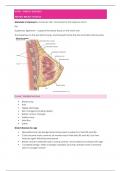
Glandular component – produces milk, connected to the nipple by ducts
Fat
Suspensory ligaments – suspend the breast tissue on the chest wall
The breast lies on the pectoral muscle, and beneath this lie the ribs and intercostal muscles.
CLINIC PRESENTATIONS
Breast lump
Pain
Nipple discharge
Skin changes (including nipple)
Breast contour changes
Axillary lump
Infection
Other
Breast diseases by age
Fibroadenomas are benign breast lumps seen in patients in their 20s and 30s
Cysts become more common as women reach their late 30s and 40s, but then
reduces again following menopause
Breast cancer is relatively rare in young women, and incidence increases with age
‘Localised benign’ refers to benign nodularity (or lumpy breasts) more commonly
seen in younger women
, ASSESSMENT
Gold standard = triple assessment
1. History and clinical examination
2. Imaging (US mammography)
3. Pathology
a. Fine needle aspiration
b. Core biopsy – more standard approach due to greater amount of information
yielded, but samples take time to process and interpret and results are not
available on the same day.
HISTORY
HPC
o Duration of symptoms
o Associated skin changes
New lump + associated skin dimpling is worrying for cancer
Lump which gets bigger pre-period and then shrinks is more likely to be
benign
o Nipple discharge
Spontaneous and blood-stained discharge is more likely to be related
to underlying pathology than white, green, or yellow ‘physiological’
discharge
o Axillary lumps
Can be benign or malignant, but if associated with sweats, weight loss,
fatigue should raise suspicion of non-breast malignancy such as
lymphoma
o Pain – breast pain is actually often chest wall in origin and may be related to
job/hobbies
Risk factors
2
BENIGN BREAST DISEASE
Glandular component – produces milk, connected to the nipple by ducts
Fat
Suspensory ligaments – suspend the breast tissue on the chest wall
The breast lies on the pectoral muscle, and beneath this lie the ribs and intercostal muscles.
CLINIC PRESENTATIONS
Breast lump
Pain
Nipple discharge
Skin changes (including nipple)
Breast contour changes
Axillary lump
Infection
Other
Breast diseases by age
Fibroadenomas are benign breast lumps seen in patients in their 20s and 30s
Cysts become more common as women reach their late 30s and 40s, but then
reduces again following menopause
Breast cancer is relatively rare in young women, and incidence increases with age
‘Localised benign’ refers to benign nodularity (or lumpy breasts) more commonly
seen in younger women
, ASSESSMENT
Gold standard = triple assessment
1. History and clinical examination
2. Imaging (US mammography)
3. Pathology
a. Fine needle aspiration
b. Core biopsy – more standard approach due to greater amount of information
yielded, but samples take time to process and interpret and results are not
available on the same day.
HISTORY
HPC
o Duration of symptoms
o Associated skin changes
New lump + associated skin dimpling is worrying for cancer
Lump which gets bigger pre-period and then shrinks is more likely to be
benign
o Nipple discharge
Spontaneous and blood-stained discharge is more likely to be related
to underlying pathology than white, green, or yellow ‘physiological’
discharge
o Axillary lumps
Can be benign or malignant, but if associated with sweats, weight loss,
fatigue should raise suspicion of non-breast malignancy such as
lymphoma
o Pain – breast pain is actually often chest wall in origin and may be related to
job/hobbies
Risk factors
2