Macbeth
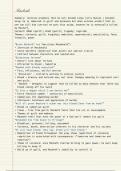
Summary: receives prophecy that he will become king; kills Duncan + becomes
king; he is immersed in guilt and paranoia but when witches predict that no
one can kill him (untrue) he puts this aside, however he is eventually killed
by Macduff.
Context: DRoK (guilt); GCoB (guilt); tragedy; regicide
Themes: violence; guilt; kingship; ambition; supernatural; masculinity; fate;
freewill; power
“Brave Macbeth” (vs “merciless Macdonald”)
• Inversion of Macdonald
• Stock epithets (adjective that points out special traits)
• Contrast between characters and reputations
“Disdaining fortune”
• Doesn’t care about fortune
• Attracted to blood - hamartia
“Smoked with bloody execution”
• Fury, efficiency, skilful warrior
• ‘Execution’ - initially working to achieve justice
• Blood = bravery and heroism now, but later changes meaning to represent evil
and guilt.
• ‘Smoked’ - metaphor to suggest that he killed so many enemies that there was
blood coming off his sword
“Is this a dagger which I see before me?”
• Extra feminine symbol - insecurity of masculinity
• Symbolises the impending murder
• Sibilance: harshness and aggression of murder
“Will all great Neptune’s ocean was this blood/Clean from my hand?”
• Blood to symbolise guilt
• Clean - free from guilt; Macbeth feels that his sin is inescapable
• Themes of guilt and madness
• Macbeth feels that even the power of a God won’t remove his guilt
“Unseamed him from knave to th’chaps”
• Bloodlust, personal, killing, enjoyment
• Violence, death, destruction inherent to his character and his society
“It will have blood; they say, blood will have blood.”
• Repetition of blood throughout the play shows repetition of violence;
repetition is associated with consequences (“tomorrow and tomorrow and
tomorrow”)
• Theme of violence: once Macbeth started killing to gain power, he must keep
killing to keep it
• Build up of guilt, and Macbeth’s inability to control it
,Lady Macbeth
“Glamis thou art, and Cawdor, and shalt be/ What thou art promised; yet do I
fear thy nature,/ It is too full o’th’milk or human kindness/ To catch the
nearest way.” (A1S5)
• Follows the same structure as the Witches’ prophecies, implying she has her
own psychic abilities and associating her with the supernatural.
• Lady Macbeth ‘fear[s]’ Macbeth’s kind nature; fear is typically associated
with evil/supernatural but Lady Macbeth, in fearing Macbeth’s kindness,
implies that morality is a frightening and threatening thing.
• “Nature” = Macbeth’s mortal soul, she is referring to Macbeth’s true
identity and presenting his as someone whose moral compass is inherent and
permanent.
• Ancient medicine - four different fluids: by saying that Macbeth is ‘too
full’ of ‘milk’ she may be saying that he is ill or mentally imbalanced.
• Connotes breastfeeding - femininity of Macbeth (constantly criticised)
“Come, you spirits/that tend on mortal thoughts, unsex me here/ And fill me
from the crown to the toe topfull/ Of direst cruelty;…Come to my woman’s
breasts/ And take my milk for gall, you murd’ring ministers.” (A1S5)
• This is a pivotal moment in her character development - dedicating herself
entirely to conspiracy, willing to sacrifice her own mind and body to any
evil spirits that may help her to reach her goal.
• Use of anatomy makes her speech feel invasive and uncomfortable, and shows
how she wants to mutate into something else.
• Another link to ancient medicine and the four humours - asking for a change
to her true nature.
• ‘Unsex’ - theme of gender, conveys androgyny and ambiguity. Shakespeare
implies that gender is a sign of humanity; by being ‘unsex[ed]’, Lady
Macbeth would escape the gender binary altogether and would be removed from
humanity, freeing her from the burdens and weaknesses of morality and
conscience.
“Look like th’innocent flower,/ But be the serpent under’t”
• Explicit nod to appearance vs reality, with LMB instructing her husband on
how to fool everyone around them. Shakespeare shows how she intends to
exploit the differences between her own appearance vs reality, and to
exploit how gullible our senses are, to achieve her own goal.
• Contrast between nature and evil - asks Macbeth to hide his humanity and
femininity
“Nought’s had, all’s spent/ Where our desire is got without content. ‘It’s
safer to be that which we destroy/ Than by destruction swell in doubtful joy.”
(A3S2)
• Parallel phrases (nought vs all) shows how LMB thinks in black-and-white,
she goes from one extreme to the other, showing that she sees no value in
their actions w/o success.
• Comparative adjective (‘safer’) implies fear and suggests that she is aware
of their dangerous position.
• ‘Dwell in doubtful joy’ - uncertainty and hesitancy; mimics chattering teeth
, Banquo
“The Earth hath bubbles” & “Have we eaten on the insane root?”
• Demonstrates how Banquo works to distance himself from the witches whilst
Macbeth aligns himself with them.
• The contemporary audience would recognise the witches as a force of evil and
thus favour Banquo, whilst a modern audience would perhaps view the witches
as numerous, due to the lack of a belief in witches’ existence.
“If you can look into the seeds of time,/ And say which train will grow and
which will not,/ Speak then to me, who neither beg nor fear/ Your favours not
your hate.” (A1S3)
• Demonstrates that though Banquo is interested by the prophecy and does show
his own ambition, the ambition he possesses is not as strong as Macbeth’s.
• In this situation, he remains composed and in control.
• This reveals reveals that Banquo is very moralistic and a responsible
character who is not easily led astray.
• Creates a strong character due to his ability to resist the temptation of
evil/allure of supernatural/intrigue at potential to see future
“And oftentimes, to win us our harm,/ The instruments of darkness tell us
truths,/ Win us with honest trifles, to betray’s/ In deepest consequence.”
• Banquo notes that the stories told by the witches may be attempts to
manipulate Macbeth.
• Poses the question of fate vs free will.
• Concludes a paradoxical phrase - “honest trifles” that “betray”.
• Banquo therefore argues that he and Macbeth should resist believing the
witches too much, despite the fact that they have so far been correct in
their prophecies. This belief posits a worldview in which humans can act
freely from supernatural forces - positions Banquo as a morally correct
character.
• Foreshadows Macbeth’s betrayal of Banquo (because of witches prophecy)
“Lesser than Macbeth, and greater.// Not so happy, yet much happier.// Thou
shalt get kings, though thou be none.” (A1S3)
• No primogeniture
• Paradoxes - Banquo believed to be James I’s ancestor, ‘proves’ prophecy -
Fleance = first Stuart king
”Our fears in Banquo/ Stick deep, and in his royalty of nature/ Reigns that
which would be feared.”
• Macbeth is shown to fear Banquo’s “royalty of nature”.
• Banquo has had the same experience as Macbeth, yet Banquo has responded as
Macbeth should have. This means Banquo serves as a constant reflection of how
Macbeth should have acted. He also serves as a constant reminder of the
morality Macbeth started with and is losing.
Banquo is a Scottish nobleman, general and friend of Macbeth. He is also the
father of Fleance. The weird sisters prophecy that, while Banquo will never be
king of Scotland, his descendants will one day sit on the throne. Banquo is as
ambitious as Macbeth but resists prioritising selfish ambition.
Summary: receives prophecy that he will become king; kills Duncan + becomes
king; he is immersed in guilt and paranoia but when witches predict that no
one can kill him (untrue) he puts this aside, however he is eventually killed
by Macduff.
Context: DRoK (guilt); GCoB (guilt); tragedy; regicide
Themes: violence; guilt; kingship; ambition; supernatural; masculinity; fate;
freewill; power
“Brave Macbeth” (vs “merciless Macdonald”)
• Inversion of Macdonald
• Stock epithets (adjective that points out special traits)
• Contrast between characters and reputations
“Disdaining fortune”
• Doesn’t care about fortune
• Attracted to blood - hamartia
“Smoked with bloody execution”
• Fury, efficiency, skilful warrior
• ‘Execution’ - initially working to achieve justice
• Blood = bravery and heroism now, but later changes meaning to represent evil
and guilt.
• ‘Smoked’ - metaphor to suggest that he killed so many enemies that there was
blood coming off his sword
“Is this a dagger which I see before me?”
• Extra feminine symbol - insecurity of masculinity
• Symbolises the impending murder
• Sibilance: harshness and aggression of murder
“Will all great Neptune’s ocean was this blood/Clean from my hand?”
• Blood to symbolise guilt
• Clean - free from guilt; Macbeth feels that his sin is inescapable
• Themes of guilt and madness
• Macbeth feels that even the power of a God won’t remove his guilt
“Unseamed him from knave to th’chaps”
• Bloodlust, personal, killing, enjoyment
• Violence, death, destruction inherent to his character and his society
“It will have blood; they say, blood will have blood.”
• Repetition of blood throughout the play shows repetition of violence;
repetition is associated with consequences (“tomorrow and tomorrow and
tomorrow”)
• Theme of violence: once Macbeth started killing to gain power, he must keep
killing to keep it
• Build up of guilt, and Macbeth’s inability to control it
,Lady Macbeth
“Glamis thou art, and Cawdor, and shalt be/ What thou art promised; yet do I
fear thy nature,/ It is too full o’th’milk or human kindness/ To catch the
nearest way.” (A1S5)
• Follows the same structure as the Witches’ prophecies, implying she has her
own psychic abilities and associating her with the supernatural.
• Lady Macbeth ‘fear[s]’ Macbeth’s kind nature; fear is typically associated
with evil/supernatural but Lady Macbeth, in fearing Macbeth’s kindness,
implies that morality is a frightening and threatening thing.
• “Nature” = Macbeth’s mortal soul, she is referring to Macbeth’s true
identity and presenting his as someone whose moral compass is inherent and
permanent.
• Ancient medicine - four different fluids: by saying that Macbeth is ‘too
full’ of ‘milk’ she may be saying that he is ill or mentally imbalanced.
• Connotes breastfeeding - femininity of Macbeth (constantly criticised)
“Come, you spirits/that tend on mortal thoughts, unsex me here/ And fill me
from the crown to the toe topfull/ Of direst cruelty;…Come to my woman’s
breasts/ And take my milk for gall, you murd’ring ministers.” (A1S5)
• This is a pivotal moment in her character development - dedicating herself
entirely to conspiracy, willing to sacrifice her own mind and body to any
evil spirits that may help her to reach her goal.
• Use of anatomy makes her speech feel invasive and uncomfortable, and shows
how she wants to mutate into something else.
• Another link to ancient medicine and the four humours - asking for a change
to her true nature.
• ‘Unsex’ - theme of gender, conveys androgyny and ambiguity. Shakespeare
implies that gender is a sign of humanity; by being ‘unsex[ed]’, Lady
Macbeth would escape the gender binary altogether and would be removed from
humanity, freeing her from the burdens and weaknesses of morality and
conscience.
“Look like th’innocent flower,/ But be the serpent under’t”
• Explicit nod to appearance vs reality, with LMB instructing her husband on
how to fool everyone around them. Shakespeare shows how she intends to
exploit the differences between her own appearance vs reality, and to
exploit how gullible our senses are, to achieve her own goal.
• Contrast between nature and evil - asks Macbeth to hide his humanity and
femininity
“Nought’s had, all’s spent/ Where our desire is got without content. ‘It’s
safer to be that which we destroy/ Than by destruction swell in doubtful joy.”
(A3S2)
• Parallel phrases (nought vs all) shows how LMB thinks in black-and-white,
she goes from one extreme to the other, showing that she sees no value in
their actions w/o success.
• Comparative adjective (‘safer’) implies fear and suggests that she is aware
of their dangerous position.
• ‘Dwell in doubtful joy’ - uncertainty and hesitancy; mimics chattering teeth
, Banquo
“The Earth hath bubbles” & “Have we eaten on the insane root?”
• Demonstrates how Banquo works to distance himself from the witches whilst
Macbeth aligns himself with them.
• The contemporary audience would recognise the witches as a force of evil and
thus favour Banquo, whilst a modern audience would perhaps view the witches
as numerous, due to the lack of a belief in witches’ existence.
“If you can look into the seeds of time,/ And say which train will grow and
which will not,/ Speak then to me, who neither beg nor fear/ Your favours not
your hate.” (A1S3)
• Demonstrates that though Banquo is interested by the prophecy and does show
his own ambition, the ambition he possesses is not as strong as Macbeth’s.
• In this situation, he remains composed and in control.
• This reveals reveals that Banquo is very moralistic and a responsible
character who is not easily led astray.
• Creates a strong character due to his ability to resist the temptation of
evil/allure of supernatural/intrigue at potential to see future
“And oftentimes, to win us our harm,/ The instruments of darkness tell us
truths,/ Win us with honest trifles, to betray’s/ In deepest consequence.”
• Banquo notes that the stories told by the witches may be attempts to
manipulate Macbeth.
• Poses the question of fate vs free will.
• Concludes a paradoxical phrase - “honest trifles” that “betray”.
• Banquo therefore argues that he and Macbeth should resist believing the
witches too much, despite the fact that they have so far been correct in
their prophecies. This belief posits a worldview in which humans can act
freely from supernatural forces - positions Banquo as a morally correct
character.
• Foreshadows Macbeth’s betrayal of Banquo (because of witches prophecy)
“Lesser than Macbeth, and greater.// Not so happy, yet much happier.// Thou
shalt get kings, though thou be none.” (A1S3)
• No primogeniture
• Paradoxes - Banquo believed to be James I’s ancestor, ‘proves’ prophecy -
Fleance = first Stuart king
”Our fears in Banquo/ Stick deep, and in his royalty of nature/ Reigns that
which would be feared.”
• Macbeth is shown to fear Banquo’s “royalty of nature”.
• Banquo has had the same experience as Macbeth, yet Banquo has responded as
Macbeth should have. This means Banquo serves as a constant reflection of how
Macbeth should have acted. He also serves as a constant reminder of the
morality Macbeth started with and is losing.
Banquo is a Scottish nobleman, general and friend of Macbeth. He is also the
father of Fleance. The weird sisters prophecy that, while Banquo will never be
king of Scotland, his descendants will one day sit on the throne. Banquo is as
ambitious as Macbeth but resists prioritising selfish ambition.