

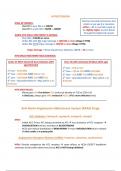
HYPERTENSION
Arterial vasculature becomes less
IDEAL BP RANGES: elastic as we age (i.e. becomes
- Ideal BP in over 80s = < 150/90 stiffer) – BP in over 80s needs to
- Ideal BP in under 80s = 90/60 – 120/80 be slightly higher to push blood
through the tightened vessels
WHEN HTN DRUG-TREATMENT IS NEEDED:
- Over 80s = 150/90 or more
- Under 80s with NO organ damage = 160/100 or more (Stage II HTN)
- Under 80s WITH organ damage = 140/90 or more (Stage I HTN)
Organ Damage = Renal impairment, Diabetes, QRISK = 10 or more
HTN DRUG TREATMENT NICE GUIDANCE:
Under 55 (NOT black) OR have Diabetes (ANY Over 55 (ANY ethnicity) OR Black (ANY age)
age/ethnicity)
1st Line – CCB or TLD
1st Line – ACEi/ARB 2nd Line – CCB or TLD AND ACEi/ARB
2nd Line – ACEi/ARB AND CCB or TLD 3rd Line – CCB AND TLD AND ACEi/ARB
3rd Line – ACEi/ARB AND CCB AND TLD 4th Line – Specialist Referral – May add in α or
4th Line – Specialist Referral – May add in α or β-blocker
β-blocker
HTN DRUG RULES:
- Always give CCB first before TLD (unless pt already on TLD or CCB is CI)
- In Black pts, always give ARBs instead of ACEIs (ARBs more effective here)
Anti-Renin-Angiotensin-Aldosterone System (RAAS) Drugs
ACE inhibitors: lisinopril, captopril, enalapril, ramipril
MOA:
- Inhibit ACE less AT1 being converted to ATII less activation of AT1 receptors
VASODILATION and less secretion of ALDOSTERONE
- ACEis also reduce breakdown of BRADYKININ more VASODILATION due to release
of nitric oxide and prostacyclin
Angiotensin Receptor Blockers (ARBs): losartan, valsartan, candesartan
MOA: Directly antagonise the AT1 receptor same effects as ACEis EXCEPT bradykinin
continues to be broken down here (since ACE is NOT being inhibited)
, Both ACEis and ARBs have a vasodilatory effect in the RENAL ARTERY – improves renal
blood flow and reduces risk of kidney injury.
SIDE EFFECTS:
- HYPOTENSION: can present as postural, headaches, dizziness
- HYPERKALAEMIA: normally aldosterone induces hypervolemia by reabsorbing Na +
into the blood and excreting K + into the urine – anti-RAAS drugs reverse this. More
common in pre-existing renal disease and DIABETES.
- ANGIOEDEMA – MAINLY ACEis: build-up of bradykinin creates swelling/oedema in
the dermis (under the epidermis) and mucosal tissues – mainly affects LIPS, TONGUE,
and FACE. – similar to allergic reaction (BUT NO HISTAMINE IS INVOLVED)
- PERISITENT DRY COUGH – MAINLY ACEis: build-up of bradykinin induces coughing
Bradykinin is a PRO-INFLAMMATORY mediator – so causes cough and angioedema
- NEPHROTOXICITY: normally ATII maintains
higher pressure in EFFERENT arteriole high
glomerular pressure needed to maintain
normal kidney function; anti-RAAS drugs
antagonise this mechanism – so filtering
properties of glomerulus is REDUCED.
CONTRA-INDICATIONS:
- BILATERAL RENAL ARTERY STENOSIS: narrowing of renal arteries - ACEis reduce
filtering abilities of glomerulus, so using them in stenosis exacerbates this effect
AZOTEMIA (build-up of nitrogen-containing compounds in blood e.g. urea)
- ANGIOEDEMA: can be hereditary or pt may have had a previous ACEi-induced
reaction
COMMON INTERACTIONS:
- HYPERKALEMIC DRUGS: Anti-RAAS, Amiloride, Heparins
- NSAIDs: renal impairment & HYPERKALAEMIA
- Lithium: renal impairment
- Azathioprine: Anaemia risk
, Alpha1-SELECTIVE Blockers: Doxazosin, Prazosin, Indoramin
MOA:
- Antagonise post-synaptic alpha1 receptors on vascular smooth muscle less binding
of catecholamines (e.g. NA) VASODILATION
SIDE EFFECTS:
- HYPOTENSION: especially upon 1st dose (can cause falls) – 1st doses should be taken
BEFORE BED, then pt can begin taking doses during the day if unaffected by ADRs
Tamsulosin and Alfusozin are also selective α1-adrenoreceptor antagonists – but they have
a HIGHER AFFINITY for receptors lining the PROSTATE – so are indicated mainly for BPH
(vice versa for Doxazosin, Prazosin, and Indoramin)
β-BLOCKERS
CLASSIFYING β-BLOCKERS (βBs):
- Almost ALL ORAL βBs are CARDIOSELECTIVE i.e. antagonise mainly the β1 receptors
in cardiac muscle
- Propranolol, Nadolol, Sotalol, Labetalol, & Carvedilol are the only ORAL βBs that are
NON-SELECTIVE (i.e. bind to β1 AND β2 subtypes)
Most of the NON-selective βBs’ names do NOT end in ‘-olol’ (e.g. Carvedilol, Labetalol)
- More cardioselectivity = better for cardiovascular conditions:
o Heart Failure (1st line w/ ACEi/ARB & Diuretics)
o Arrythmias (1st line in Rate & Rhythm control)
o Stable Angina (1st line in PROPHYLAXIS – not acute treatment)
o Hypertension (NOT in NICE guidance i.e NOT 1st line)
- NON-selectivity = better for NON-cardiovascular conditions: Some non-selective βBs can
o Treating anxiety-like symptoms (e.g. tremor & sweating) still be used in cardiac
o Migraine Prophylaxis conditions (but there are
better & safer options)
βB SOLUBILITY:
- All βBs are LIPID-soluble EXCEPT for: Atenolol (cardio-selective), Nadolol, Sotalol
- These βBs are WATER SOLUBLE – do NOT cross the BBB LESS CNS effects
- Main CNS effects = NIGHTMARES & DISTURBED SLEEP
- Although they’re better in avoiding CNS effects, they are more readily excreted via
KIDNEYS – so need frequent adjustment in RENAL IMPAIRMENT
βBs MOA:
- βBs mainly block β1 receptors in the heart reduced cardiac output reduces BP
- Unlike other anti-HTNs, βBs do NOT have direct vasodilatory effects on vascular
smooth muscle (as they mainly work on cardiac muscle)
Arterial vasculature becomes less
IDEAL BP RANGES: elastic as we age (i.e. becomes
- Ideal BP in over 80s = < 150/90 stiffer) – BP in over 80s needs to
- Ideal BP in under 80s = 90/60 – 120/80 be slightly higher to push blood
through the tightened vessels
WHEN HTN DRUG-TREATMENT IS NEEDED:
- Over 80s = 150/90 or more
- Under 80s with NO organ damage = 160/100 or more (Stage II HTN)
- Under 80s WITH organ damage = 140/90 or more (Stage I HTN)
Organ Damage = Renal impairment, Diabetes, QRISK = 10 or more
HTN DRUG TREATMENT NICE GUIDANCE:
Under 55 (NOT black) OR have Diabetes (ANY Over 55 (ANY ethnicity) OR Black (ANY age)
age/ethnicity)
1st Line – CCB or TLD
1st Line – ACEi/ARB 2nd Line – CCB or TLD AND ACEi/ARB
2nd Line – ACEi/ARB AND CCB or TLD 3rd Line – CCB AND TLD AND ACEi/ARB
3rd Line – ACEi/ARB AND CCB AND TLD 4th Line – Specialist Referral – May add in α or
4th Line – Specialist Referral – May add in α or β-blocker
β-blocker
HTN DRUG RULES:
- Always give CCB first before TLD (unless pt already on TLD or CCB is CI)
- In Black pts, always give ARBs instead of ACEIs (ARBs more effective here)
Anti-Renin-Angiotensin-Aldosterone System (RAAS) Drugs
ACE inhibitors: lisinopril, captopril, enalapril, ramipril
MOA:
- Inhibit ACE less AT1 being converted to ATII less activation of AT1 receptors
VASODILATION and less secretion of ALDOSTERONE
- ACEis also reduce breakdown of BRADYKININ more VASODILATION due to release
of nitric oxide and prostacyclin
Angiotensin Receptor Blockers (ARBs): losartan, valsartan, candesartan
MOA: Directly antagonise the AT1 receptor same effects as ACEis EXCEPT bradykinin
continues to be broken down here (since ACE is NOT being inhibited)
, Both ACEis and ARBs have a vasodilatory effect in the RENAL ARTERY – improves renal
blood flow and reduces risk of kidney injury.
SIDE EFFECTS:
- HYPOTENSION: can present as postural, headaches, dizziness
- HYPERKALAEMIA: normally aldosterone induces hypervolemia by reabsorbing Na +
into the blood and excreting K + into the urine – anti-RAAS drugs reverse this. More
common in pre-existing renal disease and DIABETES.
- ANGIOEDEMA – MAINLY ACEis: build-up of bradykinin creates swelling/oedema in
the dermis (under the epidermis) and mucosal tissues – mainly affects LIPS, TONGUE,
and FACE. – similar to allergic reaction (BUT NO HISTAMINE IS INVOLVED)
- PERISITENT DRY COUGH – MAINLY ACEis: build-up of bradykinin induces coughing
Bradykinin is a PRO-INFLAMMATORY mediator – so causes cough and angioedema
- NEPHROTOXICITY: normally ATII maintains
higher pressure in EFFERENT arteriole high
glomerular pressure needed to maintain
normal kidney function; anti-RAAS drugs
antagonise this mechanism – so filtering
properties of glomerulus is REDUCED.
CONTRA-INDICATIONS:
- BILATERAL RENAL ARTERY STENOSIS: narrowing of renal arteries - ACEis reduce
filtering abilities of glomerulus, so using them in stenosis exacerbates this effect
AZOTEMIA (build-up of nitrogen-containing compounds in blood e.g. urea)
- ANGIOEDEMA: can be hereditary or pt may have had a previous ACEi-induced
reaction
COMMON INTERACTIONS:
- HYPERKALEMIC DRUGS: Anti-RAAS, Amiloride, Heparins
- NSAIDs: renal impairment & HYPERKALAEMIA
- Lithium: renal impairment
- Azathioprine: Anaemia risk
, Alpha1-SELECTIVE Blockers: Doxazosin, Prazosin, Indoramin
MOA:
- Antagonise post-synaptic alpha1 receptors on vascular smooth muscle less binding
of catecholamines (e.g. NA) VASODILATION
SIDE EFFECTS:
- HYPOTENSION: especially upon 1st dose (can cause falls) – 1st doses should be taken
BEFORE BED, then pt can begin taking doses during the day if unaffected by ADRs
Tamsulosin and Alfusozin are also selective α1-adrenoreceptor antagonists – but they have
a HIGHER AFFINITY for receptors lining the PROSTATE – so are indicated mainly for BPH
(vice versa for Doxazosin, Prazosin, and Indoramin)
β-BLOCKERS
CLASSIFYING β-BLOCKERS (βBs):
- Almost ALL ORAL βBs are CARDIOSELECTIVE i.e. antagonise mainly the β1 receptors
in cardiac muscle
- Propranolol, Nadolol, Sotalol, Labetalol, & Carvedilol are the only ORAL βBs that are
NON-SELECTIVE (i.e. bind to β1 AND β2 subtypes)
Most of the NON-selective βBs’ names do NOT end in ‘-olol’ (e.g. Carvedilol, Labetalol)
- More cardioselectivity = better for cardiovascular conditions:
o Heart Failure (1st line w/ ACEi/ARB & Diuretics)
o Arrythmias (1st line in Rate & Rhythm control)
o Stable Angina (1st line in PROPHYLAXIS – not acute treatment)
o Hypertension (NOT in NICE guidance i.e NOT 1st line)
- NON-selectivity = better for NON-cardiovascular conditions: Some non-selective βBs can
o Treating anxiety-like symptoms (e.g. tremor & sweating) still be used in cardiac
o Migraine Prophylaxis conditions (but there are
better & safer options)
βB SOLUBILITY:
- All βBs are LIPID-soluble EXCEPT for: Atenolol (cardio-selective), Nadolol, Sotalol
- These βBs are WATER SOLUBLE – do NOT cross the BBB LESS CNS effects
- Main CNS effects = NIGHTMARES & DISTURBED SLEEP
- Although they’re better in avoiding CNS effects, they are more readily excreted via
KIDNEYS – so need frequent adjustment in RENAL IMPAIRMENT
βBs MOA:
- βBs mainly block β1 receptors in the heart reduced cardiac output reduces BP
- Unlike other anti-HTNs, βBs do NOT have direct vasodilatory effects on vascular
smooth muscle (as they mainly work on cardiac muscle)



