Week 2 – Cells, homeostasis & the cell membrane & structure
Part 1: Levels of physiological organisations
LO:
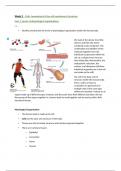
• Identify and describe the levels of physiological organization within the human body
We start at the atomic level (the
atoms), and then the atoms
combined create molecules. The
combination and addition of the
molecule together form the
individual components within the
cell, at a cellular level. Here we
have things like mitochondria, the
endoplasmic reticulum, the
nucleus, and ribosomes (all these
individual organelles are in the cell
and make up the cell).
The cell is the basic unit of
structure within the human body.
From a cell to a tissue (a
cumulation or appearance of
multiple cells of the same type
within one location). A tissue to an
organ (made up of different types of tissues and they each have their different function). We can
then group all the organs together in a human body to work together and we end up with a fully
functional human.
Physiological Organisation:
• The human body is made up of cells
• Cells are the basic unit structure of the body
• Tissues are cells of similar structure and function organised together
• There are 4 primary tissues:
– Epithelial
– Connective
– Nerve
– Muscle
, Tissues:
Visual demonstration of 4 different types of tissues. Layer of the stomach.
Facing the lumen inside the stomach you're going to find:
Epithelial lining
Epithelial tissues
Cells
Epithelial tissues -re required in terms of absorption, secretion and protection due to the pH
within the stomach.
Going out (in terms of the GI layer), you’re going to find connective tissue in the stomach
and it is there for structural supports & helps to connect the different layers
Going out further you have the muscle tissue, which is responsible for the movements(the
contraction and churning of the stomach).
Within the same location embedded within the muscle tissue there is the nervous tissue,
which is responsible for communicating (to the stomach as to when to churn and create its
movement) , coordinating and controlling.
Glands are a type of epithelial tissue they are just specialised epithelial tissue (they are not a
5th type of tissue).
Part 1: Levels of physiological organisations
LO:
• Identify and describe the levels of physiological organization within the human body
We start at the atomic level (the
atoms), and then the atoms
combined create molecules. The
combination and addition of the
molecule together form the
individual components within the
cell, at a cellular level. Here we
have things like mitochondria, the
endoplasmic reticulum, the
nucleus, and ribosomes (all these
individual organelles are in the cell
and make up the cell).
The cell is the basic unit of
structure within the human body.
From a cell to a tissue (a
cumulation or appearance of
multiple cells of the same type
within one location). A tissue to an
organ (made up of different types of tissues and they each have their different function). We can
then group all the organs together in a human body to work together and we end up with a fully
functional human.
Physiological Organisation:
• The human body is made up of cells
• Cells are the basic unit structure of the body
• Tissues are cells of similar structure and function organised together
• There are 4 primary tissues:
– Epithelial
– Connective
– Nerve
– Muscle
, Tissues:
Visual demonstration of 4 different types of tissues. Layer of the stomach.
Facing the lumen inside the stomach you're going to find:
Epithelial lining
Epithelial tissues
Cells
Epithelial tissues -re required in terms of absorption, secretion and protection due to the pH
within the stomach.
Going out (in terms of the GI layer), you’re going to find connective tissue in the stomach
and it is there for structural supports & helps to connect the different layers
Going out further you have the muscle tissue, which is responsible for the movements(the
contraction and churning of the stomach).
Within the same location embedded within the muscle tissue there is the nervous tissue,
which is responsible for communicating (to the stomach as to when to churn and create its
movement) , coordinating and controlling.
Glands are a type of epithelial tissue they are just specialised epithelial tissue (they are not a
5th type of tissue).