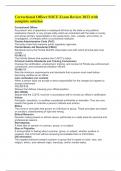
CPEG208 TNCC Final Exam Test Latest Update Graded A+
Why is a measure of serum lactate obtained in the initial assessment of the trauma patient? Answer: c a) to measure oxygenation and ventilation b) to quantify the base deficit for the adequacy of cellular perfusion c) to gauge end-organ perfusion and tissue hypoxia * d) to determine the underlying cause of shock A trauma patient is restless and repeatedly asking "where am I?" vital signs upon arrival were BP 100/60 mm Hg, HR 96 beats/min, and RR 24 breaths/min. Her skin is cool and dry. Current vital signs are BP 104/84mm Hg, HR 108, RR 28 breaths/min. The patient is demonstrating signs and symptoms of which stage of shock? Answer: A A) compensated ** B) Progressive C) irreversible D) decompensated An elderly patient with a history of anticoagulant use presents after a fall at home that day. she denies any loss of consciousness. She has a hematoma to her forehead and complains of headache, dizziness, and nausea. Which is a most likely cause of her symptoms? Answer: D A) epidural hematoma B) diffuse axonal injury C) post-concussive syndrome D) subdural hematoma *** EMS brings a patient who fell riding his bicycle. Using the American College of Surgeons screening guidelines, which assessment finding would prompt the nurse to prepare the patient for radiologic spine clearance? Answer: D A) Alert with no neurologic deficits B) Multiple abrasions to the extremities C) Multiple requests of water D) Smell of alcohol on breath *** A patient with lower extremity fracture complains of severe pain and tightness in his calf, minimally relieved by pain medications. Which of the following is the priority nursing intervention? Answer: C A) elevating the extremity above the level of the heart B) repositioning and apply ice C) Elevating the extremity to the level of the heart *** D) Preparing the patient for ultrasound A 36-year old female has a deformity of the left wrist after a fall. She is reluctant to move her hand due to pain. Which of the following is the most appropriate intervention?
Written for
- Institution
- CPEG208 TNCC
- Module
- CPEG208 TNCC
Document information
- Uploaded on
- November 1, 2023
- Number of pages
- 29
- Written in
- 2023/2024
- Type
- Exam (elaborations)
- Contains
- Questions & answers
Subjects
-
cpeg208 tncc
-
cpeg208 tncc final exam 202324
-
cpeg208 tncc final exam test