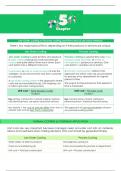
Job-Order costing vs Process costing and firms who’d use each method.
There’s two major types of firms, depending on if their products or services are unique.
Job-Order Costing Process Costing
Job-order costing is used for firms who produce Process costing is used for firms who mass-
a wide variety of products or services that are produce large quantities of similar or
unique and quite distinct from each other. Each homogeneous products or services. One
unit/ batch has a different total cost. unit/ batch = another unit or batch.
Customized or built-to-order products fit into this A process costing system refers to the
category, as do services that vary from customer approach by which costs are accumulated
to customer. by process or by department for a given
period of time.
A job-order costing system = the approach where
costs are accumulated by job. (This assigning cost The output for the process for that period of
is called a job-order costing system). time is measured.
Unit cost = Total product costs Unit cost = Process costs
Output Output
E.g. printing, construction, furniture making, medical E.g. manufacturing, cement, petroleum,
and dental services, car repair, beautician services. pharmaceutical + chemical manufacturing.
Key feature = the cost of one job differs from that of This approach of cost accumulation is known
another and must be kept track of separately. as a process-costing system.
NORMAL COSTING & OVERHEAD APPLICATION
Unit costs are very important because managers need accurate cost info on materials,
labour and overhead when making decisions. (This cost should be generated timely).
Job-Order Costing Process Costing
Wide variety of distinct products Homogeneous products
Costs accumulated by job Costs accumulated by process or department
Unit cost = Total job costs/output Unit cost = Process costs/output
, Actual Costs vs Normal Costing
Two ways are commonly used to measure the costs associated with production: actual
costing and normal costing.
Actual Costing Normal Costing
Actual cost system determines unit cost by Normal cost system determines unit cost by
adding actual direct material, actual direct adding actual direct materials, actual direct
labour, and actual overhead. labour, and estimated overhead.
Actual Costs
In an actual cost system, only actual costs of direct materials, direct labour and overhead are
used to determine unit cost. (But there are several issues involved in using actual costing)
o Overhead items do not have the direct relationship with units produced.
Defining o Even if the firm averages overhead cost by totalling manufacturing overhead
overhead costs distorted costs can occur.
costs o The distortion can be traced to uneven incurrence of overhead costs and
uneven production from period to period.
o Many overhead costs are not incurred uniformly throughout the year.
o This timing can make overhead costs in the month of a machine breakdown
Uneven
higher than in other months.
overhead
o The 2nd problem, nonuniform production levels, can mean that low production in
costs one month would give rise to high unit overhead cost and high levels would lead
to the opposite.
o Strict actual cost systems are rarely used because they cannot provide accurate
unit cost information.
Uneven o Cost information (which is needed throughout the year) is used to prepare interim
production financial statements and help managers make decisions such as pricing.
o Managers need to react to day-to-day conditions in the marketplace in order to
maintain a sound competitive advantage/position.
Normal Costing
o Normal costing solves the problems associated with actual costing.
o Normal cost system determines unit cost by adding actual direct materials, actual direct
labour and estimated overhead.
o Overhead can be estimated by approximating the year’s actual overhead at the
beginning of the year and then using a predetermined rate throughout the year to
obtain the needed unit cost information.
, The importance of unit costs to manufacturing firms
o Unit costs are essential for valuing inventory, determining income (disclosing these being
financial reporting requirements that a firm face at the end of each period) and making
numerous important decisions.
o In the long run, for any product to be viable, its price must cover its full cost.
o Decisions that rely on cost information include: o Introducing a new product
o Continuing a current product
o Analysing long-run prices
The importance of unit costs to service firms
o Services must first identify the service “unit” being produced.
o Service firms use cost data in much the same way that manufacturing firms do.
o Service firms use costs to determine profitability, the feasibility of introducing a new
service etc.
Ethical Decisions
1. Different firms have responsibilities such as being cost-efficient, using the funds of
taxpayers wisely etc.
2. Due to these responsibilities, questionable result may occur.
3. Tendering is a common requirement in the markets for specialized products and
services.
There’s two major types of firms, depending on if their products or services are unique.
Job-Order Costing Process Costing
Job-order costing is used for firms who produce Process costing is used for firms who mass-
a wide variety of products or services that are produce large quantities of similar or
unique and quite distinct from each other. Each homogeneous products or services. One
unit/ batch has a different total cost. unit/ batch = another unit or batch.
Customized or built-to-order products fit into this A process costing system refers to the
category, as do services that vary from customer approach by which costs are accumulated
to customer. by process or by department for a given
period of time.
A job-order costing system = the approach where
costs are accumulated by job. (This assigning cost The output for the process for that period of
is called a job-order costing system). time is measured.
Unit cost = Total product costs Unit cost = Process costs
Output Output
E.g. printing, construction, furniture making, medical E.g. manufacturing, cement, petroleum,
and dental services, car repair, beautician services. pharmaceutical + chemical manufacturing.
Key feature = the cost of one job differs from that of This approach of cost accumulation is known
another and must be kept track of separately. as a process-costing system.
NORMAL COSTING & OVERHEAD APPLICATION
Unit costs are very important because managers need accurate cost info on materials,
labour and overhead when making decisions. (This cost should be generated timely).
Job-Order Costing Process Costing
Wide variety of distinct products Homogeneous products
Costs accumulated by job Costs accumulated by process or department
Unit cost = Total job costs/output Unit cost = Process costs/output
, Actual Costs vs Normal Costing
Two ways are commonly used to measure the costs associated with production: actual
costing and normal costing.
Actual Costing Normal Costing
Actual cost system determines unit cost by Normal cost system determines unit cost by
adding actual direct material, actual direct adding actual direct materials, actual direct
labour, and actual overhead. labour, and estimated overhead.
Actual Costs
In an actual cost system, only actual costs of direct materials, direct labour and overhead are
used to determine unit cost. (But there are several issues involved in using actual costing)
o Overhead items do not have the direct relationship with units produced.
Defining o Even if the firm averages overhead cost by totalling manufacturing overhead
overhead costs distorted costs can occur.
costs o The distortion can be traced to uneven incurrence of overhead costs and
uneven production from period to period.
o Many overhead costs are not incurred uniformly throughout the year.
o This timing can make overhead costs in the month of a machine breakdown
Uneven
higher than in other months.
overhead
o The 2nd problem, nonuniform production levels, can mean that low production in
costs one month would give rise to high unit overhead cost and high levels would lead
to the opposite.
o Strict actual cost systems are rarely used because they cannot provide accurate
unit cost information.
Uneven o Cost information (which is needed throughout the year) is used to prepare interim
production financial statements and help managers make decisions such as pricing.
o Managers need to react to day-to-day conditions in the marketplace in order to
maintain a sound competitive advantage/position.
Normal Costing
o Normal costing solves the problems associated with actual costing.
o Normal cost system determines unit cost by adding actual direct materials, actual direct
labour and estimated overhead.
o Overhead can be estimated by approximating the year’s actual overhead at the
beginning of the year and then using a predetermined rate throughout the year to
obtain the needed unit cost information.
, The importance of unit costs to manufacturing firms
o Unit costs are essential for valuing inventory, determining income (disclosing these being
financial reporting requirements that a firm face at the end of each period) and making
numerous important decisions.
o In the long run, for any product to be viable, its price must cover its full cost.
o Decisions that rely on cost information include: o Introducing a new product
o Continuing a current product
o Analysing long-run prices
The importance of unit costs to service firms
o Services must first identify the service “unit” being produced.
o Service firms use cost data in much the same way that manufacturing firms do.
o Service firms use costs to determine profitability, the feasibility of introducing a new
service etc.
Ethical Decisions
1. Different firms have responsibilities such as being cost-efficient, using the funds of
taxpayers wisely etc.
2. Due to these responsibilities, questionable result may occur.
3. Tendering is a common requirement in the markets for specialized products and
services.