CHAPTER 4: REVENUE
Total Average and Marginal Revenue
Renevue is equals to the product of price of the good and the quantity
of the good sold. P X Q. This is not to be mixed up with profits which
is Total Revenue – Total Cost.
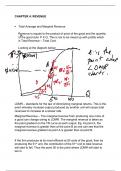
Looking at the diagram below:
LDMR – standards for the law of diminishing marginal returns. This is the
point whereby increase output produced by another unit will cause total
revenues to increase at a slower rate.
Marginal Revenue – The marginal revenue from producing one more of
a good can change owing to LDMR. The marginal revenue is taken as
the point gradient on the TR curve at each output. Eg. At point A, the
marginal revenue is greater than at the point B as one can see that the
marginal revenue gradient at point A is greater than at point B.
If the firm produces at its most efficient at 50 units of the good, then by
producing the 51st unit, the contribution of the 51st unit to total revenue
will start to fall. Thus the point 50 is the point where LDMR will start to
set in.
, Revenue Curves
There are 3 types of revenue curve they are:
- Total Revenue - TR
- Marginal Revenue - MR
- Average Revenue. AR (the total revenue of selling x number of
goods divided by the X number of the good)
Total Revenue/Number of goods.
Revenue and Elasticity
Based on the elastic of demand for the good, the firm can either
increase the price of the item or decrease the price to make more
total revenues.
A good that is price elastic in DD
A good that is price inelastic in demand:
Total Average and Marginal Revenue
Renevue is equals to the product of price of the good and the quantity
of the good sold. P X Q. This is not to be mixed up with profits which
is Total Revenue – Total Cost.
Looking at the diagram below:
LDMR – standards for the law of diminishing marginal returns. This is the
point whereby increase output produced by another unit will cause total
revenues to increase at a slower rate.
Marginal Revenue – The marginal revenue from producing one more of
a good can change owing to LDMR. The marginal revenue is taken as
the point gradient on the TR curve at each output. Eg. At point A, the
marginal revenue is greater than at the point B as one can see that the
marginal revenue gradient at point A is greater than at point B.
If the firm produces at its most efficient at 50 units of the good, then by
producing the 51st unit, the contribution of the 51st unit to total revenue
will start to fall. Thus the point 50 is the point where LDMR will start to
set in.
, Revenue Curves
There are 3 types of revenue curve they are:
- Total Revenue - TR
- Marginal Revenue - MR
- Average Revenue. AR (the total revenue of selling x number of
goods divided by the X number of the good)
Total Revenue/Number of goods.
Revenue and Elasticity
Based on the elastic of demand for the good, the firm can either
increase the price of the item or decrease the price to make more
total revenues.
A good that is price elastic in DD
A good that is price inelastic in demand: