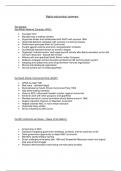
Rights and protest summary
Key groups:
the African National Congress (ANC);
• Founded 1910
• Mandela was a leading member
• Organized strikes and collaborated with SACP with success 1948
• Organized defiance campaign with success of involving masses
• Government portrayed them as Communist
• Fought against extreme economic marginalization of blacks
• Successfully attracted women to women’s league
• Organized “cultural centres” and urged boycott schools after Bantu education act but did
not have resources - boycott did not last
• Alliance with anti-apartheid South African Indian Congress
• Defiance campaign and bus boycotts symbolic but did not bring down system
• Adopting arms played into arms of government “terrorist organization”
• Rivonia trial destroyed organization
• Did not achieve aim of ending apartheid
the South African Communist Party (SACP)
• CPSA founded 1921
• Red scare - declared illegal
• Reconstituted as South African Communist Party 1953
• Had white leading members
• Close to ANC, influenced Freedom charter, against rivonia trial
• Aimed to work with other groups to end apartheid
• Mandela served on central committee shortly before arrest in 1962
• Hugely important influence on liberation movement
• Helped orientate ANC in more militant direction
• Organized many strikes
• Not as influential as ANC by far
the MK (Umkhonto we Sizwe—“Spear of the Nation”)
• Armed wing of ANC
• Explosions targeting government buildings, symbolic, tried to avoid loss of life
• Gave government opportunity to depict ANC as terrorist
• Members lacked military training
• Driven underground anyway after 1960 and Sharpeville Massacre meant next logical
step was armed struggle
• Peaceful demonstrations were being met with police brutality
, • Law 1962 made it criminal to plan even minor acts of sabotage, less frequent attacks
• Hunted down my government and dismantled 1964
• Many arrested
• Showed courage
• Helped keep spirit of resistance alive
Racism and violence against African Americans; the Ku Klux Klan; disenfranchisement
• Much racial violence especially in Mississippi, KKK very active
• Violent whites were often acquitted by an all white jury
• KKK violence and intimidation hindered voter registration
• Mississippi 1964 only 1% black voters registered
Segregation and education; Brown versus Board of Education decision (1954);
• Court case to overturn plessy v ferguson (separate but equal)
• NAACP had devised and implemented a legal strategy to overturn p v f
• 1954 supreme court ruled that segregation by race in public schools was unequal, pvf
was overturned
• Changed landscape of legal support for segregation
• Caused fear in white segregationist americans
• Resistance in southern states
• Florida excessively complicated system required applications for blacks to join white
schools ensured desegregation would not take place
• southern legislators signed southern manifesto pledging not to allow desegregation of
public schools
• First real challenge to Jim Crow laws in south
Little Rock (1957)
• 9 black students enrolled
• Governor ordered prevent blacks entering high school to prevent violence
• requests for government to prevent enrollment fear of potential violence
• Attempted to attend anyway but met by angry white crowd
• Entered through side door a week later, angry crowd gathered and police removed
students from school
• Eisenhower spoke out against it
• Little rock 9 escorted to school by US army soldiers
• National guard remained at high school for remainder of the year
• All 4 integrated high schools in little rock closed a year later, only half of black students
found another school position
• Aim to prevent NAACP from challenging segregation: employment of NAACP members
banned in Arkansas
Economic and social discrimination; legacy of the Jim Crow laws; impact on individuals
Protests and action
Key groups:
the African National Congress (ANC);
• Founded 1910
• Mandela was a leading member
• Organized strikes and collaborated with SACP with success 1948
• Organized defiance campaign with success of involving masses
• Government portrayed them as Communist
• Fought against extreme economic marginalization of blacks
• Successfully attracted women to women’s league
• Organized “cultural centres” and urged boycott schools after Bantu education act but did
not have resources - boycott did not last
• Alliance with anti-apartheid South African Indian Congress
• Defiance campaign and bus boycotts symbolic but did not bring down system
• Adopting arms played into arms of government “terrorist organization”
• Rivonia trial destroyed organization
• Did not achieve aim of ending apartheid
the South African Communist Party (SACP)
• CPSA founded 1921
• Red scare - declared illegal
• Reconstituted as South African Communist Party 1953
• Had white leading members
• Close to ANC, influenced Freedom charter, against rivonia trial
• Aimed to work with other groups to end apartheid
• Mandela served on central committee shortly before arrest in 1962
• Hugely important influence on liberation movement
• Helped orientate ANC in more militant direction
• Organized many strikes
• Not as influential as ANC by far
the MK (Umkhonto we Sizwe—“Spear of the Nation”)
• Armed wing of ANC
• Explosions targeting government buildings, symbolic, tried to avoid loss of life
• Gave government opportunity to depict ANC as terrorist
• Members lacked military training
• Driven underground anyway after 1960 and Sharpeville Massacre meant next logical
step was armed struggle
• Peaceful demonstrations were being met with police brutality
, • Law 1962 made it criminal to plan even minor acts of sabotage, less frequent attacks
• Hunted down my government and dismantled 1964
• Many arrested
• Showed courage
• Helped keep spirit of resistance alive
Racism and violence against African Americans; the Ku Klux Klan; disenfranchisement
• Much racial violence especially in Mississippi, KKK very active
• Violent whites were often acquitted by an all white jury
• KKK violence and intimidation hindered voter registration
• Mississippi 1964 only 1% black voters registered
Segregation and education; Brown versus Board of Education decision (1954);
• Court case to overturn plessy v ferguson (separate but equal)
• NAACP had devised and implemented a legal strategy to overturn p v f
• 1954 supreme court ruled that segregation by race in public schools was unequal, pvf
was overturned
• Changed landscape of legal support for segregation
• Caused fear in white segregationist americans
• Resistance in southern states
• Florida excessively complicated system required applications for blacks to join white
schools ensured desegregation would not take place
• southern legislators signed southern manifesto pledging not to allow desegregation of
public schools
• First real challenge to Jim Crow laws in south
Little Rock (1957)
• 9 black students enrolled
• Governor ordered prevent blacks entering high school to prevent violence
• requests for government to prevent enrollment fear of potential violence
• Attempted to attend anyway but met by angry white crowd
• Entered through side door a week later, angry crowd gathered and police removed
students from school
• Eisenhower spoke out against it
• Little rock 9 escorted to school by US army soldiers
• National guard remained at high school for remainder of the year
• All 4 integrated high schools in little rock closed a year later, only half of black students
found another school position
• Aim to prevent NAACP from challenging segregation: employment of NAACP members
banned in Arkansas
Economic and social discrimination; legacy of the Jim Crow laws; impact on individuals
Protests and action