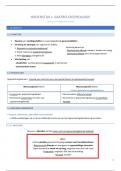
Middle Adulthood (46-65 years)
Ageing process begins. Loss of
strength and stamina. Menopause
begins.
Early Childhood (3-8 years) Infancy (0-2 years)
. Children continue to grow at a steady . Infants grow rapidly and reach half their
rate. They continue to develop strength height. They can walk by 1 year and run by
and coordination. 2 years.
Adolescence (9-18 years)
Early Adulthood (19-45 years)
Adolescents experience growth spurts.
Young adults reach peak of their Develop sexual characteristics during
physical fitness. puberty.
Later Adulthood (65+ years)
Ageing process begins with slow loss of
mobility. Older adults = loss of height by
a few cm.
, PREOPERATIONAL (2-7 YEARS) SENSORIMOTOR (0-2 YEARS)
. Speak and understand words as well as using . Develop experiences and movement through our
symbols to represent discoveries 5 senses
. Thinking is categorised into symbolic functions and . Become aware of things around us + begin to do things
intuitive thoughts. They also have fantasies + believe intentionally
objects are alive (make believe play) . Invent ways to solve problems as we are curious e.g.
taste food, listen to sounds + talk to strangers
Primitive reasoning – lots of knowledge but we
don’t know how to acquired it . Do not have a way to remember/ think about the
world until 18 months
. Do not understand ideas such as number, mass, and volume
Egocentric – perceives world from their own POV only.
FORMAL OPERATIONAL (11-18 YEARS)
CONCRETE OPERATIONAL (7-11 YEARS)
Abstract logical thinking – solve problems
Concrete logical thinking – ability to solve problems
rationally using imagination without having to see
using logical thinking so long as a child can see or
the concrete image.
physically handle the issue involved e.g. sorting
objects in a container . Understand abstract concepts such as success,
failure, love + hate
. Begin to see things from other people’s perspective
. Understand why people behave the way they do +
. Understand that our thoughts & feelings are unique
become more compassionate
and other do not feel the same way as us
. Able to compare two statements and reach a
. Actions can be reversed by doing the opposite conclusion
Ageing process begins. Loss of
strength and stamina. Menopause
begins.
Early Childhood (3-8 years) Infancy (0-2 years)
. Children continue to grow at a steady . Infants grow rapidly and reach half their
rate. They continue to develop strength height. They can walk by 1 year and run by
and coordination. 2 years.
Adolescence (9-18 years)
Early Adulthood (19-45 years)
Adolescents experience growth spurts.
Young adults reach peak of their Develop sexual characteristics during
physical fitness. puberty.
Later Adulthood (65+ years)
Ageing process begins with slow loss of
mobility. Older adults = loss of height by
a few cm.
, PREOPERATIONAL (2-7 YEARS) SENSORIMOTOR (0-2 YEARS)
. Speak and understand words as well as using . Develop experiences and movement through our
symbols to represent discoveries 5 senses
. Thinking is categorised into symbolic functions and . Become aware of things around us + begin to do things
intuitive thoughts. They also have fantasies + believe intentionally
objects are alive (make believe play) . Invent ways to solve problems as we are curious e.g.
taste food, listen to sounds + talk to strangers
Primitive reasoning – lots of knowledge but we
don’t know how to acquired it . Do not have a way to remember/ think about the
world until 18 months
. Do not understand ideas such as number, mass, and volume
Egocentric – perceives world from their own POV only.
FORMAL OPERATIONAL (11-18 YEARS)
CONCRETE OPERATIONAL (7-11 YEARS)
Abstract logical thinking – solve problems
Concrete logical thinking – ability to solve problems
rationally using imagination without having to see
using logical thinking so long as a child can see or
the concrete image.
physically handle the issue involved e.g. sorting
objects in a container . Understand abstract concepts such as success,
failure, love + hate
. Begin to see things from other people’s perspective
. Understand why people behave the way they do +
. Understand that our thoughts & feelings are unique
become more compassionate
and other do not feel the same way as us
. Able to compare two statements and reach a
. Actions can be reversed by doing the opposite conclusion