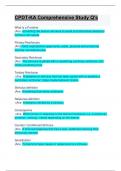
CPDT-KA Comprehensive Study Questions & Answers: Updated Solution
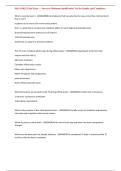
What is a Punisher (Ans- something the learner will work to avoid and diminishes likelihood behavior will repeat Primary Reinforcers (Ans- food, reproductive opportunity, water, physical and emotional security, sometimes play Secondary Reinforcer (Ans- The stimulus is paired with or predicting a primary reinforcer, EX: clicker predicting food Tertiary Reinforcer (Ans- A behavior or stimulus that has been paired with or predicts a secondary reinforcer; helps create behavior chains Stimulus definition (Ans- Something that elicits a behavior Response definition (Ans- A behavior elicited by a stimulus Consequence (Ans- What occurs in response to the learner's behavior (i.e. a reinforcer, punisher, nothing). Varies depending on the learner Counter- Conditioned Stimulus (Ans- A stimulus/response that has a new, redefined meaning than previously learned Sensitization (Ans- To become hyper aware or responsive to a stimulus Desensitization (Ans- To become less aware/sensitive of a stimulus through a protocol or intentional practice Adaptation (Ans- Physical/sensory systems have been fatigued Habituation (Ans- To become less aware/sensitive to a stimulus through "been there, done that" and stimulus was/is always present in full force. Overlearning (Ans- Practicing until lesson is understood no matter how information is presented Poisoned Cue (Ans- When negative association has been attached to a cue Eustress (Ans- "Good" stress--learner is primed and ready to engage in learning, is a pleasant state of arousal Distress (Ans- "Bad" stress--learner is overwhelmed and overloaded with stress hormones Consequences of distress (Ans- dogs will show calming signals, have lowered problem-solving ability Elicited behavior (Ans- involuntary/reflexive/emotional behavior What type of training can be used to change behavior that is elicited? (Ans- Classical Conditioning Emitted behavior (Ans- A voluntary choice behavior When training through operant learning/conditioning we are looking for (Ans- Emitted Behavior Extinction definition (Ans- Decreasing/extinguishing (frequency) of a conditioned behavior by removing reinforcement Extinction Burst definition (Ans- Where behavior increases in frequency/intensity early during extinction Spontaneous Recovery definition (Ans- "backsliding" in recover/extinction What is the Premack Principle (Ans- A more likely behavior can reinforce a less likely behavior Grandma's Law (Ans- AKA Premack Principle "Eat your peas and then you can have ice cream" is an example of using the ____________ (Ans- Premack Principle Torndike's Law of Effect (Ans- Behaviors are more likely to be repeated if they lead to a satisfying consequence, and less likely to be repeated if they lead to an unsatisfying consequence Torndike's Law of Effect states that (3 parts) (Ans- 1) Learning is incremental 2)Learning can occur via trail and error 3) "Use it or lose it!" Learning can be lost if not practiced/reviewed occasionally Classical Learning/Conditioning works on changing (Ans- visceral/emotional/reflexive associations NS stands for (Ans- Neutral Stimulus a Neutral Stimulus (NS) is (Ans- a stimulus that has no meaning, an untrained stimulus UCS stands for (Ans- Unconditioned stimulus a Unconditioned Stimulus (UCS) is (Ans- a stimulus that has inherent but NOT lea
Written for
- Institution
- CPDT-KA
- Module
- CPDT-KA
Document information
- Uploaded on
- September 26, 2023
- Number of pages
- 11
- Written in
- 2023/2024
- Type
- Exam (elaborations)
- Contains
- Questions & answers
Subjects
-
what is a punisher ans something the learner wi
-
primary reinforcers ans food reproductive oppo
-
v
-
secondary reinforcer ans the stimulus is paired

Also available in package deal