

100% satisfaction guarantee Immediately available after payment Both online and in PDF No strings attached 4.2 TrustPilot
logo-home
Exam (elaborations)

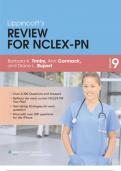
Lippincott's Review for NCLEX-PN, 9th Edition (Lippincott's State Board Review for Nclex-Pn

Rating
-
Sold
-
Pages
680
Grade
A
Uploaded on
23-09-2023
Written in
2022/2023

UNIT 1 The Nursing Care of Adults with Medical-Surgical Disorders 1 TEST 1 The Nursing Care of Clients with Musculoskeletal Disorders Nursing Care of Clients with Musculoskeletal Injuries Nursing Care of Clients with Fractures Nursing Care of Clients with Casts Nursing Care of Clients in Traction Nursing Care of Clients with Inflammatory Joint Disorders Nursing Care of Clients with Degenerative Bone Disorders Nursing Care of Clients with Amputations Nursing Care of Clients with Skeletal Tumors Nursing Care of Clients with Herniated Intervertebral Disks Correct Answers and Rationales Directions: With a pencil, blacken the space in front of the option you have chosen for your correct answer. Nursing Care of Clients with Musculoskeletal Injuries A client who golfs at least three times a week has been experiencing wrist pain aggravated by movement. The physician diagnoses the condition as tenosynovitis and recommends temporarily avoiding repetitive wrist motion. 1. Which statement made by the client to the nurse provides the best evidence that the client understands the therapeutic plan? [ ] 1. “I should keep my hand as still as possible.” [ ] 2. “I should stop playing golf for the time being.” [ ] 3. “I can substitute playing miniature golf.” [ ] 4. “I can wear a tight leather glove when golfing.” The nurse examines a client who slipped and fell while climbing stairs and now has ankle swelling and pain on movement. 2. While the client is waiting for the ankle to be X-rayed, which nursing measure is most helpful for relieving the soft-tissue swelling? [ ] 1. Place a heating pad on the ankle. [ ] 2. Apply ice to the ankle. [ ] 3. Exercise the client’s foot. [ ] 4. Immobilize the client’s foot. The ankle X-ray reveals that the bones are not fractured. The physician tells the client that the ankle is severely sprained. 3. The physician directs the nurse to wrap the client’s lower extremity with an elastic bandage. Where should the nurse begin applying the bandage? [ ] 1. Below the knee [ ] 2. Above the ankle [ ] 3. Across the phalanges [ ] 4. At the metatarsals 4. Which is the best technique for the nurse to use when applying the elastic bandage to the client’s lower extremity? [ ] 1. Making figure-eight turns with the bandage [ ] 2. Making spiral-reverse turns with the bandage [ ] 3. Making recurrent turns with the bandage [ ] 4. Making spica turns with the bandage Before the client is discharged from the emergency depart- ment, the nurse provides instructions on how to care for the sprained ankle at home. 5. The nurse advises the client on the need for mainte- nance of the bandage. When should the nurse advise the client with a sprained ankle to rewrap the elastic bandage? [ ] 1. When the toes appear pink [ ] 2. When the ankle feels painful [ ] 3. When the toes look swollen [ ] 4. When the joint feels stiff 2 TEST 1 A client arrives in the emergency department with a shoul- der injury after falling from a stepladder. 6. When the nurse assesses the client, which finding is the best indication that the shoulder has been dislocated? [ ] 1. The client is experiencing intense pain. [ ] 2. There is obvious swelling about the joint. [ ] 3. The client is hesitant to move the arm. [ ] 4. The affected arm is longer than the other. The physician informs the client of plans to correct the shoulder dislocation by manipulation. 7. When the client asks the nurse what is meant by the term manipulation, which explanation is most accurate? []1. Manipulation involves making an incision to rea- lign the bones. []2. Manipulation involves the insertion of a pin or wire into the joint. []3. Manipulation repositions the bone ends manually. []4. Manipulation strengthens the joint with exercise. Before discharge, the nurse informs the client that a sling needs to be worn to immobilize the injured shoulder. The client tells the nurse that there is no insurance to pay for the hospital bill or a sling. The nurse teaches a family member how to apply a triangular sling made from muslin. 8. Which statement made by the family member indicates the need for further teaching? The Nursing Care of Clients with Musculoskeletal Disorders 3 An X-ray of the injured teenager’s leg reveals a comminuted fracture of the distal tibia. 10. Which explanation by the nurse can best help this client understand the injury that has occurred? [ ] 1. One bone end is driven into the other. [ ] 2. The bone is splintered into pieces. [ ] 3. There is no open break in the skin. [ ] 4. A portion of the bone is split away. After consulting the attending physician, the nurse learns that the teenager will require surgery to realign the bones in the fractured tibia. 11. In this case, from whom is it most appropriate for the physician, with the nurse as a witness, to obtain consent to perform the surgical procedure? [ ] 1. The client [ ] 2. The client’s physician [ ] 3. The client’s youth leader [ ] 4. The client’s parent 12. The client is about to go to surgery but is still wear- ing a class ring. Which nursing action is most appropriate regarding care of the client’s valuables? [ ] 1. Put the ring in the bedside stand. [ ] 2. Tape the ring to the client’s finger. [ ] 3. Give the ring to a security guard. [ ] 4. Take the ring to the hospital safe. The client has returned from surgery with a leg cast, and the nurse is assisting the client back to bed. 13. Which of the following would the nurse identify as the highest priority when documenting the postopera- tive circulation status of the recently casted extremity? [ ] 1. Adequate neurovascular functioning [ ] 2. Minimal pain on movement [ ] 3. Vital signs within normal limits [ ] 4. No drainage noted on the cast 14. The nurse knows that a client who sustains multiple fractures of long bones is at risk for developing fat embo- lism syndrome. Which findings suggest that the client is developing this complication? Select all that apply. [ ] 1. Bradycardia [ ] 2. Petechiae [ ] 3. Dyspnea [ ] 4. Mental status changes [ ] 5. Hypertension [ ] 6. Hematuria A nurse stops to assist an individual who was involved in a motor vehicle accident. The victim was not wearing a seat belt and was thrown from the car. 15. Of the following emergency measures, which one should the nurse perform first? [ ] 1. Check the victim’s breathing. [ ] 2. Cover the victim with a blanket. [ ] 3. Move the victim to the curb. [ ] 4. Assess the victim for injuries. [ ] 1. [ ] 2. [ ] 3. [ ] 4. “The hand should be elevated higher than the elbow.” “The knot should be tied at the back of the neck.” “The elbow should be flexed within the sling.” “The sling is used to elevate and support the arm.” Nursing Care of Clients with Fractures While backpacking with a youth group, a 17-year-old falls and sustains an injury to the lower leg. A nurse who is accompanying the group suspects a fracture of the tibia. 9. To immobilize the suspected fracture, how should the nurse apply a splint? [ ] 1. Below the knee to above the hip [ ] 2. Above the knee to below the hip [ ] 3. Above the ankle to below the knee [ ] 4. Below the ankle to above the knee 4 UNIT 1 The Nursing Care of Adults with Medical-Surgical Disorders The nurse suspects that the victim has sustained rib fractures. 16. Which assessment finding is the best indication that the client is experiencing secondary complications from the fractured ribs? [ ] 1. Irregular pulse rate [ ] 2. Asymmetrical chest expansion [ ] 3. Expiratory wheezing on auscultation [ ] 4. Coughing up pink, frothy sputum Aside from the suspected rib fractures, the nurse sees a bone fragment protruding from the client’s thigh as well as profuse bleeding from the wound. 17. Which technique is most appropriate to control the bleeding? [ ] 1. Place a tourniquet around the leg. [ ] 2. Apply direct pressure on the wound. [ ] 3. Compress the femoral artery. [ ] 4. Elevate the injured extremity. The nurse suspects that the accident victim might also have a broken back. 18. Which is the most preferred position when transport- ing a victim with a possible back injury? [ ] 1. Side-lying [ ] 2. Prone [ ] 3. Supine [ ] 4. Semi-Fowler’s An 80-year-old client who sustained a fall at a long-term care facility is suspected of having a fractured right hip. 19. Which statements support the nurse’s belief that the client has a fractured hip? Select all that apply. 22. The nurse uses a diagram of the hip to explain to the client and the family where an intertrochanteric fracture of the femur has occurred. Identify with an X the anatomic location of the injury. After the client’s fractured hip is stabilized with an open reduction and internal fixation (ORIF), the nurse teaches the client to perform isometric quadriceps-setting exercises using the unaffected leg. 23. Which instruction should the nurse reinforce to ensure that the exercises are done correctly? [ ] 1. [ ] 2. [ ] 3. [ ] 4. [ ] 5. [ ] 6. The client has pain near the distal femur. The client cannot bear weight on the affected leg. The client’s affected leg is shorter than her unaf- fected leg. The client’s affected leg is adducted. The client’s affected leg is externally rotated. The client prefers to sit rather than lie flat. After surgery, the client is instructed to wear thigh-high antiembolism stockings. 24. Which statement by the nurse provides the best expla- nation about the purpose of antiembolism stockings? 20. Which risk factor found in the client’s medical record does the nurse identify as most significant for sustaining a hip fracture? [ ] 1. The client is postmenopausal. [ ] 2. The client is somewhat obese. [ ] 3. The client has type 2 diabetes. [ ] 4. The client is lactose intolerant. 21. Which of the following evening snacks would the nurse encourage for the client with immobility due to the fractured hip? [ ] 1. Anorange [ ] 2. Rice cakes [ ] 3. Peanut butter and celery [ ] 4. Potato chips [ ] 1. [ ] 2. [ ] 3. [ ] 4. Antiembolism stockings prevent blood from pool- ing in the legs. Antiembolism stockings reduce blood flow to the extremities. Antiembolism stockings keep the blood pressure lower in the legs. Antiembolism stockings keep the blood vessels constricted. [ ] 1. [ ] 2. [ ] 3. [ ] 4. Move your toes toward and away from your head. Contract and relax your thigh muscles. Lift your lower leg up and down from the bed. Bend your knee and pull your lower leg upward. 25. The nurse supervises a nursing assistant who is apply- ing the client’s antiembolism stockings. What is the correct technique for applying these stockings? [ ] 1. [ ] 2. [ ] 3. [ ] 4. The nursing assistant applies the stockings before getting the client out of bed. The nursing assistant applies the stockings just before helping the client do leg exercises. The nursing assistant applies the stockings after noting that the client’s legs are cool. The nursing assistant applies the stockings at night before the client’s bedtime. 26. Postoperatively, which intervention should be completed before turning the client onto the nonoperative side? [ ] 1. Placing pillows between the client’s legs [ ] 2. Having the client point the toes downward [ ] 3. Flexing the client’s knee on the affected side [ ] 4. Elevating the head of the client’s bed 27. The physician orders that the client with a hip prosthesis may be out of bed to sit in a chair. How should the nurse position the chair to facilitate transferring the client from the bed? [ ] 1. At the end of the bed [ ] 2. Perpendicular to the bed [ ] 3. Parallel with the bed [ ] 4. Against a side wall A client with a hip prosthesis is allowed to ambulate with a walker using a three-point partial weight-bearing gait. []2. [ ] 3. [ ] 4. 31. How can the nurse best support the wet cast while the physician wraps the arm with rolls of wet plaster? [ ] 1. By using a soft mattress [ ] 2. By resting it on a firm surface [ ] 3. By using the tips of the fingers [ ] 4. By using the palms of the hands 32. After the arm cast has been applied, which nursing observation is the best indication that the client may be developing compartment syndrome? [ ] 1. The client experiences severe pain. [ ] 2. The client’s hand becomes reddened. [ ] 3. The fingers develop muscle spasms. [ ] 4. The radial pulse feels bounding. 33. Which is the best material for the nurse to place under a wet cast immediately after application? [ ] 1. Synthetic sheepskin [ ] 2. A vinyl sheet [ ] 3. An absorbent pad [ ] 4. Several pillows 34. What is the best technique a nurse can use for drying the wet plaster arm cast? [ ] 1. Leave the casted arm uncovered. [ ] 2. Apply a heating blanket to the cast. [ ] 3. Use a hair dryer to blow hot air onto the cast. [ ] 4. Place a heat lamp directly above the cast. 35. Which is the best method to assess circulation in the casted extremity? 28. Which return demonstration indicates that the client has understood the correct way to ambulate with the walker? []1. The client advances the walker and operative leg while putting most of the weight on the walker’s handgrips. The client advances the walker and operative leg while putting most of the weight on the back legs of the walker. The client advances the walker and operative leg while putting most of the weight on the toes of the operative leg. The client advances the walker and operative leg while putting most of the weight on the heel of the nonoperative leg. [ ] 1. [ ] 2. [ ] 3. [ ] 4. Ask the client to wiggle the fingers. Feel the cast to determine if it is unusually hot or cold. Depress the client’s nail beds, and document the time it takes for the color to return. See if there is enough room to insert a finger between the cast and the extremity. A client who has degenerative arthritis involving the hips undergoes a total hip replacement. 29. After the client’s total hip replacement surgery, which While waiting for the cast to dry, the client asks the nurse about the differences between plaster casts and those made of synthetic materials such as fiberglass. 36. Which statement by the nurse about fiberglass casts is most accurate? nursing [ ] 1. [ ] 2. [ ] 3. [ ] 4. [ ] 5. [ ] 6. actions are essential? Select all that apply. Keeping the client’s knees apart at all times Avoiding flexing the client’s hips more than 90 degrees Having the client use a raised toilet seat Raising the head of the client’s bed 90 degrees Placing two pillows beneath the client’s knees Keeping the client’s legs internally rotated [ ] 1. [ ] 2. [ ] 3. [ ] 4. Fiberglass casts are less expensive than plaster casts. Fiberglass casts are lightweight. Fiberglass casts are flexible. Fiberglass casts are less restrictive than plaster casts. Nursing Care of Clients with Casts A plaster arm cast will be applied to an adult client with a compound fracture of the radius. 30. When preparing the client for cast application, which statement by the nurse is most accurate? [ ] 1. “The cast will feel tight as it’s applied.” [ ] 2. “Your arm will feel warm as the wet plaster sets.” [ ] 3. “You can expect a foul odor until the cast is dry.” [ ] 4. “You may feel itchy while the cast is wet.” Before discharging the client, the nurse provides the client with cast care instructions and information about signs and symptoms of complications. The client returns to the clinic several hours later with bloody drainage seeping through the cast. TEST 1 The Nursing Care of Clients with Musculoskeletal Disorders 5 6 UNIT 1 The Nursing Care of Adults with Medical-Surgical Disorders 37. After assessing the client’s cast, what action should the nurse take next? [ ] 1. Document the finding in the medical record. [ ] 2. Call the physician and report the finding. [ ] 3. Circle the area, then record the time. [ ] 4. Apply an ice bag over the drainage area. A hip-spica cast is applied to a 16-year-old who sustained a fractured femur in a motorcycle accident. 38. The client tells the nurse, “My father is furious with me. He does not want me to ride a motorcycle.” Which response by the nurse is most appropriate? After the client has had the hip-spica cast for nearly 3 weeks, the nurse detects a foul odor coming from the cast. 43. Which statement is most accurate regarding the cause of the cast’s unpleasant odor? [ ] 1. The plaster has dried improperly. [ ] 2. There is bleeding under the cast. [ ] 3. The cast is disintegrating. [ ] 4. There is an infected wound. The physician cuts a small window in the hip-spica cast to inspect the underlying tissue. 44. Which nursing action is most appropriate after the piece of plaster is removed to create a window in the cast? [ ] 1. [ ] 2. [ ] 3. [ ] 4. “As they say, ‘Father knows best.’ ” “All parents want their children to be safe.” “It can be frustrating when you disagree with your father.” “I think you should obey your father’s wishes.” [ ] 1. [ ] 2. [ ] 3. [ ] 4. Dispose of the piece of plaster in a plastic biohazard bag. Replace the piece of plaster in the cast hole with tape. Put the piece of plaster in the client’s bedside table. Send the piece of plaster to the laboratory for culturing. 39. Which developmental task should the nurse keep in mind while planning the client’s care? [ ] 1. The client is searching for sexual identity. [ ] 2. The client is testing physical abilities. [ ] 3. The client is acquiring independence. [ ] 4. The client is learning to control emotions. 40. Which equipment should the nurse anticipate needing to facilitate the client’s bowel elimination? [ ] 1. Bedside commode [ ] 2. Fracture bedpan [ ] 3. Mechanical lift [ ] 4. Raised toilet seat The client asks the nurse to explain the purpose of the bar running between the thighs on the hip-spica cast. 41. Which statement by the nurse about the cast’s bar is most accurate? [ ] 1. The bar facilitates lifting and turning clients. [ ] 2. The bar enhances physical exercise. [ ] 3. The bar strengthens the cast. [ ] 4. The bar maintains the proper position. After several days, the client tells the nurse that the skin itches terribly beneath the cast. 42. Which nursing action is most appropriate at this time? 45. Which nursing action is most correct when the rough edges on the client’s hip-spica cast begin to threaten the integrity of the skin? [ ] 1. Line the cast edge with adhesive petals of moleskin. [ ] 2. Apply a fresh strip of plaster to the cast edge. [ ] 3. Trim the rough cast edge with a cast cutter. [ ] 4. Cover the cast edge with a gauze dressing. 46. Which assessment finding suggests that the client in the hip-spica cast may be developing a response to room confinement known as cast syndrome? [ ] 1. The client becomes nauseated and vomits. [ ] 2. The client becomes disoriented and confused. [ ] 3. The client becomes feverish and hypotensive. [ ] 4. The client becomes dyspneic and hyperventilates. Nursing Care of Clients in Traction Before undergoing surgery for a fractured hip, an older client is placed in Buck’s traction. 47. Which nursing technique is best when planning to change the client’s bed linens? [ ] 1. [ ] 2. [ ] 3. [ ] 4. Collaborate with the physician on prescribing an antipruritic medication. Provide powder for the client to sprinkle in the cast. Obtain a flat ruler so the client can scratch inside the cast. Apply a commercially prepared ice bag to the outside of the cast. [ ] 1. [ ] 2. [ ] 3. [ ] 4. Roll the client from one side of the bed to the other. Apply the linens from the foot to the top of the bed. Leave the bottom sheets in place until after surgery. Raise the client from the bed with a mechanical lift. 48. Which assessment finding warrants immediate action by the nurse when a client is in Buck’s traction? [ ] 1. The traction weights are hanging above the floor. [ ] 2. The leg is in line with the pull of the traction. [ ] 3. The client’s foot is touching the end of the bed. [ ] 4. The rope is in the groove of the traction pulley. 49. Which technique is the best strategy for assessing circulation in the leg in Buck’s traction? A client with a fractured femur is in skeletal traction with a pin through the distal femur. The affected leg is supported by balanced suspension. 54. Which material added by the nurse is best for cover- ing the tips of the pin to prevent injuries while the client is in skeletal leg traction? [ ] 1. Gauze squares [ ] 2. Cotton balls [ ] 3. Cork blocks [ ] 4. Rubber tubes 55. Which nursing assessment finding is the best indica- tion that the client has an infection at the pin site? [ ] 1. Serous drainage at the pin site [ ] 2. Bloody drainage at the pin site [ ] 3. Mucoid drainage at the pin site [ ] 4. Purulent drainage at the pin site The physician orders antibiotic therapy for the client’s infection. 56. If the client is allergic to penicillin, the nurse must question a medical order for which type of antibiotic? [ ] 1. [ ] 2. [ ] 3. [ ] 4. Observe whether the client can wiggle or move the toes. Palpate for pulsation of the dorsalis pedis artery. Take the client’s blood pressure with a thigh cuff positioned on the affected leg. Determine whether the client can feel sharp and dull sensations. An older client is placed in Russell’s traction while await- ing surgery. 50. To prevent skin breakdown while the client is in traction, the nurse must frequently inspect the skin in which area? [ ] 1. Over the ischial spines [ ] 2. In the popliteal space [ ] 3. Near the iliac crests [ ] 4. At the zygomatic arch The nurse enters the client’s room to assess the traction apparatus. 51. Which of the following might interfere with the effectiveness of Russell’s traction? [ ] 1. The rope is strung tautly from pulley to pulley. [ ] 2. The trapeze is hanging above the client’s chest. [ ] 3. The rope is knotted at the location of a pulley. [ ] 4. The weight is about 24′′ (61 cm) from the floor. On the day of surgery, the client in Russell’s traction is transported to the operating room in the bed. 52. Which nursing action is appropriate while the client is being transported? [ ] 1. [ ] 2. [ ] 3. [ ] 4. An aminoglycoside such as gentamicin sulfate (Garamycin) A cephalosporin such as cefaclor (Ceclor) A tetracycline such as doxycycline (Vibramycin) A sulfonamide such as trimethoprim/sulfameth- oxazole (Bactrim) []1. []2. [ ] 3. [ ] 4. The nurse leaves the traction as is. The nurse removes the weights during the transport. The nurse rests the weights on the end of the bed. The nurse takes the client’s leg out of the traction. [ ] 1. [ ] 2. []3. []4. “It restricts neck movement but enables physical activity.” “It allows head movement while immobilizing the spine.” “It accelerates healing by facilitating physical therapy.” “It promotes faster bone repair within a shorter time span.” A cervical halter type of skin traction is applied to a client who has experienced a whiplash injury in a motor vehicle accident. 53. When the nurse makes rounds at the beginning of the shift, which observation requires the nurse’s immediate attention? [ ] 1. The halter rests under the client’s chin and occiput. [ ] 2. The client’s ears are clear of the traction ropes. [ ] 3. The weight hangs between the headboard and wall. [ ] 4. There is a soft pillow beneath the client’s head. 58. Which nursing observation provides the best indi- cation that the halo-cervical traction device is applied appropriately? [ ] 1. The client has full range of motion in the neck. [ ] 2. The client’s neck pain is within a tolerable level. [ ] 3. The client can speak and hear at preinjury levels. [ ] 4. The client reports the ability to see straight ahead. 59. Which assessment finding is the best indication that the client in halo traction is developing a serious complication? []1. The client experiences orthostatic hypotension. []2. The client needs assistance with shaving. []3. The client cannot open the mouth widely. []4. The client complains about irritation under the TEST 1 The Nursing Care of Clients with Musculoskeletal Disorders 7 A client with a fractured cervical vertebra is placed in halo-cervical traction, a type of skeletal traction consisting of pins inserted into the skull that are incorporated into a vest of plaster. 57. Which description by the nurse most accurately states the purpose of halo-cervical traction? axillae. 8 UNIT 1 The Nursing Care of Adults with Medical-Surgical Disorders Nursing Care of Clients with Inflammatory Joint Disorders An adult consults a physician about persistent joint pain and stiffness. 60. Which laboratory test value, if elevated, is the best diagnostic indicator of rheumatoid arthritis? [ ] 1. Erythrocyte sedimentation rate (ESR) [ ] 2. Partial thromboplastin time (PTT) [ ] 3. Fasting blood sugar (FBS) [ ] 4. Blood urea nitrogen (BUN) 61. If the client is typical of most people with rheumatoid arthritis, when would the nurse expect the client’s symp- toms to first become evident? [ ] 1. In very early childhood [ ] 2. At the onset of puberty [ ] 3. During young adulthood [ ] 4. After midlife The physician diagnoses rheumatoid arthritis and pre- scribes a total of 5 grams of aspirin per day. The client is surprised the physician prescribed a common drug such as aspirin to treat her condition. 62. The nurse should plan to include which information related to the therapeutic benefits of aspirin in the teaching plan for this client? [ ] 1. Aspirin stimulates the immune system. [ ] 2. Aspirin relaxes skeletal muscles. [ ] 3. Aspirin reduces joint inflammation. [ ] 4. Aspirin interrupts nerve synapses. The client tells the nurse about experiencing an upset stomach when taking aspirin. 63. Which modification in the client’s care plan is most appropriate to relieve the client’s stomach discomfort? [ ] 1. Give aspirin before meals only. [ ] 2. Give aspirin with cold water. [ ] 3. Give aspirin with hot tea. [ ] 4. Give aspirin with food or meals. 64. Because the client takes large amounts of aspirin daily, the nurse monitors for signs and symptoms of aspirin toxicity. Which assessment finding is the best indication of aspirin toxicity? [ ] 1. Ringing in the ears [ ] 2. Dizziness [ ] 3. Metallic taste in the mouth [ ] 4. Proteinuria 65. When the client experiences exacerbation of symp- toms of rheumatoid arthritis, which of the following medi- cations does the nurse anticipate will be prescribed for a short time in addition to aspirin? [ ] 1. Ibuprofen (Advil) [ ] 2. Prednisone (Deltasone) [ ] 3. Etanercept (Enbrel) [ ] 4. Levofloxacin (Levaquin) 66. Which statement made by the client indicates that further instruction regarding corticosteroid therapy is necessary? [ ] 1. [ ] 2. [ ] 3. [ ] 4. “I’m susceptible to getting infections.” “I should never stop taking my medication abruptly.” “I may become very depressed and perhaps sui- cidal.” “I may develop low blood sugar and need glu- cose.” The client tells the nurse that watching television helps decrease the discomfort. 67. Which conclusion made by the nurse is most accurate given the above information? []1. []2. [ ] 3. [ ] 4. The client’s condition is improving due to elec- tronic signals. The client is having less pain transmission. The client is experiencing a slight case of arthritis. The client is being distracted from the pain. 68. Which finger joints would the nurse expect to be most affected by the client’s rheumatoid arthritis? [ ] 1. Proximal finger joints [ ] 2. Medial finger joints [ ] 3. Distal finger joints [ ] 4. Lateral finger joints The physician recommends applying heat to the client’s hands to relieve discomfort. 69. Which heat application method is best for the nurse to use with this client? [ ] 1. Hot wax treatment [ ] 2. Warm moist compresses [ ] 3. Electric heating pad [ ] 4. Infrared heat lamp 70. While planning care for the client, when would the nurse expect a need for more time and assistance with activities of daily living? [ ] 1. In the early morning [ ] 2. Atnoon [ ] 3. In the late afternoon [ ] 4. Before bed 71. Which nursing recommendation has the greatest potential for helping the client maintain the ability to perform self-care? [ ] 1. Move to a warm climate like Arizona. [ ] 2. Buy clothes that are easy to pull up or slip on. [ ] 3. Enroll in an aerobics exercise class. [ ] 4. Sleep on a warm waterbed or heating pad. TEST 1 During an acute episode of rheumatoid arthritis, the physi- cian asks the nurse to apply a splint to each of the client’s hands. 72. Which explanation most accurately explains to the client the primary purpose of the splints? [ ] 1. Splints are used to rest affected joints. [ ] 2. Splints are used to slow joint deterioration. [ ] 3. Splints are used to improve hand strength. [ ] 4. Splints are used to increase range of motion. The client has not responded to the current drug therapy and the physician has added methotrexate (Rheumatrex) and cyclosporine (Sandimmune) to the medication regimen. 73. Which statement to the nurse indicates a good understanding by the client of the use of methotrexate and cyclosporine together? The Nursing Care of Clients with Musculoskeletal Disorders 9 The client reports taking 400 mg of ibuprofen (Motrin) four times a day at home. 78. Which question best helps the nurse determine whether the client is experiencing an adverse effect from taking nonsteroidal anti-inflammatory drugs (NSAIDs) such as ibuprofen (Motrin)? [ ] 1. “Have you noticed any hand tremors?” [ ] 2. “Are you urinating more frequently?” [ ] 3. “Has your interest in food changed?” [ ] 4. “What color are your stools?” A total hip replacement (hip arthroplasty) is planned for a 70-year-old client with osteoarthritis. The physician instructs the client to stop taking enteric-coated aspirin (Ecotrin) 1 week before surgery. 79. Which statement by the nurse best explains the ration- ale for the physician’s instructions? [ ] 1. “Aspirin can increase your risk of wound infection.” [ ] 2. “Aspirin impairs your ability to control bleeding.” [ ] 3. “Aspirin can make it difficult to assess your pain.” [ ] 4. “Aspirin interferes with your ability to heal.” Before the total hip replacement, the nurse teaches the cli- ent how to use an incentive spirometer. 80. Which statement indicates that the client understands how to use the incentive spirometer correctly? []1. []2. []3. [ ] 4. “I am having an exacerbation of symptoms so two medications are needed.” “Cyclosporine is given to enhance the effect of the methotrexate.” “Methotrexate and cyclosporine together decrease unwanted side effects.” “My symptoms are severe enough to indicate the use of two strong medications.” 74. Which assessment finding would the nurse consider a likely adverse effect of the client’s methotrexate (Rheuma- trex) therapy? [ ] 1. Constipation [ ] 2. Polyuria [ ] 3. Mouth sores [ ] 4. Chest pain A 75-year-old client with osteoarthritis in the left hip has been told by the physician to apply a heating pad to the area several times a day. 75. Which nursing instruction about heating pads is essential to include in the client’s teaching plan? [ ] 1. Keep the heating pad on the low setting. [ ] 2. Place the heating pad directly on the skin. [ ] 3. Cover the heating pad with plastic during use. [ ] 4. Apply the heating pad for 2 hours at a time. 76. Which nursing instruction is most beneficial to mini- mize stress on the client’s painful joints? [ ] 1. Maintain a normal weight. [ ] 2. Apply a topical analgesic cream. [ ] 3. Take a calcium supplement. [ ] 4. Become more physically active. 77. The client uses a cane when ambulating. When the nurse observes the client walking, which assessment find- ing indicates the need for more instruction regarding the use of the cane? [ ] 1. The tip of the cane is covered with a rubber cap. [ ] 2. The client wears athletic shoes with nonskid soles. [ ] 3. The client uses the cane on the painful side. [ ] 4. The client looks straight ahead when walking. [ ] 1. [ ] 2. [ ] 3. [ ] 4. “I should position the mouthpiece and inhale deeply.” “I should position the mouthpiece and exhale forcefully.” “I should position the mouthpiece and cough effectively.” “I should position the mouthpiece and breathe naturally.” Just before the total hip replacement, the nurse prepares a large area of the client’s skin for surgery. 81. Which technique is most appropriate for the nurse to use when preparing the operative site? [ ] 1. Washing the area with soap and water [ ] 2. Pressing the razor deeply into the skin while shaving [ ] 3. Clipping the hair around the intended incisional area [ ] 4. Shaving in the direction of hair growth 82. After the client undergoes a total hip replacement, how should the nurse position the affected hip? [ ] 1. Adduct the hip [ ] 2. Abduct the hip [ ] 3. Flex the hip [ ] 4. Extend the hip 83. What equipment is most helpful to have on hand post- operatively when providing nursing care for the client who is recovering from a total hip replacement? [ ] 1. A bed cradle [ ] 2. A bed board [ ] 3. An overhead trapeze [ ] 4. Lower side rails 10 UNIT 1 The Nursing Care of Adults with Medical-Surgical Disorders 84. What equipment is best for preventing external rota- tion of the operative leg when caring for a client with a total hip replacement? [ ] 1. A footboard [ ] 2. A trochanter roll [ ] 3. A turning sheet [ ] 4. A foam mattress After the client’s total hip replacement, the nurse provides discharge instructions regarding positions to be temporar- ily avoided. 85. Which statement indicates that the client understands the restrictions to be followed? [ ] 1. “I shouldn’t cross my legs.” [ ] 2. “I should avoid pointing my toes.” [ ] 3. “I shouldn’t lie flat in bed.” [ ] 4. “I shouldn’t stand upright.” 86. When planning the client’s discharge, the nurse must help the client obtain which essential piece of equipment for home care? [ ] 1. A wheelchair [ ] 2. A hospital bed [ ] 3. A raised toilet seat [ ] 4. A mechanical lift 87. Which area of health teaching is essential to include in the discharge instructions for a client who has under- gone a total hip replacement? [ ] 1. Modifying ways of donning clothing [ ] 2. Using special equipment for bathing [ ] 3. Taking vigorous daily walks [ ] 4. Receiving a daily stool softener A 36-year-old client undergoes an arthroscopy of the right knee for diagnosing and treating chronic joint pain. 88. Which information is most appropriate to teach the client before the arthroscopy procedure? [ ] 1. Signs and symptoms of arthritis [ ] 2. Technique for using crutches [ ] 3. Adverse effects of drug therapy [ ] 4. The need to balance rest and exercise A 60-year-old client with osteoarthritis is scheduled to undergo knee arthroplasty in which an artificial joint will replace the natural knee joint. A continuous passive motion (CPM) machine will be used postoperatively. 89. What is the purpose of the continuous passive motion (CPM) machine that the nurse should explain while teach- ing the client? []1. A CPM machine is used to strengthen the leg muscles. []2. A CPM machine is used to relieve foot swelling. []3. A CPM machine is used to reduce surgical pain. []4. A CPM machine is used to restore joint function. 90. When the nurse is documenting the client’s progress while using a continuous passive motion (CPM) machine, which assessment data are essential to include? []1. []2. [ ] 3. [ ] 4. Degree of flexion, number of cycles, and condition of the sutures around the incision Degree of flexion, number of cycles, and amount of time the client used the machine Degree of flexion, number of cycles, and charac- teristics of drainage from the wound Degree of flexion, number of cycles, and presence and quality of arterial pulses 91. Which evidence is the best indication that the client who had a knee arthroplasty is recovering according to expected outcomes and no longer needs the continuous passive motion (CPM) machine? [ ] 1. The client has minimal pain when ambulating. [ ] 2. The client can flex the operative knee 90 degrees. [ ] 3. The client can perform straight-leg raising. [ ] 4. The client’s surgical wound is approximated. A 54-year-old client is being treated for gout. 92. When the nurse examines the client, which body part is usually affected by gout? [ ] 1. Greattoe [ ] 2. Index finger [ ] 3. Sacrococcygeal vertebrae [ ] 4. Temporomandibular joint 93. The nurse knows that elevated findings on which laboratory test typically validate a diagnosis of gout? [ ] 1. Creatinine clearance [ ] 2. Blood urea nitrogen [ ] 3. Serum uric acid [ ] 4. Serum calcium After the physician orders a low-purine diet for the client, the nurse assesses the client’s dietary needs and knowl- edge of appropriate foods. 94. The nurse would be correct to request a consultation with a dietitian if the client chooses a meal that includes which food? [ ] 1. Beets [ ] 2. Milk [ ] 3. Eggs [ ] 4. Liver The client suffers an acute attack of gout. The physician prescribes colchicine to be given every hour until the cli- ent’s pain is relieved. 95. Which client symptom indicates that the nurse should discontinue the medication and notify the physician even if the client’s pain is unrelieved? [ ] 1. Vomiting [ ] 2. Dizziness [ ] 3. Drowsiness [ ] 4. Headache TEST 1 The Nursing Care of Clients with Musculoskeletal Disorders 11 The client with gout is at risk for forming kidney stones and has been instructed by the nurse to drink 3,000 mL of fluid daily. 96. When implementing the care plan, the nurse should encourage the major intake of fluids at which time of the day? [ ] 1. Before bedtime [ ] 2. Early evening [ ] 3. In the morning [ ] 4. Midafternoon The nurse advises the client to continue consuming a high intake of fluid after discharge. 97. The nurse correctly instructs the client to avoid which type of fluid? [ ] 1. Coffee [ ] 2. Alcohol [ ] 3. Cranberry juice [ ] 4. Carbonated drinks Nursing Care of Clients with Degenerative Bone Disorders 98. The physician orders passive range-of-motion (ROM) exercises for an elderly client on bed rest. Which state- ment regarding the performance of ROM exercises is correct? 101. The nurse is caring for a client who was just diag- nosed with osteoporosis. In this lateral view of the spine, identify with an X the area where an abnormality will most likely be observed. []1. []2. [ ] 3. [ ] 4. ROM exercises should be completed indepen- dently with verbal cues from the nurse. Force may be needed during ROM exercises to achieve maximum benefit. Support should be maintained to the proximal and distal areas of the joint during ROM exercise. ROM exercises should be performed until the cli- ent verbalizes discomfort. A 55-year-old client has developed bone necrosis as a result of chronic osteomyelitis in the tibia of the left leg. 102. Which nursing intervention is most appropriate for preventing a pathological fracture? [ ] 1. Encouraging a high fluid intake [ ] 2. Providing a nutritional diet [ ] 3. Supporting the limb during movement [ ] 4. Relieving pressure on bony prominences A 68-year-old Hispanic client immigrated to the United States 3 months ago. The client comes to the emergency department with complaints of severe pain in the shoulder, elbow, and knee. The physician diagnoses bursitis. 103. On the basis of the nurse’s knowledge of the client’s culture and beliefs, which statement regarding the health- seeking behavior is probably most accurate? A middle-aged client asks the nurse about methods for preventing or delaying the onset of osteoporosis. 99. Which assessment finding most likely indicates that a client has osteoporosis? [ ] 1. Swollen joints [ ] 2. Discomfort when sitting [ ] 3. Spinal deformity [ ] 4. Diminished energy level 100. A client diagnosed with osteoporosis receives nurs- ing instructions on methods to reduce disease progression. Which substances should the nurse advise the client to avoid? [ ] 1. Aspirin and fiber-containing laxatives [ ] 2. Tobacco products and carbonated beverages [ ] 3. Orange juice and caffeinated drinks [ ] 4. Calcium-enriched dairy products []1. []2. []3. [ ] 4. Home remedies have been unsuccessful, and the condition threatens the client’s self-image. The power to cure comes from physicians and is based on advances in medical technology. The client has lost faith in prayer, supernatural forces, and the curandero. The client’s condition is the result of the mal de ojo (evil eye). A client diagnosed with osteomalacia has been told that the condition may improve with the addition of vitamin D. 104. Aside from recommending the consumption of foods fortified with vitamin D, which suggestion by the nurse is most appropriate? [ ] 1. Obtain more direct exposure to sunlight. [ ] 2. Eat meat from growth-stimulated cattle. [ ] 3. Consume bright orange vegetables. [ ] 4. Purchase organically grown produce. 12 UNIT 1 The Nursing Care of Adults with Medical-Surgical Disorders Nursing Care of Clients with Amputations During a farming accident, the arm of a 50-year-old person was caught in a grain elevator. The lower left arm and hand were crushed. 105. If the client is in shock, how should the nurse posi- tion the accident victim’s body while continuing to assess and provide care? [ ] 1. Prone with the arm supported [ ] 2. In Fowler’s position with the knees flexed [ ] 3. Supine with the legs elevated [ ] 4. Lateral with the back extended The client is rushed to surgery where the injured arm is amputated above the elbow. 106. Postoperatively, the client screams obscenities at the nurse after realizing that the injured forearm is missing. Which nursing action is most appropriate at this time? [ ] 1. Leave until the client works through the anger. [ ] 2. Stay quietly with the client at the bedside. [ ] 3. Tell the client to gain emotional control. [ ] 4. Call the physician and request a sedative. Later the client says, “I know my arm isn’t there, but I feel it throbbing.” 107. Which response by the nurse would be most accurate? The client asks the nurse why the stump is rewrapped with elastic bandages several times a day. 110. While teaching the client, what can the nurse explain about the purpose of stump bandaging? [ ] 1. It lengthens and tones the muscles. [ ] 2. It shrinks and shapes the stump. [ ] 3. It maintains joint flexibility. [ ] 4. It absorbs blood and drainage. 111. When caring for a client with a below-the-knee amputation, the nurse promotes the client’s potential use of a prosthesis. To ensure optimum rehabilitation, what nurs- ing actions are appropriate? Select all that apply. [ ] 1. [ ] 2. [ ] 3. [ ] 4. “You may be experiencing referred pain from an adjacent muscle.” “You may be experiencing phantom pain from the amputated site.” “You may be experiencing psychogenic pain from emotional distress.” “You may be experiencing intractable pain that can best be treated with opioids.” Nursing Care of Clients with Skeletal Tumors An 18-year-old client is diagnosed with a cancerous bone tumor (osteogenic sarcoma) in the femur. An above-the- knee amputation (AKA) is performed. 112. What equipment should be kept at the client’s bed- side during the immediate postoperative period? [ ] 1. Gauze dressings [ ] 2. Rubber tourniquet [ ] 3. Oropharyngeal airway [ ] 4. Oxygen equipment A rigid plaster shell surrounds the client’s stump. A pylon, or temporary prosthesis, allows the client to ambulate with crutches soon after surgery. 113. Which observation by the nurse best suggests that the client’s crutches need further adjustment? An older diabetic client is admitted with vascular prob- lems. The nurse notes that some toes on the left foot are black. The client is scheduled for a below-the-knee ampu- tation (BKA). 108. When planning the client’s postoperative care, which is the least desirable position in which the nurse can place the client? [ ] 1. Lying prone [ ] 2. Lying supine [ ] 3. Sitting in a chair [ ] 4. Standing to shower The nursing team meets to develop a plan for strengthen- ing the client’s muscles to prepare for ambulating with crutches after surgery. 109. Which activity is best to begin implementing imme- diately after the client’s surgery? [ ] 1. Standing at the side of the bed [ ] 2. Balancing between parallel bars [ ] 3. Lifting oneself with the trapeze [ ] 4. Transferring from the bed to a chair [ ] 1. [ ] 2. [ ] 3. [ ] 4. The client stands straight without bending forward. The client’s elbows are slightly flexed when stand- ing in place. The top bars of the crutches fit snugly into the axillae. The client’s wrists are hyperextended when grasp- ing the handgrips. [ ] 1. [ ] 2. [ ] 3. [ ] 4. [ ] 5. Encourage the client to dangle at the bedside dur- ing personal care and for meals. Instruct the client to place a pillow under the thigh of the amputated limb while in bed. Teach the client to wrap the stump distally to proximally with an elastic bandage. Have the client tighten the thigh muscles and press the knee into the bed several times a day. Have the client remove and replace the stump bandage every other day. 114. Because of the location of a malignant bone tumor like osteogenic sarcoma, the nurse knows to assess for which possible complication? [ ] 1. Bowel obstruction [ ] 2. Liver dysfunction [ ] 3. Mental status changes [ ] 4. Anemia [ ] 1. [ ] 2. [ ] 3. [ ] 4. The sensation created by the TENS unit blocks the brain’s perception of pain impulses. The sensation created by the TENS unit travels to the nerve root of the injury. The sensation created by the TENS unit destroys the brain’s pain center. The sensation created by the TENS unit weakens nociceptor sensory nerves. TEST 1 The Nursing Care of Clients with Musculoskeletal Disorders 13 115. Which diagnostic test result should the nurse moni- tor when assessing for evidence of metastasis? [ ] 1. Lungscan [ ] 2. Urinalysis [ ] 3. Spinal tap [ ] 4. Blood glucose Nursing Care of Clients with Herniated Intervertebral Disks A construction worker has an acute onset of severe low back pain. The physician suspects that the client has a herniated intervertebral disk in the lumbar spine. 116. When assessing the characteristics of pain in a cli- ent with a herniated disk, the nurse would expect to docu- ment increased intensity of pain during which activity? [ ] 1. Eating [ ] 2. Sneezing [ ] 3. Sleeping [ ] 4. Urinating 117. If the client is typical of others with a herniated disk, the nurse would expect the client to report which additional symptom? [ ] 1. Pain radiating into the buttocks and leg [ ] 2. Tenderness over one or both iliac crests [ ] 3. Diminished sensation in one or both knees [ ] 4. Brief periods when the toes feel quite cold The physician makes a tentative diagnosis of herniated intervertebral disk and prescribes 30 mg of cycloben- zaprine hydrochloride (Flexeril) orally b.i.d. 118. While teaching the client, what can the nurse explain about the purpose for prescribing this medication? [ ] 1. To reduce emotional depression [ ] 2. To relax skeletal muscles [ ] 3. To promote restful sleep [ ] 4. To relieve inflammation The physician orders a transcutaneous electric nerve stim- ulation (TENS) unit for the client with lower back pain. 119. Which statement reflects the most widely recog- nized theory for the use of transcutaneous electric nerve stimulation (TENS)? The physician orders a myelogram with a water-soluble contrast dye to confirm the diagnosis of a herniated intervertebral disk. 120. Which nursing intervention is most important after the client returns from the myelogram? [ ] 1. Reducing glare from bright lights [ ] 2. Withholding food and fluids for 12 hours [ ] 3. Administering sedatives every 6 hours [ ] 4. Encouraging a high fluid intake Conservative treatment does not relieve the client’s symp- toms and physical disability. The client consents to have a laminectomy and spinal fusion in the lumbar area of the spine. 121. Before turning the client postoperatively, which nursing instruction is especially important to prevent post- operative complications? [ ] 1. [ ] 2. [ ] 3. []4. “Hold your breath as you are turning.” “Move your lower body first, then your chest.” “As you hold onto the trapeze, lift your hips off the bed.” “Let me roll you as if you were a log.” The nurse includes principles of good body mechanics in the discharge teaching for a client who has undergone spinal surgery. The client is from a foreign country and speaks English as a second language. 122. Until a translator is available, which nursing action is best when teaching the client who speaks English as a second language about body mechanics? [ ] 1. Speak slowly while looking at the client. [ ] 2. Write the instructions on paper. [ ] 3. Use colorful pictures or diagrams. [ ] 4. Have the client watch a video. 123. With the assistance of the translator, the nurse correctly instructs the client to use which technique when picking something up? [ ] 1. Flex both knees. [ ] 2. Keep both feet together. [ ] 3. Lift with the arms extended. [ ] 4. Bend from the waist. 14 UNIT 1 The Nursing Care of Adults with Medical-Surgical Disorders Correct Answers and Rationales Nursing Care of Clients with Musculoskeletal Injuries 1. 2. Tenosynovitis is an inflammation of the sheath that surrounds the tendons. Tendons connect muscle to bone. Typically tenosynovitis is found in the wrist and ankle and is caused by similar repeated movements (pinching, grasping, rotating). Temporarily eliminating the activity that has injured the tendons, in this case playing golf, is the best action to take at this time. Keeping the hand and wrist immobile is unnecessary. Playing miniature golf would continue to injure the tendon. Golfers wear gloves for a variety of reasons, such as preventing blisters. Although wearing a tight glove may give the wrist support, it does not protect the joint from injury. Test Taking Strategy—Use the process of elimination to identify the option that provides the best evidence that the client understands how to implement the therapeutic measure for promoting symptom relief. Recall that this condition is related to repeated movements of the same kind; therefore, discontinu- ing playing golf temporarily (option 2) will facilitate relief of the client’s symptoms. Review how teno- synovitis is managed if you had difficulty answering this question. Cognitive Level—Understanding Client Needs Category—Health promotion and maintenance Client Needs Subcategory—None 2. 2. Applying ice and elevating a swollen extremity relieves swelling. Heat is not used immediately after injury because it increases circulation to the injured part, causing more swelling. Exercise causes pain and further swelling in the early stage of an injury. Immobilization can help relieve pain and promote healing. Test Taking Strategy—Look for the key words “most helpful” in reference to a method for reducing soft- tissue swelling. Recall that the acronym RICE—Rest, Ice, Compression, Elevation—is used to manage early symptoms caused by soft-tissue injuries, mak- ing option 2 the best answer. Review methods for treating sprains if you had difficulty answering this question. Cognitive Level—Understanding Client Needs Category—Physiological integrity Client Needs Subcategory—Basic care and comfort 3. 4. When wrapping the lower extremity with an elastic bandage, bandaging starts at the metatarsal bones, which form the ball of the foot and instep. The toes, or phalanges, are left uncovered to assess circulation. To relieve swell- ing, the injured area is wrapped distally (from the meta- tarsals) to proximally (the calf). Wrapping from below the knee toward the foot would not relieve swelling. Test Taking Strategy—Analyze to determine what information the question asks for, which is the loca- tion where an elastic bandage should be started when wrapping the ankle area. Recall that to cor- rectly apply an elastic bandage to an ankle, wrap- ping begins at the foot (option 4), moving upward above the ankle. Review the techniques for applying elastic bandages if you had difficulty answering this question. Cognitive Level—Understanding Client Needs Category—Physiological integrity Client Needs Subcategory—Basic care and comfort 4. 1. By overlapping the elastic bandage in an alternately ascending and descending oblique pattern around a joint, the figure-eight turn is made. Each turn crosses the one preceding it so that it resembles the number eight. This method is used frequently for sprained ankles. A spiral- reverse turn is used to bandage a cone-shaped body part, such as the thigh or leg. The recurrent turn is used to cover the tip of a body part, such as the stump of an amputated limb. A spica turn is an adaptation of the figure-eight wrap; it is used when the wrap goes around an adjacent body part such as the thumb and hand or the thigh and hip. Test Taking Strategy—Use the process of elimination to help select the option that identifies the best tech- nique for wrapping the client’s area of injury. Recall that using a figure-eight turn (option 1) is best when wrapping an ankle. Review techniques for wrapping parts of the body using an elastic bandage if you had difficulty answering this question. Cognitive Level—Understanding Client Needs Category—Physiological integrity Client Needs Subcategory—Basic care and comfort 5. 3. The purpose of wrapping the injured area with an elastic bandage is to reduce pain and decrease swelling without interfering with circulation. If the bandage is applied too tightly, venous blood and lymph may become trapped in the toes, producing a swollen appearance. Some swelling of the toes may be the result of the initial injury. The toes may also feel numb or look blue. It is good to conduct a baseline assessment of color and swelling in the toes before applying the elastic bandage. Rewrapping the extremity may restore or improve circulation. The injured area will not be pain-free until the swelling subsides and injured tissue heals. Typically, there is some stiffness when maintaining a joint in a position. Test Taking Strategy—Analyze to determine what information the question asks for, which is when it is essential to remove and rewrap a elastic bandage. Impaired circulation is characterized by cold, pale, or blue swollen toes (option 3). Review the poten- tial for a tourniquet effect if an elastic bandage is applied too tightly or the wrapped tissue continues to swell after the bandage has been applied if you had difficulty answering this question. Cognitive Level—Applying Client Needs Category—Health promotion and maintenance Client Needs Subcategory—None TEST 1 The Nursing Care of Clients with Musculoskeletal Disorders 15 6. 4. A dislocation is caused by the tearing of the ligaments that connect and hold two bone ends within a joint, resulting in temporary displacement of the bone from its normal posi- tion. When the nurse assesses the client’s injury, the affected arm will look longer than the other arm. Most traumatic musculoskeletal injuries, including sprains, strains, and frac- tures, are accompanied by pain, swelling, and compromised mobility. Consequently, these symptoms do not provide the best evidence of a dislocation. Test Taking Strategy—Use the process of elimination to help select the option that identifies the best indi- cation that the client has experienced a shoulder dislocation. Options 1, 2, and 3 can be eliminated because they are too nonspecific for a dislocation involving the shoulder. Option 4 is the best answer because a classic sign of a shoulder dislocation is that the arm with the injury is longer than the other. Review the signs and symptoms of a shoulder dislo- cation if you had difficulty answering this question. Cognitive Level—Remembering Client Needs Category—Physiological integrity Client Needs Subcategory—Physiological adaptation 7. 3. Restoring function for a dislocation involves reposi- tioning two adjacent bones so that they are again in contact with one another. The physician does the repositioning manually, with or without anesthesia. A surgical incision is necessary when doing a procedure called an open reduc- tion. Inserting a pin or wire is a type of internal fixation. To allow time for healing, exercise is prescribed only after a period of stabilization. Test Taking Strategy—Look at the key words “most accurate” used in reference to the meaning for the term manipulation. Recall that manipulation is a procedure in which an area of an orthopedic injury is repositioned by the physician without creating a surgical incision. Review the definition of the word manipulation and a description for how it is per- formed if you had difficulty answering this question. Cognitive Level—Understanding Client Needs Category—Physiological integrity Client Needs Subcategory—Physiological adaptation 8. 2. When a triangular sling is used, the knot is tied at the side of the neck to avoid pressure on the cervical vertebrae. All the other statements made by the family member indi- cate correct information concerning the application and use of a triangular sling. Test Taking Strategy—Analyze to determine what information the question asks for, which is evidence that more teaching is required about the method for applying a triangular arm sling. Recall that there is a bony cervical vertebral prominence at the back of the neck. Therefore, the knot on the sling should be located on either side of the neck rather than in the posterior center area (option 2). Review how to apply a triangular sling to an injured arm if you had difficulty answering this question. Cognitive Level—Understanding Client Needs Category—Health promotion and maintenance Client Needs Subcategory—None Nursing Care of Clients with Fractures 9. 4. To immobilize a broken bone, a splint is applied to prevent movement of the joints above and below the injury. The tibia is located between the knee and the ankle. Therefore, it is correct to apply the splint from below the ankle to above the knee. All other areas mentioned would not stabilize the injury correctly. Test Taking Strategy—Analyze to determine what infor- mation the question asks for, which is how to immo- bilize a lower extremity using a splint. Recall that a fracture causes instability in a bone that ordinarily is continuous between its proximal and distal attach- ments. To limit further injury and reduce the discom- fort associated with the injury, joints above and below the injured bone (option 4) must be stabilized. Review the principles involved in applying an immobilizing splint if you had difficulty answering this question. Cognitive Level—Understanding Client Needs Category—Physiological integrity Client Needs Subcategory—Physiological adaptation 10. 2. A comminuted fracture means that there are pieces, fragments, or splinters of bone in the area where the bone was broken. An impacted fracture is one in which the bone ends are driven together. A simple or closed fracture is one in which there is no break in the skin. A greenstick fracture involves a longitudinal split that extends partially through one side of the bone. Test Taking Strategy—Analyze to determine what infor- mation the question asks for, which is a description of a comminuted fracture. Recall that when a bone is broken into more than two pieces (option 2), the term comminuted is used to describe it. Review the words used to describe various types of fractures, with a focus on the description of a comminuted fracture, if you had difficulty answering this question. Cognitive Level—Applying Client Needs Category—Physiological integrity Client Needs Subcategory—Basic care and comfort 11. 4. The physician or hospital personnel should first attempt to obtain permission from a minor client’s parent or guardian. Minors cannot give permission under most circumstances. If permission is obtained over the telephone, at least two people must hear the verbal consent and cosign as witnesses to what they heard. The physician’s role is to explain the procedure and the risk factors associated with the surgery. The nurse’s responsibility is to witness the signing of the consent. The youth leader is not an appropriate person to give consent unless previous arrangements were made in case of emergency. The best choice is the parent or guardian. Test Taking Strategy—Look at the key words “most appropriate,” which are used when asking who can legally give consent for treatment when the cli- ent is a minor child. Recall that unless a minor is 16 UNIT 1 The Nursing Care of Adults with Medical-Surgical Disorders emancipated (i.e., living independently from his or her parents), consent for treatment must be obtained from a parent (option 4) or legal guardian. Review legal implications regarding obtaining consents for treat- ment if you had difficulty answering this question. Cognitive Level—Applying Client Needs Category—Safe and effective care environment Client Needs Subcategory—Coordinated care 12. 4. Jewelry is removed preoperatively, then itemized, identified, and locked in a secure area such as the hospi- tal safe. The nurse is responsible for documenting in the client’s record the items that were taken and how they are being kept secure. In some health care facilities, the client is given a receipt for this property. If a client asks that a wedding ring be left on, the nurse can secure it to the fin- ger or hand with tape or a strip of gauze. Class rings, how- ever, generally contain multiple grooves or crevices that can trap and hold microorganisms. Therefore, to reduce the risk of infection, it is best to remove and safeguard the ring. The ring is subject to theft if left in the bedside stand. Security guards usually are not responsible for the safekeeping of personal valuables. Another alternative is to give the client’s valuables to a family member. Test Taking Strategy—Look at the key words “most appropriate,” which are used when asking how a client’s class ring as well as other valuables should be cared for before the client has surgery. Recall that the nurse is responsible for keeping valuables safe if they cannot be given to a responsible family member. Hospitals can retain clients’ identified valuables temporarily in their safe (option 4). Review policies for safeguarding items of value when a client does not have the capacity to personally do so if you had difficulty answering this question. Cognitive Level—Applying Client Needs Category—Safe and effective care environment Client Needs Subcategory—Coordinated care 13. 1. In documenting the client’s postoperative circula- tion status to the affected extremity, a detailed neurovas- cular assessment, including a circulation check ensuring adequate capillary refill and warm and pink toes, a sensation check requiring the client to identify touch, and a motion check requiring the client to move the toes, is a priority. Pain on movement is to be expected. An assess- ment of vital signs and inspection of the cast for drainage are important for documentation but are not of the highest priority regarding the circulatory status. Test Taking Strategy—Use the process of elimination to help select the option identifying the highest pri- ority to document when assessing circulatory status. Although options 2, 3, and 4 are valid assessment findings that indicate the absence of complications, option 1 represents a priority assessment in relation to this client’s surgical procedure. Review the impor- tance of assessing a client’s neurovascular status after orthopedic surgery and a method for doing so if you had difficulty answering this question. Cognitive Level—Applying Client Needs Category—Physiological integrity Client Needs Subcategory—Reduction of risk potential 14. 2, 3, 4. During the first 72 hours after a traumatic injury, especially to long bones, the nurse should suspect fat embolism syndrome if the client manifests the follow- ing cluster of signs and symptoms: chest pain, dyspnea, tachycardia, tachypnea, fever, disorientation, restlessness, and petechiae over the chest, axillary folds, conjunctiva, buccal membrane, and hard palate. Test Taking Strategy—Analyze to determine what information the question asks for, which is the signs and symptoms of fat embolism. Alternative-format “select all that apply” questions require considering e

Show more Read less


Whoops! We can’t load your doc right now. Try again or contact support.

Document information

Uploaded on
September 23, 2023
Number of pages
680
Written in
2022/2023
Type
Exam (elaborations)
Contains
Questions & answers

Subjects

Content preview

,
, L i p p i n c o t t ’s R e v i e w f o r

NCLEX-PN
®


NINTH EDITION


Timby_FM.indd i 8/19/2011 5:41

,
Timby_FM.indd ii 8/19/2011 5:41

Get to know the seller

Seller avatar
Reputation scores are based on the amount of documents a seller has sold for a fee and the reviews they have received for those documents. There are three levels: Bronze, Silver and Gold. The better the reputation, the more your can rely on the quality of the sellers work.
ExamsExpert (self)
View profile
Follow You need to be logged in order to follow users or courses
Sold
617
Member since
2 year
Number of followers
313
Documents
2838
Last sold
16 hours ago
ExamsExpert

We as a team provide best and Latest Test Banks that helps students to get A Grade we have vast range of test banks you can order us any test bank that you need

4.5

85 reviews

5
58
4
15
3
9
2
1
1
2

Recently viewed by you

Why students choose Stuvia

Created by fellow students, verified by reviews

Quality you can trust: written by students who passed their exams and reviewed by others who've used these revision notes.

Didn't get what you expected? Choose another document

No problem! You can straightaway pick a different document that better suits what you're after.

Pay as you like, start learning straight away

No subscription, no commitments. Pay the way you're used to via credit card and download your PDF document instantly.

Student with book image

“Bought, downloaded, and smashed it. It really can be that simple.”

Alisha Student

Frequently asked questions

