

100% satisfaction guarantee Immediately available after payment Both online and in PDF No strings attached 4.2 TrustPilot
logo-home
Exam (elaborations)

Linda Anne Silvestri Saunders Strategies for Test Success

Rating
-
Sold
-
Pages
682
Grade
A
Uploaded on
23-09-2023
Written in
2022/2023

Study groups are very helpful for some students but not for all students, so you need to think about whether they will be helpful to you. The type of learner that you are will guide you in deciding whether a study group will work for you. You may be the type of learner who requires quiet and alone time to absorb the material, or you may be the type of learner who learns best by reviewing content aloud with others. One strategy that you may want to consider is to do your quiet and alone studying, and once you feel that you have mastered the content, then join a study group to reinforce information. Just be sure that you meet your needs, and do not be persuaded to join a study group if it will not work for you. Whether you study alone or with a group, try to anticipate what the instructor may ask on the exam. Also, it is helpful to create your own exam questions for review. Standardized Testing: Why Is It So Important? You may be administered a standardized test at the end of each nursing course. This depends on the preference of your nursing program. These tests are administered primarily to assess your knowledge of the content that you learned in the nursing course. Another valuable purpose of a standardized test is that it provides a detailed report of your strengths and weaknesses and content areas that you need to improve on. These reports will help you plan both short-term and long-term goals and provide you with valuable information for planning for the NCLEX exam. So take these standardized exams seriously and prepare for them, even if they carry no weight with regard to course grading. These are your personalized and individualized study guides for future nursing courses and the NCLEX exam. So get a three-ring binder, label it “My NCLEX Study Guide,” and place all your detailed standardized reports in this binder. When it comes time to focus on future exams, primarily the NCLEX exam, you will have what you need to begin and direct your review and study. CHAPTER 2 Developing Study Skills What Are Good Study Skills? Good study skills mean that you have developed skillful study habits and adhered to a study schedule in which you have incorporated methods for learning and understanding nursing content. Good study habits develop by organizing your time and disciplining yourself to keep to your study schedule. It is important to remember that success comes from working hard, so do not just think about studying; instead, actually incorporate study into your daily school pattern. Time management is an important factor in developing good study habits and skills. In the nursing program, you will be very busy with classes, laboratory sessions, and clinical experiences. You will need to complete a great deal of reading and assignments and take and pass exams. There are only 24 hours in a day, and you will have a limited number of hours in each day to spend on studying, so you need to use this time as effectively and as efficiently as possible. To help you get started, this chapter discusses some important points for developing these habits and skills. Chapter 1 gives additional study habits and skills as they relate specifically to nursing exams. STUDY TIP Lifestyle Planning Work hard at staying organized. Keep all of your class notes, binders, papers, and flashcards dated and neatly organized. Taking 5 to 10 minutes every other day to make sure this is done can really help your study habits in the long run. How Do You Identify and Plan Your Study Times? An important part of identifying time for study is using a calendar. The calendar can come in the form of an electronic calendar or the more traditional paper type of calendar. Whatever you prefer, use what will work for you. Choose the type that best fits your needs, and let it be your academic life-guide. At the beginning of each semester, enter your class schedule into your calendar. Once you receive your course syllabus for each course, read it carefully and pay close attention to due dates for assignments and exam dates. Enter these dates in the calendar. In addition, enter into your calendar any other important dates, such as extracurricular activities or other personal activities that you have scheduled. Carry your calendar with you when you go to class. The instructor may change an assignment due date or an exam date, so you want to be sure that you can immediately make that change in your calendar. Once all this information has been added to your calendar you can plan your study times. STUDY TIP Preparing for Clinical Be sure to account for time you will need to prepare for clinical assignments. Also allow time for travel to and from clinical sites and time to complete clinical assignments such as case studies or care plans. Preparation can be time-consuming and may take away from study time if it is not properly built into your schedule. Your calendar or academic life-guide is critical to your success in effectively managing your time and developing a study plan for the semester. Be sure to look at your calendar every day to plan for the following day. Look ahead to the next week, and note what is scheduled (e.g., an exam) or due to be handed in (e.g., an assignment). If you are diligent about entering your semester schedule and course requirements into your calendar and reviewing your calendar daily, you can easily manage your time in a busy semester. What Study Habits Do You Need to Develop? A habit is a pattern of behavior that an individual establishes through repetition of the behavior. Habits can be good or bad, and you need to focus on developing good habits for studying. If you develop good habits and stick to them, you will be successful in the nursing program. There are many study habits that you can develop for yourself, and you may already have some study habits in place that you developed while in high school. If you do and they worked, then integrate these study habits into your college study plan. In addition, use the following top-10 pyramid points and study habits to help plan your study sessions. STUDY TIP Lifestyle Planning Developing good habits goes beyond attending class, completing assignments, and studying for exams. You also need to have good lifestyle habits, including getting enough rest, exercising, and having fun. Make sure the fun you have is good, healthy fun and will not cause interruption in your weekly routine. Top-10 Pyramid Points and Study Habits Pyramid Point and Study Habit 1: Plan Daily Specific Times for Studying Look at your calendar to identify daily times that are free of any other commitments, such as class or clinical obligations, and make these your study times. Block these times off in your calendar as your study times. If you have breaks between classes, use them for study. For example, if you have a class from 8:00 AM to 10:00 AM and do not have another class until 1:00 PM, block out the time between these classes as study time. Set regular study time sessions for each day because this will help establish a routine that becomes part of your school life, and remember that it is acceptable to revise your study time sessions if necessary. In other words, if you find that a particular study time is not working, then select another time to take its place. During your study time be sure that your time is spent on something related to your nursing course work. Pyramid Point and Study Habit 2: Try Not to Do Too Much Studying at One Time It is better to plan more than one study time per day rather than to plan a lengthy block of study time. In other words, plan more than one study session daily. If you try to do too much studying at one time, you will easily tire and you will not be able to concentrate and retain the information. Your study time will be more effective if you space it over shorter periods of time. Always maintain a positive attitude that you will be successful; you are studying and adequately preparing. Pyramid Point and Study Habit 3: Set Goals for Your Study Time Think about what you want to accomplish during each study time. Set your goal in writing. This will help you keep focused and concentrate on your task at hand. Then work at meeting your goal. If for whatever reason you are unable to meet your set study time goal, do not become discouraged. Just look at where you left off, revise your goals for your next study session, and keep moving forward on your plan! Pyramid Point and Study Habit 4: Avoid Procrastination Stick to your study schedule, and start studying as you planned to do. It is very easy to get off track and procrastinate because “I just do not feel like studying” or “the content or assignment is difficult” or “I would rather be doing something else.” If you procrastinate, you will not meet your goals and will need to rush at a later time to complete your work. This places unnecessary stress on you and then you will end up having to cram, so start studying when you planned to do so. You will feel great after your study session knowing that you accomplished a goal. Pyramid Point and Study Habit 5: Study the Most Difficult Material When You Are Most Alert Some students do best with studying in the early-morning hours, some do better during the daytime hours, and some do best during the evening hours. You need to determine which time is best for you and when you are most rested and alert and have the most mental energy. Once you have determined this, use this time to work on your most difficult material. If you have the mental energy and stamina, this difficult task will be easier to grasp. Pyramid Point and Study Habit 6: Find a Special Study Place That Is Free of External Distractions Your special study area should be quiet and comfortable. It can be your dormitory room, a study lounge, the library, a special room at home, or any other quiet area that works for you. Do not plan to study in a crowded or noisy room, such as a student social lounge, cafeteria, or cafe. Find your special area of tranquility, and post a “do not disturb” sign. Be sure that your cell phone is off and that any other phone or the television is off or far enough away from you so that you will not be distracted. Your study area should be adequate and roomy enough to support your necessary books, notes, and other essentials required to make the study session a success. The lighting in your special study area should be soft and provide the right amount of light to allow easy reading. Remember that temperature control is also critical to your comfort. If it is too hot, you may become sleepy. If it is too cold, you may begin to shiver and have difficulty concentrating. So find a room temperature that is comfortable for you. Remember that your special study area should be quiet and comfortable. Pyramid Point and Study Habit 7: Seek Help When You Do Not Understand the Material If you are having difficulty understanding the material, seek help. Remember that in many cases “two heads are better than one.” You can ask another student to help explain a difficult content area that you do not understand, but do not ever hesitate to ask your instructor to explain the information to you. During your study session, if you are “stuck” and are not able to understand the information using the resources that are immediately available to you, move on to the next topic. Do not waste your valuable study time. Make note of the information that you do not understand, and seek clarification later. Start the next topic to make the most of the study time you have planned. Make your own “flash cards” to help you remember that difficult-to-learn information. STUDY TIP Student-to-Student When studying, if you find something you are having difficulty understanding, highlight it and make a note of it so you can ask your instructor for clarification during the next scheduled class or clinical time. In addition, take advantage of scheduled office hours for meeting with your instructor if you need extra help. Pyramid Point and Study Habit 8: Plan Study Breaks Study breaks are important to keep your mind fresh and alert. All people differ in terms of the length of time that they can sit and study and maintain focus to concentrate, so don't compare your study needs to those of other students. How will you know when you need a study break? If you are having difficulty focusing and are moving through content but are not grasping the material, then you need a study break. If you read a page of content but at the end of the page you do not remember what you read, then you need a study break. If you are experiencing “mind chatter” or are thinking about things other than the task you are supposed to be focusing on, then you need a study break. If you are feeling sleepy or hungry, you need a study break. Pyramid Point and Study Habit 9: Eat a Healthy Diet, and Exercise Regularly Eating a healthy diet will build and maintain your energy level and your stamina to meet your set goals. Did you know that eating fatty foods will slow you down?Yes they will; so you need to avoid fatty foods. As you will learn in nursing school, nutrition is important for the functioning of every cell in your body. A nurse is also a teacher, and you will be teaching your clients about the importance of eating healthy. So practice what you will be preaching! Breakfast is an extremely important meal because it starts your day with the fuel that you need to think and perform all the activities ahead of you; however, be sure to eat a healthy breakfast. Stay away from bacon, sausage, and high- sugar syrups. Instead, for example, eat a bagel with some peanut butter, cereal, or fruit, and drink some juice. Eat lighter meals and eat more frequently to keep your body fueled and energized. Include complex carbohydrates and protein in your diet for energy. In addition, carry snacks in your backpack for between meals or for your study breaks, but again, be sure that these snacks are healthy ones. Also, be careful not to include too much caffeine in your daily diet. Caffeine will make you jittery and nervous and cause you to have difficulty focusing and concentrating. Remember that a motor vehicle needs gas or it will not run; so think about your body as the motor vehicle needing healthy food to move along and progress efficiently through the day! Exercising regularly is another extremely important habit to develop. Exercise will enhance or maintain your physical fitness and strength and your overall health. Regular physical exercise also boosts the immune system, helps prevent disease, and improves your mental health. So get into the habit of exercising regularly. As with healthy eating, you will be teaching your clients about the importance of regular exercise. Again, practice what you will be preaching! What type of exercise should you do? That depends on what you like to do. It can be anything from walking or running to working out at a gym. Even simply getting into the habit of walking to class rather than driving to class will help. Exercise is also a great outlet when you take a study break; take a walk during your break. This will get your circulation flowing, and you will find that your mind will clear and you are able to focus and concentrate. STUDY TIP Student-to-Student It is sometimes difficult to build exercise into your daily routine when you are a busy nursing student. Find a time during the day that works best for you to build in even 15 to 20 minutes of physical exercise of some form. If you want to exercise on a higher intensity level, plan to do so on fewer days. For example, if you are exercising intensely for longer periods of time, plan this form of exercise on 2 to 3 days out of the week. If you are exercising mildly or moderately, exercise every day but for shorter amounts of time. Adopting one of these habits will ensure that you are able to fit exercise into your busy schedule. Pyramid Point and Study Habit 10: Get an Adequate Amount of Sleep Every Night Sleep is like food, air, or water. You need it to think and function adequately, and you need it to survive. Lack of an adequate amount of sleep will cause mental, emotional, and physical fatigue and irritability. Think about it—do you want to go into a classroom to take an exam feeling irritable or mentally, emotionally, or physically fatigued? Of course not, because then you are placing yourself at risk for failure. If you develop a schedule for studying and stick to it then you will not have to worry about being up all night preparing for an exam the next day. One of the worst things that you can do is to cram the night before an exam and stay up all night studying. If you do this it will be very difficult to focus and concentrate while taking the exam. If you have developed a structured study plan and stuck to it, the night before the exam will require simply a review of the content. So get into the habit of going to bed at night at a specific time that will provide you with an adequate amount (6 to 8 hours) of quality sleep. Do you have difficulty falling asleep? If you do, this is probably because you are lying in bed thinking about all sorts of things, such as everything that you need to get done over the next day, the next week, and the remainder of the semester; or you may have other sorts of things on your mind. Whatever it may be that is keeping you awake needs to be eliminated from your mind. How do you do this? This may be a trial and error sort of task that will require implementing various measures or strategies to help you fall asleep until you find the one that will work for you. Remember that a measure that works for someone else may not work for you; however, if you determine what will work for you and get into the habit of implementing this measure repetitively, you will find that you will easily be able to fall asleep at night. Some measures to help you fall asleep are listed in the box below. Measures to Promote Sleep Develop a time schedule for when you will go to bed at night. Avoid taking naps during the day. Avoid consuming caffeine-containing drinks and foods. Eat healthy, and exercise regularly (avoid exercise within 3 or 4 hours of bedtime because activity increases metabolism and alertness for a few hours). Avoid eating heavily close to bedtime. Adjust the room temperature to meet your physical needs; a cool environment is best. Keep the lights off in the room at bedtime. Ensure a quiet environment; place a “sleeping” sign on your door, and use comfortable earplugs if necessary. Turn your clock around or place it in a drawer so that you cannot see it. Perform a relaxation technique, such as reading; slow, deep breathing; or meditating. Use a natural sleep remedy, such as drinking a cup of warm caffeine-free tea. NCLEX® EXAM TIP When you graduate from nursing school and are preparing to take the NCLEX exam, remember that you have been successful up to this point. Therefore, the study habits and study skills that you used during your nursing education were effective. Use these same study habits and study skills to prepare for the NCLEX exam! What Study Skills Are Important? Effective study skills develop once you have your study schedule in place and begin to implement your plan of study. Effective study skills also develop from good study habits. You may already have effective study skills in place that you developed when you were in high school; if you do and these worked for you, then continue with these study skills during your nursing education. Remember that everyone is different, and what may work for someone else may not work for you. So it is important to know what works for you! This chapter provides some of the many study skills that you can implement. Good Listening Skills It is vital to your success that you become a good listener. Listen, and get to know your instructor. Listen carefully for verbal indicators made by your instructor that will alert you to what is important to note. Some verbal indicators are statements that begin with the words: “Never forget ...,” “Please understand ...,” or “This is definitely on the NCLEX exam.” Listen to the inflection of your instructor's voice, and if he or she suddenly accents some content area, take that note. If your instructor becomes more animated during part of the lecture, pay attention and take note of that content. Finally, whatever the instructor reviews in class is worth highlighting because it will likely be on the next exam as an exam question. If you are going to succeed as a good listener, you must get your mind prepared before arriving to class. You must leave the daydreaming and “mind chatter” at home and come to class ready to pay close attention to every word the instructor speaks. You may not always find the content being discussed interesting, but keep in mind that you will be tested on the material, and it is your responsibility to listen and learn. Always pay attention to what your instructor may write on the blackboard or provide in a handout. If the instructor takes the time to write or diagram something on the blackboard or in a handout, you can be fairly certain that this information will turn up on the exam as an exam question. Effective Note Taking You cannot go to class and take notes without pens, pencils, and a note pad in a binder. It does not matter whether you use pen or pencil; you decide which one works best for you. Make sure that the pen or pencil fits your hand comfortably and has a smooth writing tip. Also, remember that pencils contain lead that can break and pens can run out of ink, so pack more than one of each in your backpack. Your note pad should have index inserts to that you will be able to label sections as necessary, and the binder needs to be secure enough to hold the note pad and any handout material that the instructor distributes to the class. Also, bring a highlighter and highlight any key points during the lecture. You may be allowed to bring your laptop computer to class for taking notes. If so, be sure that your computer battery is fully charged and you have easy access to an electrical outlet for recharging. Good note taking is a talent that requires practice and good listening skills. First, remember that you are taking notes, not writing a novel. You cannot write down every word that the instructor says. Develop a personal shorthand that will help you transcribe the important points of your instructor's lecture. For example, the instructor may say, “The signs and symptoms include nausea, vomiting, and diarrhea.” Your shorthand note could read, “S&S = N/V/D.” With practice you can develop an abbreviated note-taking style that will work successfully for you. Also, most students find that rewriting their notes after class is a good study habit, because it clarifies and reinforces what they have read and learned in class. You may find this strategy valuable to add to your study regimen. Some additional points related to effective note taking are provided in Chapter 1. STUDY TIP Scope of Practice As a nursing student, you will be documenting in the medical record on your assigned clients. Remember that when documenting in a medical record you can only use acceptable agency abbreviations. Always follow agency guidelines for using abbreviations when documenting. Reading Skills In nursing, reading involves active involvement with your textbook. Plan to do detailed reading in order to extract information accurately. In other words, do not scan or skim the content in the textbook chapter. In addition, always have a medical/nursing dictionary with you when you study; when you come across a word that you never heard of (e.g., edema, which means swelling), look it up and make note of it in your notebook as a new vocabulary word. Chapter 1 provides strategies to implement when you are reading your textbook. Some additional strategies include the following: 1. Read one section at a time under each major heading. Highlight the key points. Develop some questions that come to mind, and write these questions in your notebook. Find the answers to the questions, and if necessary plan to bring the question to class for further clarification. 2. After you finish reading some of the sections under major headings, look again at the questions that you developed and think about the answers. If you were not able to recall the answers, review these sections in the text again. Then continue reading the chapter. 3. After you have read the entire chapter, review all the highlighted key points and any notes that you made, and review the questions that you have developed to see if you can answer them. If not, then review these areas in the chapter again. It may also be helpful to make a flash card for any information that is difficult. Remembering Content Remembering what you have listened to in class and remembering what you read are essential for your success in passing exams, success in future nursing courses, and success on the NCLEX exam. If you are unable to remember what you learned, then you will be unable to apply the information in future nursing courses, in the clinical setting, or on the NCLEX exam. Some strategies for remembering content include rewriting class notes, reading your class notes every day, doing the required reading before coming to class, highlighting key points in your textbook as you read, completing study guides provided for you, and creating flash cards for the material that is difficult for you. Chapter 1 provides points related to these strategies. An additional strategy that you can use to remember content is to develop an acronym; a mnemonic device; or easily remembered letters, words, or phrases for difficult information. Many times your instructor will identify ways to remember difficult information, but you can develop these on your own or with your classmates. Three examples of these are regular and NPH insulin, decorticate versus decerebrate posturing, and MAOIs. Regular Insulin and NPH Insulin—RN RN—When mixing regular and NPH insulin in the same syringe, draw up the Regular insulin first, followed by the NPH insulin. Remember the acronym RN when mixing both these types of insulin in the same syringe. Tip for the beginning nursing student: Insulin is a medication that is prescribed for some clients with diabetes mellitus. Many times it is necessary to administer both regular and NPH insulin, and these insulins may need to be mixed in the same syringe. There is a procedure for mixing these insulins, and it is important to draw the regular insulin into the syringe first. You will learn about this procedure when you study medication administration. You will also learn about this procedure in your medical-surgical nursing course when you study endocrine disorders. Decorticate Posturing versus Decerebrate Posturing In decorticate (flexor) posturing the upper extremities (arms, wrists, fingers) are flexed on the chest. In other words, the upper extremities are brought to the core of the body; whereas in decerebrate (extensor) posturing, the upper extremities are stiffly extended with internal rotation and pronation of the palms. Therefore, when trying to distinguish the characteristics of each type of posturing, remember that in decorticate, the upper extremities are brought to the core of the body. Tip for the beginning nursing student: Posturing is an abnormal position assumed by a client with a neurological disorder and indicates deterioration in the client's condition. You will learn about posturing in your medical-surgical nursing course when you study neurological disorders. Monoamine Oxidase Inhibitors (MAOIs) MAOIs are antidepressants and include the following medications: Phenelzine sulfate (Nardil) Tranylcypromine sulfate (Parnate) Isocarboxazid (Marplan) Selegiline (Emsam) Remembering the acronym NPME as meaning Not Pleasant Medications Ever will assist in remembering the medications that belong in the MAOI classification. Tip for the beginning nursing student: MAOIs are antidepressants that are used to treat depression. Adverse effects are associated with this classification of medications, and clients must follow specific dietary measures when taking these medications. Therefore, it is important to know which medications are in the classification of MAOIs. You will learn about MAOIs in your pharmacology and your psychiatric/mental health–nursing courses. STUDY TIP Scope of Practice As a student in the clinical environment, you will create your own acronyms to use in certain situations, such as an acronym for an electrocardiogram (ECG) pattern and its interpretation. These acronyms will assist you in nursing practice, but remember that these cannot be used for documentation unless they are acceptable for use by the clinical agency. Critical Thinking Skills Critical thinking skills involve an intellectual process of actively analyzing information. It is essential that you develop good critical thinking skills because you will be making very important decisions in the clinical setting when you care for clients. In the clinical setting, you will gather information and then will need to analyze, synthesize, and apply this information; make decisions; and evaluate the outcome. Critical thinking skills take time to develop, but if you are mindful of the fact that you need to develop these skills, then you can set some goals for yourself regarding becoming a critical thinker. So what can you do to develop critical thinking skills? One strategy that you can begin with is to consistently ask yourself questions as you read nursing content. Write these questions in your notebook, and then present them in class for discussion. This discussion will generate critical thinking among your classmates. Another strategy to develop critical thinking skills is to learn content from an analytical perspective. In other words, be creative. Look at a collection of information that you are learning, and instead of simply learning the facts, think about the information in an investigative manner. For example, if you are learning about standard precautions (a basic level of infection control that should be used in the care of all clients all of the time to reduce the risk of transmission of microorganisms), do not simply remember that handwashing must be done before and after contact with a client or that gloves are worn when coming in contact with blood or body fluid excretions and secretions. Think about this content critically, and question why these procedures need to be followed. Critical thinking takes more time and energy than simply learning facts and content, but it is an essential part of the learning process in nursing. So work at it, and make it a habit to think about things critically. STUDY TIP STUDY TIP Preparing for Clinical An integral part of your success as a student in clinical is your ability to think critically. You will be assigned to care for a client (or clients) and will be required to interpret pertinent information regarding the client's status and determine the important nursing considerations with regard to client care. Gather all of your client's information before the clinical session and think critically by determining why certain medications and treatments are prescribed for the client and why the client may have a certain laboratory result or diagnostic finding. When Should You Start to Study for an Exam? Studying for an exam begins the moment your course begins and you start reading your textbooks, attending class, and taking notes. Always pay close attention to the syllabus for upcoming test dates and use the syllabus as a planning guide. Plan and schedule daily study sessions for yourself, and read your class notes taken up to that point, with a particular focus on your new notes, the notes taken that day. This is an important part of preparing for an exam so that you will not be faced with cramming the night before. Procrastinating and waiting until the last minute to prepare for an exam are two of the worst things that you can do, because these place unnecessary pressure on you and set the stage for developing test anxiety. So start preparing right away. One week before a scheduled exam, increase the time that you spend in your study session. The amount of time that you need to plan for your study sessions depends on the type of learner that you are and how quickly you are able to grasp the new content and material. A guideline that you may want to use to begin scheduling your study sessions is to plan 1 hour of study for every 3 hours of class time. So, for example, if your nursing class is scheduled for 3 hours then plan for a 1-hour review of your notes after the class. Then 1 week before the exam, increase the time that you spend in each study session to 2 hours of study for every 3 hours of class time. This is only a guideline to help you think about planning and is not a rigid rule that needs to be strictly followed. Remember that everyone is different when it comes to learning needs, so think about what works best for you and plan accordingly. Chapter 1 provides additional information regarding using your class notes to prepare for an exam. Will a Study Group Work for You? This question is one that only you can answer. If the idea of studying in a group environment has worked for you in the past and you feel comfortable with this type of study arena, by all means continue this way of studying. If you are the type of learner who needs to be alone to study in order to master the content, then a study group will not work. Some combination of alone study time and group study time may also be an option for you. In other words, you can plan to study on your own and once you are comfortable with the content and think that you have mastered it, then join a study group to help reinforce content. Study groups can be very helpful when preparing for an exam, but the study team needs to be motivated and stay on track with regard to the goal of the group. A study group can easily get off track and waste time discussing “outside of study” issues. If this happens,a study group that has the same goals that you have, and be sure that your study partners have personalities that are compatible with yours so that you can easily work together. This will help with motivating and driving each other to meet group goals. The size of the study group should be between three and five, and every group member needs to come to the study time prepared to participate. When the study group is initially created, group goals and expectations should be developed. Each study session should have established goals and work to achieve the study goals within the study time. Each group member should accept a task with regard to the contribution or role he or she will take as a member of the group. For example, if the content for a scheduled exam includes the medical-surgical areas of angina, myocardial infarction, and heart failure, then each group member should accept a topic area or a part of it for presentation at the study group session. At the end of each study session, the group members should decide when the next study group session will be, what the goals for the session will be, and each member's assignment. Remember that study groups are made of individuals and each individual is a part of the team. If each team member contributes to the study session as planned, then the team will succeed. Chapter 1 provides additional information about study groups. CHAPTER 3 Reducing Test Anxiety What Is Test Anxiety? Test anxiety is a psychological condition that can cause a significant amount of stress related to preparing for and taking an examination. Test anxiety is a type of performance anxiety because the individual is under pressure to do well in order to pass. A person with test anxiety experiences tension and stress before, during, and possibly after finishing an exam. Test anxiety can block the thinking processes and cause poor performance with testing, regardless of the amount of preparation for the exam. This chapter provides some tips and strategies to help you prevent test anxiety and to reduce the anxiety if it occurs. However, if you feel that your test anxiety is so overwhelming that you are unable to focus or concentrate, seek assistance. As a starting point, you may want to contact your advisor to discuss your test anxiety experiences. How Can You Know If You Have Test Anxiety? You have attended all your classes, you have done all your reading assignments, you have participated in class discussions, and you followed your study plan. Then the day of the test arrives, and you feel so nervous that you freeze up and are unable to focus, think, or concentrate. It is normal to feel a little nervous and stressed before a test, and actually a little anxiety can keep you sharp and alert during testing. But if the anxiety is overwhelming and you cannot control it, your thinking processes will be blocked, you will have difficulty focusing and concentrating, and you will forget the material that you learned. Anxiety related to taking an examination can cause various symptoms. Test anxiety can bring on a feeling of “butterflies in the stomach,” a stomachache, nausea, vomiting, or diarrhea. Test anxiety also can cause headaches, excessive sweating, a rapid heart rate (feeling like the heart is pounding), and rapid breathing. Some students may describe their physical feelings related to test anxiety as “I feel like throwing up” or “I feel like I might pass out.” Test anxiety can also cause overwhelming feelings of helplessness and a sense of feeling out of control of the situation. STUDY TIP Student-to-Student When you arrive at the place where you will be taking a test, do not discuss your methods of preparation, what you studied, or the content that you think may be on the test with other students. Other students may bring up content that you feel as though you didn't prepare enough for, causing your anxiety to increase. What Causes Test Anxiety? Taking a test can be stressful because you know that you need to perform well to pass the exam. Physiologically, when you feel stressed your body releases a hormone called adrenaline, which prepares you for the stressful situation. This is called the fight or flight response and is the same physiological response that occurs when someone encounters a dangerous situation. When the adrenaline is released, the physical symptoms of sweating, the heart pounding, and rapid breathing occur. Someone who worries about everything or who thinks that he or she needs to achieve a perfect test score is likely to experience test anxiety. This person, who may be termed a perfectionist, may find it difficult to obtain anything less than a perfect score and may experience test anxiety because of the great pressure and stress being placed on oneself. A person with negative thoughts about how he or she will perform promotes test anxiety. Previous experiences, such as poor performance on a previous test, can affect how one might feel about testing. Negative experiences can affect self-confidence and the belief that one can be successful. Focusing on the negative takes a lot of energy and drains the individual of energy needed to perform because it causes fatigue and makes the individual feel worse. This pessimistic view of how one might perform creates more intense feelings of anxiety and distracting thoughts, setting the stage for failure on the exam. STUDY TIP Lifestyle Planning Planning your time and ensuring there is enough uninterrupted time allotted to preparing for exams will help avoid the experience of test anxiety. Look as far ahead as possible in the semester in planning life commitments and obligations and ensure that you plan accordingly around exam dates. Another cause of test anxiety is a lack of preparation for the exam. If you are not prepared for an exam, then you will be worried about passing and this will produce anxiety. Anxiety from lack of preparation occurs as a result of failing to organize and manage your time, poor study habits, not studying enough, or feeling tired because of being up all night and cramming for the test. What Will Help Prevent Test Anxiety? One important way to prevent test anxiety is to be as prepared as possible for the exam. Time management and a structured study plan also prevent test anxiety because you are planning ahead and working on preparing for a test and other assignments well in advance of the scheduled date. You cannot procrastinate. Procrastinating places unnecessary pressure on you, creating test anxiety or making test anxiety worse. If you study daily rather than cramming at the last minute, you will know the content well enough so that you can recall it even if you are stressed. Preparation also builds your confidence because you will feel more comfortable about knowing the material. Refer to Chapters 1 and 2, which provide specific tips and strategies on study habits, study skills, and time management that will help you prepare for an exam. Incorporating these tips and strategies on test preparation into your academic life will help prevent test anxiety. What Can You Do When You Are Experiencing Test Anxiety? Relaxation techniques can help when you experience test anxiety because they relax you and help you gain control. Several types of relaxation techniques that you can use include resting your eyes, muscle relaxation/tightening exercises, meditation, or breathing exercises. Use whatever technique works for you. Breathing exercises are a commonly used technique that can be done at any time, including during your testing. These exercises will not only help relax you but also oxygenate your body. Think about it: you would ask a postoperative client whose pulse oximetry reading is low to take slow, deep breaths. When the client takes the breaths what happens? The pulse oximetry reading rises. This same effect will occur for you if you take slow, deep breaths, which will increase oxygenation throughout your body and tissues and help you relax and control your anxiety. In addition, the slow, deep breaths will give your body and brain an oxygen boost. And wouldn't you want your brain to be as oxygenated as possible when taking the exam? Now how do you effectively take slow, deep breaths? If you become anxious before or during the exam or if you are have difficulty sleeping the night before the exam, sit or lie in a comfortable position, close your eyes, relax, inhale deeply through your nose, hold your breath to a count of 4, exhale slowly through your mouth, and, again, relax. Repeat this breathing exercise several times until you begin to feel relaxed and free from anxiety. During the exam, if you find that you are becoming anxious and distracted and are having difficulty focusing, sit back, close your eyes, and perform your breathing exercises to help relax and get oxygen moving through your body. Remember that the slow, deep- breathing exercises will help you relax and gain control of the moment. STUDY TIP Scope of Practice Whenever a client experiences anxiety related to his or her condition, an upcoming procedure, or other event, the nurse is the person who is there to help the client work through the anxiety. Think about what you tell your clients to make them feel more at ease and implement the same strategies on exam day. To relieve your own anxiety, use trial and error techniques to find what works best for you. Breathing Exercises Sit or lie in a comfortable position. Close your eyes. Relax. Inhale deeply through your nose. Hold your breath to a count of 4. Exhale slowly through your mouth and relax. Repeat until you begin to feel relaxed and free from anxiety. What Is Positive Pampering, and Why Is It Important? Positive pampering means that you take care of yourself from a holistic perspective. It helps to maintain an academic and nonacademic balance as you prepare for any examination, which in turn will help alleviate some anxiety. You need to care for yourself by including physical activity, fun and relaxation, and a balanced and healthy diet in your preparation plan. You can implement several measures, identified below, to be sure that you are caring for you. Specific interventions for these measures are described in Chapter 2 under the heading “Top-10 Pyramid Points and Study Habits.” Be sure to read this section to help you incorporate positive pampering strategies into your daily academic life. Positive Pampering Fun Relaxation Physical activity Balanced and healthy diet

Show more Read less


Whoops! We can’t load your doc right now. Try again or contact support.

Document information

Uploaded on
September 23, 2023
Number of pages
682
Written in
2022/2023
Type
Exam (elaborations)
Contains
Questions & answers

Subjects

Content preview

,
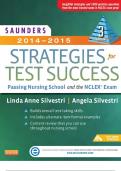
,Saunders 2014–2015 Strategies for
Test Success

Passing Nursing School and the
NCLEX® Exam

THIRD EDITION


Linda Anne Silvestri, PhD, RN
Instructor of Nursing, Salve Regina University, Newport, Rhode Island President
Nursing Reviews, Inc. and Professional Nursing Seminars, Inc. Charlestown,
Rhode Island Instructor NCLEX-RN® and NCLEX-PN® Review Courses


Angela Silvestri, RN, MSN
Graduate Assistant, School of Nursing, University of Nevada, Las Vegas, Las
Vegas, Nevada

, This title includes additional digital media when purchased in
print format. For this digital book edition, media content may
not be included.


Get to know the seller

Seller avatar
Reputation scores are based on the amount of documents a seller has sold for a fee and the reviews they have received for those documents. There are three levels: Bronze, Silver and Gold. The better the reputation, the more your can rely on the quality of the sellers work.
ExamsExpert (self)
View profile
Follow You need to be logged in order to follow users or courses
Sold
617
Member since
2 year
Number of followers
313
Documents
2838
Last sold
16 hours ago
ExamsExpert

We as a team provide best and Latest Test Banks that helps students to get A Grade we have vast range of test banks you can order us any test bank that you need

4.5

85 reviews

5
58
4
15
3
9
2
1
1
2

Why students choose Stuvia

Created by fellow students, verified by reviews

Quality you can trust: written by students who passed their exams and reviewed by others who've used these revision notes.

Didn't get what you expected? Choose another document

No problem! You can straightaway pick a different document that better suits what you're after.

Pay as you like, start learning straight away

No subscription, no commitments. Pay the way you're used to via credit card and download your PDF document instantly.

Student with book image

“Bought, downloaded, and smashed it. It really can be that simple.”

Alisha Student

Frequently asked questions
